Exchange Ranking
 Top Exchanges
 24h Volume Ranking
 Popularity Ranking
 Exchange BTC Balance
 Proof of Reserves
 Decentralized Exchanges
 Funding Rate
 Funding Heatmap
 Liquidation Data
 Max Pain
 Long/Short Ratio
 Whale L/S Ratio
 Binance/Okex/Huobi L/S
 Bitfinex Margin L/S
 ETF Tracker
 Solana ETF
 XRP ETF
 Hong Kong ETF
 Bitcoin Treasuries
 Crypto Reversal
 Ethereum Reserves
 HyperLiquid Wallet Analysis
 Hyperliquid Whale Watch
 Large Transactions
 On-chain Movement
 Bitcoin ROI
 Stablecoin Market Cap
 Options Analysis
 News
 Articles
 Economic Calendar
 Features
 Wallet
 Contract Calculator


 Security
 Collections
 Watchlist
 Following
汇丰银行与蚂蚁数科完成基于代币化存款的AI代理支付系统技术测试
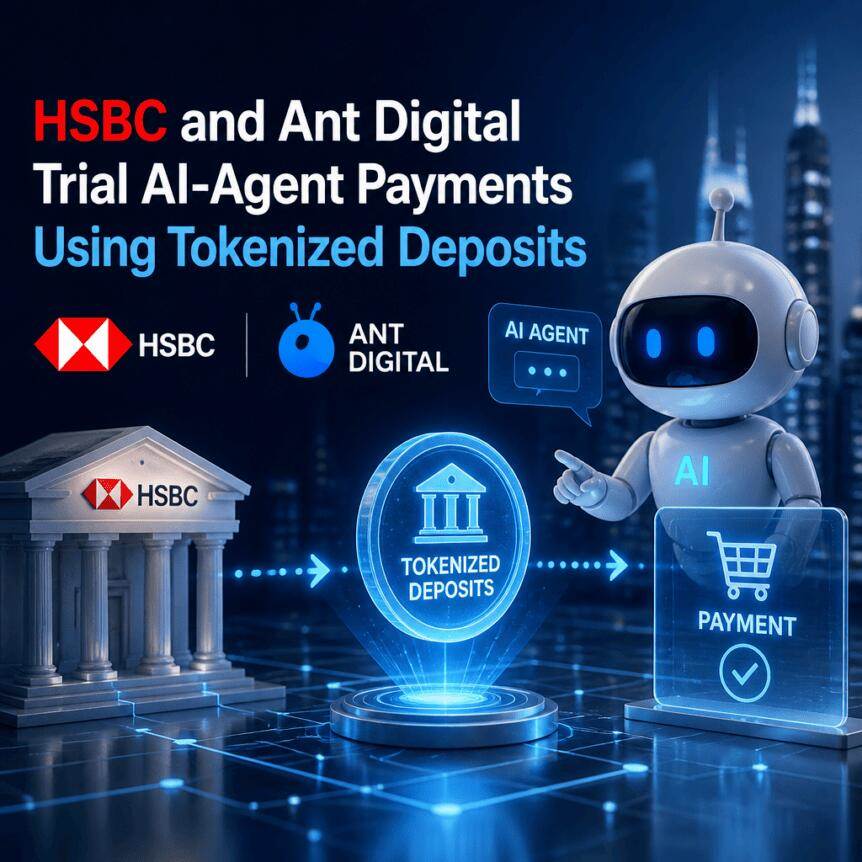
汇丰银行(HSBC)与蚂蚁数科(Ant Digital Technologies)宣布,他们已完成一项基于代币化银行存款、在区块链测试环境中实时结算的AI代理支付系统的技术测试。此次演示的重点在于展示AI代理如何定位数字服务、发起支付,并通过可编程流程完成交易——整个过程无需人工手动执行步骤。
两家公司将此次运行定义为“微支付”验证——通常指金额低于2美元的转账——并强调这并非商业推广。尽管如此,该测试反映了传统金融机构更广泛的推动力:探索AI代理是否能够在自动化、全天候的模式下安全地与支付通道和数字服务进行交互。
关键要点
- 汇丰银行与蚂蚁数科使用代币化银行存款和区块链测试网结算,对AI代理微支付进行了技术验证。
- 该系统整合了多层级的角色:汇丰银行负责结算能力和实时风险检查,而蚂蚁数科协调服务访问和支付流程。
- 交易在二层(Layer-2)测试网上实时结算,突显了在自动化流程中对即时结算的关注。
- 参与者表示,这不是面向客户的实际产品发布,因此关于其生产就绪程度的结论有限。
- Tests by other banks show broader industry models-from MasterCard and Visa's agent infrastructure to blockchain mainnet experiments-although views on feasibility vary.
How HSBC and Ant Digital Testing Work
In an announcement released on Friday, HSBC and Ant Digital described a system designed to allow AI agents to interact with digital services and make small payments through tokenized deposits. The test integrates three key components: HSBC's tokenized deposit service, Ant Digital's Anvita Flow network (designed to help AI agents discover and use services and perform payments), and Jovay Testnet (described as a two-tier blockchain testing environment).
According to both companies, the demonstration implemented end-to-end functionality: the AI agent selected a digital service and completed the payment. HSBC's contribution focuses on settlement capabilities and real-time risk inspections, while Ant Digital's network coordinates service access and payment processes.
The project uses blockchain settlement, which clearly reveals the relevance of this experiment to cryptographic infrastructure. The test does not just view tokenization as an internal bookkeeping exercise, but aims to move towards an on-chain settlement process suitable for automated, programmatic transaction execution.
At the same time, the company made it clear that the test was limited to technical verification and did not represent a commercial release or actual operation for customers, as pointed out in its statement.
Why micropayments are crucial to AI agency businesses
Micropayments are often seen as a natural fit for machine-driven commerce. When AI agents make frequent small purchases-such as paying for function access fees, single digital transactions, or low-cost services-the economics and users of the payment are different from traditional bank cards or bank transfers.
By describing the experiment as "micropayments"(less than $2), HSBC and Ant Digital implicitly targeted scenarios where transaction volumes were high and payment processes had to be efficient. For investors and developers, the core issue is not whether specific tests can handle small payments, but whether the architecture can support automatic authorization, settlement and compliance checks without introducing bottlenecks.
HSBC included a real-time risk check in the presentation, indicating that the test authors understood that the autonomy of AI agents did not eliminate the need for a guardrail mechanism. If banks want AI systems to initiate payments on behalf of users, they must embed controls that can respond immediately to suspicious patterns or policy violations.
Extensive trial trajectory for AI proxy payments in the banking world
HSBC's test joins a series of bank and payment provider trials that explore AI proxy initiated transactions. Earlier this year, Santander completed what it calls Europe's first end-to-end payment performed by an AI agent, using Mastercard's Agent Pay infrastructure, a test involving the bank's real-time payment system.
In May, Swiss digital asset bank Sygnum reported on testing of AI agent-driven transactions on the blockchain main network, while retaining customer approval and signature requirements. Shortly afterwards, CaixaBank, in partnership with Visa Intelligent Commerce, used the existing merchant payment system to complete bank card transactions initiated by AI agents.
These examples together highlight that the industry is not moving along a single unified path. Some experiments emphasize agent-to-payment infrastructure on traditional payment channels, while others explore tokenization and blockchain settlement. HSBC's and Ant Digital's approach is closer to the latter, at least in terms of settlement presentation.
Can existing systems adapt-or will dedicated infrastructure win out?
Despite the strong momentum of these experiments, doubts remain whether traditional banks can transform legacy infrastructure for autonomous, 24/7 payment processes.
In an interview with Cointelegraph, Augustus Bank CEO Ferdinand Dabitz believes that traditional clearing banks are built to automate human processes rather than around the clock. He also described Augustus as developing a U.S. bank designed around stablecoins and AI-driven processes, aiming to replace some of the functions of traditional systems with infrastructure built specifically for machine-initiated activities.
HSBC's test did not resolve the controversy. This test is positioned as a technical verification, and it is still unclear how far it is from actual production. However, the very act of running settlements and risk checks in real time in a blockchain testing environment suggests that banks are at least exploring an architecture that is quite different from standard payment pipelines.
The adoption of blockchain may depend on "always-on" programmability
In addition to individual pilot projects, research institutions have been making more conceptual arguments for the importance of blockchain in the AI proxy business. Citrini Research pointed out in a report titled "Breaking The Wall" released October 8 that autonomous AI agents--which continue to operate in a programmatic manner--may increase the need for programmable financial infrastructure.
The report points out that traditional systems are mainly designed for users, and as AI processes transactions across applications, funds and financial assets also need to be moved in a programmatic manner. The agency's core reasoning is that blockchain networks can provide an "always-on" infrastructure suitable for asset flows in an automated environment.
Citrini wrote in the report: "It is logical that AI agents move programmatically and around the clock across applications, so funds and financial assets will eventually do the same."
The HSBC and Ant Digital test can be seen as an attempt to practice this argument in a restricted environment: tokenize deposits, route service access through AI proxy flows, quickly settle payments, and apply risk checks in real time.
For readers concerned in this area, the next signs to follow include whether these demonstrations will evolve into production-level systems with clear user authorization models, whether tokenized deposits will go beyond the scope of test objects, and how much banks can coordinate real-time risk control and AI agent autonomy in real-life operating environments.