Exchange Ranking
 Top Exchanges
 24h Volume Ranking
 Popularity Ranking
 Exchange BTC Balance
 Proof of Reserves
 Decentralized Exchanges
 Funding Rate
 Funding Heatmap
 Liquidation Data
 Max Pain
 Long/Short Ratio
 Whale L/S Ratio
 Binance/Okex/Huobi L/S
 Bitfinex Margin L/S
 ETF Tracker
 Solana ETF
 XRP ETF
 Hong Kong ETF
 Bitcoin Treasuries
 Crypto Reversal
 Ethereum Reserves
 HyperLiquid Wallet Analysis
 Hyperliquid Whale Watch
 Large Transactions
 On-chain Movement
 Bitcoin ROI
 Stablecoin Market Cap
 Options Analysis
 News
 Articles
 Economic Calendar
 Features
 Wallet
 Contract Calculator


 Security
 Collections
 Watchlist
 Following
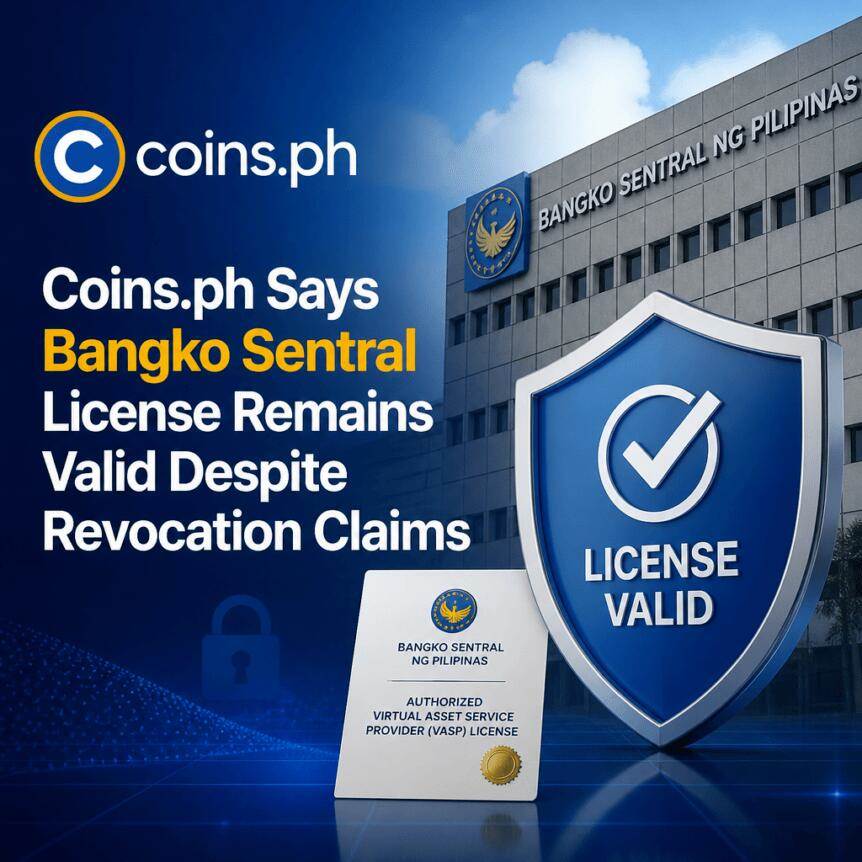
Coins.ph 否认牌照被吊销,强调合规运营以应对监管审查
尽管有报道称菲律宾中央银行(BSP)可能着手取消与涉嫌受限离岸赌博运营商活动相关的授权,但加密货币交易所 Coins.ph 表示其 BSP 牌照尚未被吊销。该交易所声称其仍为 BSP 许可机构,并表示其平台旨在根据央行要求筛查客户和交易。
争议的核心在于 Coins.ph 的支付体系,特别是与运营 Coins.ph 电子钱包服务的 DCPay Philippines 相关的现金入账服务。据 CoinGecko 数据显示,Coins.ph 周三的 24 小时现货交易量约为 5200 万美元,这凸显了其在菲律宾加密市场的规模,尽管目前面临的监管审查日益严密。
关键要点
- 持牌状态: Coins.ph 表示其仍持有 BSP 许可,并坚决否认明知故犯地为离岸赌博或博彩运营商提供服务。
- 业务限制范围: 据报道,BSP 的限制主要针对与 Coins.ph 相关联的支付服务——即现金入账和 QRPh 收款,而交易和提现功能继续正常运行。
- 合规声明: Coins.ph 表示不接受也不允许离岸赌博运营商,并对客户和交易进行持续的合规审查。
- 监管关联不明:BSP has not disclosed how early anti-gambling payment regulations are linked to current restrictions. Therefore, the accusations of license revocation remain unclear.
Coins.ph has responded strongly: they deny any violations of regulations.
Coins.ph has taken immediate action. In a statement shared with the media, a Coins.ph spokesperson stated that the company “denies outright” any claims that it provides services to offshore gambling operators. The exchange also assured users that their funds are safe, and it continues to operate under its BSP license.
Coins.ph’s response came in response to reports suggesting that the company might face license revocation due to suspected involvement in transactions with restricted offshore gambling operators. When asked whether such transactions occur on its platform, the spokesperson stated that Coins.ph does not accept or allow such operators, and continues to screen customers and transactions according to BSP requirements. However, Coins.ph did not confirm or deny the existence of such transactions.
For users and traders, this distinction is important. Denying certain transactions does not automatically resolve the issue of whether those transactions can be processed through the platform’s services—regulators typically focus on the results of internal controls and compliance checks.
The focus of regulation lies with payment channels, not encrypted transactions themselves.
It is reported that BSP’s efforts focus on payment processes, rather than cryptocurrency transactions. Coins.ph previously informed users that BSP has instructed the company to strengthen internal controls. In its announcement, Coins.ph stated that cash deposit services and QRPh payments are currently unavailable. However, cryptocurrency trading, withdrawals, bill payments, and merchant QRPh payments remain accessible. QRPh is the national QR standard established by the Philippine Central Bank.
It seems that the restrictions related to cash deposits and collection services are more related to payment processes, rather than cryptocurrency functions within the exchange. BitPinas reports that these restrictions were implemented in accordance with BSP Monetary Commission Resolution No. 839. The report also highlights the separation between payment and cryptocurrency regulations within Coins.ph’s operations: DCPay Philippines holds a license for issuing electronic currencies, while Betur Inc. reportedly holds a license as a virtual asset service provider for cryptocurrency-related services.
According to this framework, the restrictions imposed seem to target DCPay’s payment services, not Betur’s cryptocurrency services. Coins.ph’s own experiences (as indicated in their announcements) appear to confirm this division—cryptocurrency-related features continue to be available, while certain cash conversion channels are restricted.
Historical context and future uncertainties
As early as 2025, the BSP ordered regulated financial institutions to remove links to gambling websites through payment applications. A public BSP directive cited in the report indicates that the central bank has taken measures to regulate payment interfaces used for accessing offshore gambling activities. At the same time, the BSP has not publicly linked this directive from 2025 with the restrictions imposed on Coins.ph. When seeking further comments from the BSP, a central bank representative stated that an investigation would be conducted, but no additional information was provided at the time of publication.
This lack of clear connections creates significant uncertainty for market participants: Is the regulatory action aimed at specific compliance issues related to Coins.ph’s payment services, or are they adopting a broader framework to address potential offshore gambling payment flows that may involve multiple operators?
This situation raises questions for both markets and users. For Coins.ph users, the main concern is operational issues: Will cash deposits and QRPh payments continue to be restricted, and will further changes affect other payment channels? For the broader market, this incident reminds us that Philippine compliance regulations apply not only to cryptocurrency services but also to payment channels used in fiat transactions.
Readers should pay attention to the BSP’s clarification of the scope of restrictions, as well as any additional enforcement measures related to specific past transactions. It is also important to see whether Coins.ph will make clearer statements regarding whether prohibited offshore gambling funds have ever entered its system.