Exchange Ranking
 Top Exchanges
 24h Volume Ranking
 Popularity Ranking
 Exchange BTC Balance
 Proof of Reserves
 Decentralized Exchanges
 Funding Rate
 Funding Heatmap
 Liquidation Data
 Max Pain
 Long/Short Ratio
 Whale L/S Ratio
 Binance/Okex/Huobi L/S
 Bitfinex Margin L/S
 ETF Tracker
 Solana ETF
 XRP ETF
 Hong Kong ETF
 Bitcoin Treasuries
 Crypto Reversal
 Ethereum Reserves
 HyperLiquid Wallet Analysis
 Hyperliquid Whale Watch
 Large Transactions
 On-chain Movement
 Bitcoin ROI
 Stablecoin Market Cap
 Options Analysis
 News
News Articles
 Economic Calendar
 Features
 Wallet
 Contract Calculator


 Security
 Collections
 Watchlist
 Following
 ETH
ETH  KAS
KAS Kaspa has completed the largest protocol upgrade in history, which has a profound impact on the cryptocurrency market.
Kaspa has completed the largest protocol upgrade in its history, a move that is crucial to the impact of the cryptocurrency market. The Toccata hard fork went online on June 30, 2026, transforming Kaspa from a high-speed payment network to a fully programmable first-layer blockchain.
This upgrade introduces native smart contracts, KRC-20 tokens, and crucial EVM compatibility. The market today faces an immediate question: Can Kaspa use its technological advantages to challenge Ethereum's long-standing dominance?
Kaspa's EVM breakthrough: Why 200 times lower fees are crucial to KAS
Toccata upgrade changes Kaspa's value proposition. Prior to this upgrade, Kaspa operated primarily as a payment-focused network, relying on its GHOSTDAG protocol to achieve near-instant final confirmation at a rate of 10 blocks per second. The addition of native first-layer contracts and EVM compatibility completely changed the situation.
Transaction fees are the most telling. Average Gas fees for Ethereum continue to remain high, with each transaction often exceeding $5 to $10 during periods of network congestion.
Independent testing showed that Kaspa's EVM layer passed comprehensive stress testing at a cost of 200 times less. Independent testing conducted 66 operations on Kasplex and Igra, covering token transfers, decentralized exchange (DEX) conversions, lending, and NFT minting. Both achieved a 100% success rate, and their execution results were exactly the same as those of the Ethereum Sepolia test network.
Kaspa's BlockDAG architecture processes transactions with fees approximately 200 times lower than current Ethereum rates. This cost difference is not trivial and has a significant impact on developers building DeFi applications, NFT marketplaces and other on-chain services.
Ethereum's scalability challenges are driving developers to turn to second-tier solutions such as Arbitrum and Optimism. While these networks reduce costs, they also introduce fragmentation and additional complexity. Kaspa provides native programmability without users having to go through bridging mechanisms or trust additional security assumptions.
How Kasplex and Igra passed Ethereum equivalent stress testing
The technical verification of Kaspa's EVM implementation comes from real-world testing. The network's smart contract platform, Kasplex, and its token standard implementation, Igra, recently passed a stress test comparable to a level of activity on the Ethereum main network. These tests simulated thousands of concurrent transactions, complex smart contract executions, and token transfers between networks.
Kaspa's BlockDAG structure handled the load during testing without congestion and kept the confirmation time within 1 second. The results show that Kaspa's throughput capabilities are not limited to simple payments, but can also be extended to complex programmable interactions. The Ethereum network has historically faced congestion problems during periods of high demand, causing soaring fees and delays in confirmation. Kaspa's ability to maintain performance under equal stress conditions suggests that its architecture may provide a more solid foundation for mainstream DeFi applications.
What an available EVM means for the growth of the Kaspa ecosystem
The availability of EVMs on Kaspa opens the door to rapidly expanding the ecosystem. Developers building applications on Ethereum can deploy their existing code and frameworks with minimal modifications. The introduction of KRC-20 tokens allows the natively creation of tokens, DeFi protocols, and NFT projects on Kaspa. This function creates network effects through liquidity pools, revenue farming opportunities, and secondary markets.
The Toccata upgrade also includes a zero-knowledge proof verification opcode, allowing privacy features and extended solutions to be implemented directly at the base layer. This ability reduces the need for external privacy agreements or a separate ZK-Rollup.
KAS Price Analysis: Can the chart confirm the bullish narrative of fundamentals?
Kaspa's price has dropped by approximately 2.39% in the past 24 hours. The 4-hour chart shows that since the US$0.0318 -0.0320 region was rejected, lower highs and lower lows have formed, showing a short-term downward trend. Direct support is in the US$0.0285 -0.0287 region, and the main support is in the US$0.0278 -0.0280 region. This range has previously triggered strong rebounds and buyers are expected to defend this level again. A break below $0.0280 will shift the focus to $0.0270, while continuing to stand above $0.0300 means a potential bullish reversal.
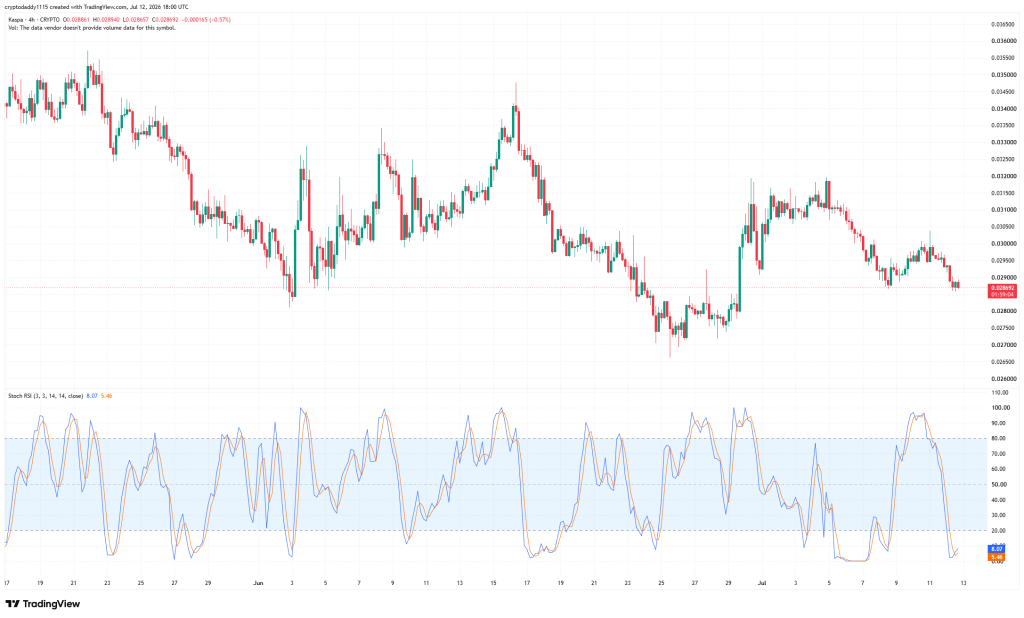
The Stocking RSI indicator currently shows a %K value of approximately 8 and a %D value of approximately 5, indicating that the indicator has entered a deeply oversold area. Although oversold conditions do not guarantee an immediate rebound, they indicate that selling momentum has been overstretched. Resistance levels of $0.0296-$0.0300 are the primary obstacle to any attempt at a rebound. The main resistance area of $0.0308 -0.0312 has rejected prices multiple times in recent weeks.
Kaspa Price Forecast: Can EVM momentum push KAS to higher levels?
Kaspa's fundamental logic lies in its network's ability to attract developers and users after the Toccata upgrade. Successful ecosystem growth will drive demand for KAS tokens for transaction fees, pledges, and collateral in the DeFi protocol. Short-term price movements depend on whether current support levels can be held. A bullish scenario requires Kaspa to maintain the US$0.0285 -0.0280 range, then withdraw US$0.0300 and break past US$0.0312. The upside targets in this scenario are at $0.0298,$0.0308 and $0.0318. The bearish scenario is that the support level of US$0.0280 falls, and the downside targets are looking at US$0.0270 and US$0.0265. A decisive break below $0.0270 would confirm a continuation of the short-term downtrend and could widen the decline into the $0.0250 region.
FAQs
Will Kaspa reach $1? A $1 KAS price is possible, but this requires higher adoption rates, broader exchange support and favorable market conditions. There is no guarantee that Kaspa will achieve this goal.
Does Kaspa have a future? Kaspa continues to grow through network upgrades, ecosystem expansions, and the development of EVM compatibility layers. Its BlockDAG architecture and focus on fast, scalable payments make it one of the high-profile proof-of-work projects.
Is Kaspa good investment? This depends on your investment goals and risk tolerance. Kaspa has attracted attention for its technology and developing ecosystem, but like all cryptocurrencies, KAS remains a volatile asset with both upside potential and downside risks.