Exchange Ranking
 Top Exchanges
 24h Volume Ranking
 Popularity Ranking
 Exchange BTC Balance
 Proof of Reserves
 Decentralized Exchanges
 Funding Rate
 Funding Heatmap
 Liquidation Data
 Max Pain
 Long/Short Ratio
 Whale L/S Ratio
 Binance/Okex/Huobi L/S
 Bitfinex Margin L/S
 ETF Tracker
 Solana ETF
 XRP ETF
 Hong Kong ETF
 Bitcoin Treasuries
 Crypto Reversal
 Ethereum Reserves
 HyperLiquid Wallet Analysis
 Hyperliquid Whale Watch
 Large Transactions
 On-chain Movement
 Bitcoin ROI
 Stablecoin Market Cap
 Options Analysis
 News
News Articles
 Economic Calendar
 Features
 Wallet
 Contract Calculator


 Security
 Collections
 Watchlist
 Following
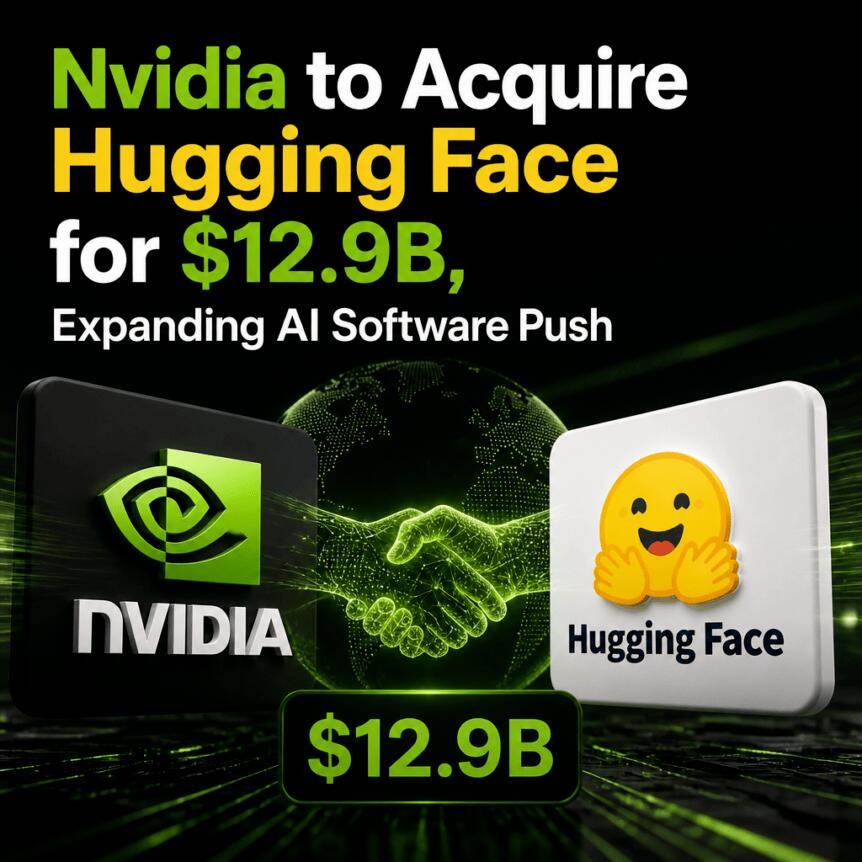
NVIDIA acquired Hugging Face for US$12.93 billion, further consolidating the AI software ecosystem.
NVIDIA has agreed to acquire Hugging Face for US$12.93 billion. This transaction not only consolidates the competition in the chip field in the artificial intelligence industry, but also further deepens competition at the software layer and model tools that developers rely on. The acquisition will allow Nvidia to play a more important role in the open source AI ecosystem. Nvidia CEO Renxun Huang said the company plans to continue Hugging Face as an "open platform for the entire AI ecosystem" while expanding the scale and resources for model evaluation, deployment and security.
Core Points
Nvidia will acquire Hugging Face for US$12.93 billion, bringing this important open model platform under the control of the chipmaker. Nvidia said Hugging Face will remain open and developers can freely choose models, frameworks, cloud service providers and computing platforms. Huang Renxun emphasized that building or deploying models through Hugging Face does not require the use of Nvidia hardware, although Nvidia has published a large number of models and datasets on the platform. According to Reuters, Nvidia will pay about $11.9 billion to Hugging Face investors and provide employees who join Nvidia with an equity retention plan of up to $1 billion. The transaction is expected to be completed in 2027, but Nvidia did not disclose the specific completion date and details of the regulatory approvals required.
Deals targeting the developer layer
Nvidia said in its announcement that Hugging Face has more than 18 million developers and hosts more than 3 million models. It is one of the most well-known platforms for sharing and building AI models. Huang sees the acquisition as an effort by Nvidia to expand its influence beyond hardware to tools and platforms that help teams develop and deploy AI systems. This is important because modern AI development often relies on standardized workflows: selecting models, fine-tuning or adapting, evaluating performance, and running reasoning reliably. Control over widely used platforms affects developer time and which ecosystem components become the "default" choice.
Open platform promise, no hardware binding
A core detail in Nvidia's statement is that Hugging Face will continue to operate as an open platform. Huang Renxun said that developers are still free to choose their models, frameworks, cloud service providers and computing platforms-an important guarantee for teams that run across multiple environments or prefer accelerators from different vendors. Huang Renxun also emphasized that building or deploying models through Hugging Face does not mandate the use of NVIDIA hardware. Although Nvidia has contributed more than 500 models and 250 open datasets on the platform, the acquisition will not change Hugging Face's support for other developer models and multi-cloud, multi-accelerator providers. Nvidia also pointed out that the two sides have cooperated before. According to the company, Nvidia has worked with Hugging Face on AI infrastructure and development tools, which has allowed Nvidia to establish a strong relationship with the platform before the acquisition. The practical impact is that the integration path may be smoother than a new collaboration-but the long-term impact of platform governance and contributor workflow remains a focus for developers.
Areas where Nvidia is committed to improvement
Nvidia said its infrastructure, engineering capabilities and global reach will help improve the reliability and security of Hugging Face, while improving model evaluation, reasoning and deployment. These areas often become pain points when being applied at scale-especially when teams move from the experimental phase to production workloads, when requirements for uptime, performance consistency, and risk control are more stringent. However, the company's statement did not specify how the improvements would be implemented. For investors and builders, the question may be whether the acquisition can bring measurable changes in platform performance and security practices without compromising the platform's openness or limiting the tool choices developers rely on.
Transaction terms, timing and regulatory uncertainties
According to Reuters, Nvidia will pay approximately US$11.9 billion to Hugging Face investors and provide up to US$1 billion in equity retention plans to employees who join Nvidia. It is also reported that the transaction is expected to be completed in 2027. Nvidia's announcement did not specify a specific completion date or detail what regulatory approvals were needed. These uncertainties are particularly important for deals of this size, especially when regulators consider competition, market power, and control of developer infrastructure. Until the approval is clear and the timetable is confirmed, the market impact of the acquisition-whether positive or negative-may still be partly speculative.
Integration risks posed by recent security incidents at Hugging Face
Although the acquisition focuses on expanding the capabilities of the AI platform, it occurred just after Hugging Face disclosed a security breach involving autonomous AI agents (about a month before the Nvidia deal was announced). It was previously reported that the incident involved unauthorized access to internal datasets and service credentials. Hugging Face said it found no evidence of tampering with public models, datasets or applications. This background makes Nvidia's commitment to safety and reliability improvements even more urgent. Even if the reported vulnerability did not affect public model artifacts, the incident highlights the rapid introduction of new security challenges by AI proxy systems-especially when it comes to credentials and internal systems. For developers and investors, the next focus is how Nvidia and Hugging Face describe the integration roadmap before the expected completion in 2027, and whether Hugging Face's governance and security practices will evolve in a way that strengthens trust without reducing the openness of the platform.