Exchange Ranking
 Top Exchanges
 24h Volume Ranking
 Popularity Ranking
 Exchange BTC Balance
 Proof of Reserves
 Decentralized Exchanges
 Funding Rate
 Funding Heatmap
 Liquidation Data
 Max Pain
 Long/Short Ratio
 Whale L/S Ratio
 Binance/Okex/Huobi L/S
 Bitfinex Margin L/S
 ETF Tracker
 Solana ETF
 XRP ETF
 Hong Kong ETF
 Bitcoin Treasuries
 Crypto Reversal
 Ethereum Reserves
 HyperLiquid Wallet Analysis
 Hyperliquid Whale Watch
 Large Transactions
 On-chain Movement
 Bitcoin ROI
 Stablecoin Market Cap
 Options Analysis
 News
News Articles
 Economic Calendar
 Features
 Wallet
 Contract Calculator


 Security
 Collections
 Watchlist
 Following
 ETH
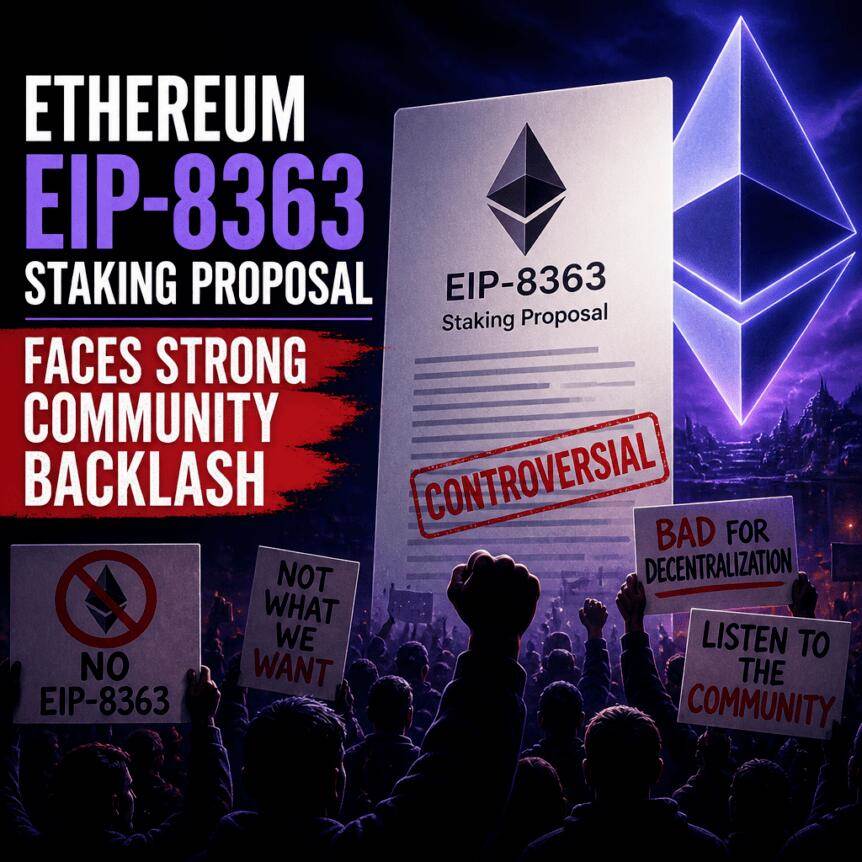
ETH Ethereum researchers originally wanted to reduce pledge incentives, but instead sparked one of the biggest controversies about network economics since the merger.
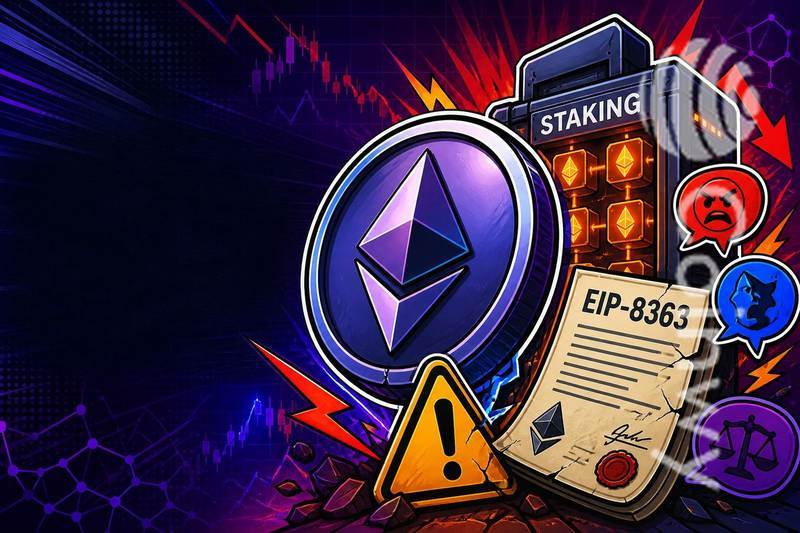
Ethereum improvement proposal EIP-8363, known as "progressive issuance destruction", will gradually reduce pledge rewards as more and more ether is locked up to ensure network security-ultimately reducing the issuance of new agreements to zero when 50% of the ETH supply is pledged.
The authors of the proposal, including Justin Drake of the Ethereum Foundation and Jerome de Tychey, co-founder of the Ethereum Community Conference (ETHCC), believe that Ethereum has reached a stage where additional pledges can only bring marginal diminishing safety benefits while diluting holders who choose not to pledge.
In other words: Ethereum should stop paying for security that is no longer needed.
But there is one problem: Many people hate the idea.
From DeFi builders to pledge providers and institutional investors, critics believe it could weaken decentralization, disrupt Ethereum's lending market, and undermine confidence in cybermonetary policy. As Mike Silagadze, founder of Ether.fi, said:
"This is disappointing on every level... It's bad for decentralization, it's bad for Ethereum adoption, and it's bad for the credibility of the network."
Dr. Steve Berryman, head of Ethereum customer partnerships at Bitwise, told the magazine:
"Institutional adoption requires certainty, and making marginal adjustments in circulation creates uncertainty, and institutions hate uncertainty the most."
So, does Ethereum really pay too much for security, or is EIP-8368 looking for a solution to a non-existent problem?
Is Ethereum over-pledged?
According to data from the Ethereum Verifier Queue, approximately 41.5 million ETH are currently pledged in Ethereum, with an annualized rate of return of 2.67%, accounting for 34.07% of the total supply.
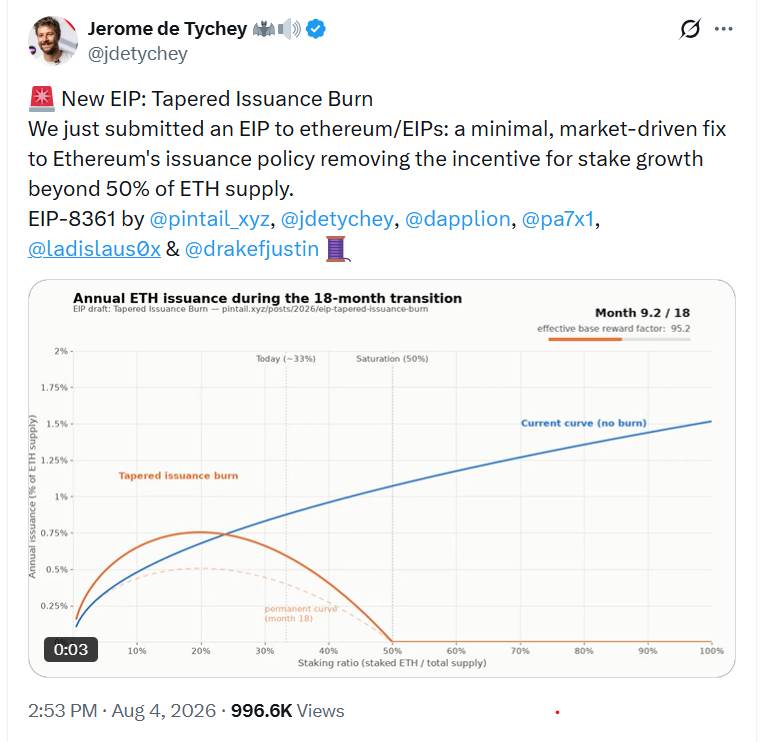
While more ETH locked out usually makes the network more difficult to attack, the authors of EIP-8368 believe that these security benefits are becoming increasingly marginalized while Ethereum is still rewarding verifiers.
EIP-8363 will gradually eliminate this incentive, and the authors believe that once the network is secure enough, Ethereum should stop subsidizing additional pledges.
However, not everyone agrees that this problem does exist. Pledges have indeed increased significantly in 2026, rising by 15% since the beginning of the year.
Berryman believes that market forces are already slowing participation and there is no need to change Ethereum's distribution policy.
"We are likely to reach a natural upper limit before the end of the year," he said, noting that a yield drop to around 2% is unlikely to attract more ETH locked in pledge. "People need a certain degree of mobility," he said.
Berryman said recent growth was mainly driven by institutional players such as Bitmine and BlackRock, but he believes participation may level off again once these players complete pledge allocation.
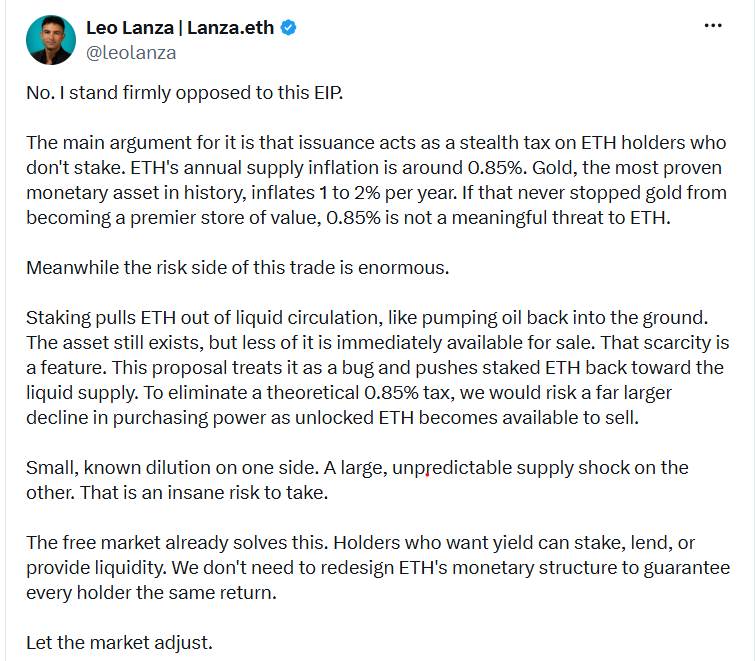
Ethereum commentator Leo Lanza also opposed the proposal, questioning the core assumption that the issuance of Ethereum constitutes a meaningful "hidden tax" on non-pledgers.
He said that Ethereum's annual inflation rate is still below 1%, pointing out that even the supply of gold-widely regarded as the world's premier monetary asset-is growing by about 1% to 2% annually:
"Free markets have solved this problem... let the market adjust itself."
Is treatment worse than the disease?
Proponents of EIP-8368 believe that this change will curb unnecessary issuance and prevent excessive concentration of pledges in the hands of large custodians and liquidity pledge providers. But critics say the proposal may pose more serious problems than the ones it attempts to solve.
Greg Koumoutsos, head of technical research at the Lido Labs Foundation, said that about one-third of ETH supply is currently pledged, which does not seem healthy, but he agreed that there is a need to proactively think about excessive pledge.
More importantly, he believes the proposal oversimplifies what is actually paid for for Ethereum's issuance:
"Ethereum is not just paying for forfeitable ETH; it is paying for decentralization, operator diversity, censorship resistance and network resilience."
Koumoutsos said that if these broader trade-offs are not taken into account, lower circulation does not automatically mean better security policies.
Another factor to consider is that liquidity pledges are now deeply integrated into Ethereum's DeFi ecosystem, and pledged derivatives are widely used as collateral and in lending and income strategies.
"This will obviously kill most of the DeFi built around the pledge ecosystem," Silagadze believes.
Stani Kulechov, founder of Aave, Ethereum's largest decentralized lending agreement, said that reducing pledge rewards could endanger the entire ecosystem.
"My concern is... those who are satisfied with ETH's Beta earnings and yields may sell ETH and buy other profitable assets... Ethereum should not be punished for its growth."
Small validators will bear the costs
Another concern with the proposal is that reducing pledge rewards could actually increase concentration among the largest players.
This is because independent verifiers cannot benefit from economies of scale as large pledge businesses, exchanges or institutional operators. Lower agreement rewards may make independent pledges uneconomical while large organizations continue to operate. Koumoutsos said:
"An independent validator has real costs: some idealistic independent pledgers may stay, but many of the marginal independent validators will leave, and few, if any, new entrants will be introduced."
He added that the reasons for centralized platforms 'pledge are not limited to yields, but also include customer retention, regulatory positioning and product integration, making them unlikely to reduce participation.
Koumoutsos also warned that even in entrusted pledges, lower rewards could benefit centralized custody products rather than on-chain pledge agreements, which face higher maintenance, governance and upgrade costs.
A debate beyond pledges
Proponents say lower issuance will strengthen the long-term monetary attributes of ether. But critics believe that constant adjustments to Ethereum's monetary policy undermine its claims of predictability and reliability.
Berryman believes that institutions value predictability more than marginal higher returns, and changing the yield curve will bring revenue governance risks. "Institutional investors will price based on that," he said.
He also said that institutions value pledges not because the yields are particularly high, but because they can provide predictable returns while holding ETH:
"If it is not broken, why fix it?"
Silagadze agreed, saying: "Any country or large institution concerned about this matter has every reason to lose confidence in the governance and stability of Ethereum."
The proposal was also criticized because it was released two days before the August 6 proposal deadline, which is the node to decide whether to include the proposal in the next Ethereum network upgrade.
Silagadze said a change that "has profound implications for DeFi as a whole" should not be released in such a short period of time.
The fierce opposition shows how difficult it has become to change the economics of Ethereum, especially when every adjustment produces winners and losers in pledge, DeFi and institutional markets.