Exchange Ranking
 Top Exchanges
 24h Volume Ranking
 Popularity Ranking
 Exchange BTC Balance
 Proof of Reserves
 Decentralized Exchanges
 Funding Rate
 Funding Heatmap
 Liquidation Data
 Max Pain
 Long/Short Ratio
 Whale L/S Ratio
 Binance/Okex/Huobi L/S
 Bitfinex Margin L/S
 ETF Tracker
 Solana ETF
 XRP ETF
 Hong Kong ETF
 Bitcoin Treasuries
 Crypto Reversal
 Ethereum Reserves
 HyperLiquid Wallet Analysis
 Hyperliquid Whale Watch
 Large Transactions
 On-chain Movement
 Bitcoin ROI
 Stablecoin Market Cap
 Options Analysis
 News
News Articles
 Economic Calendar
 Features
 Wallet
 Contract Calculator


 Security
 Collections
 Watchlist
 Following
 BTC
BTC  ETH
ETH Thailand's SEC promotes consultation on regulatory framework for spot bitcoin and Ethereum ETFs
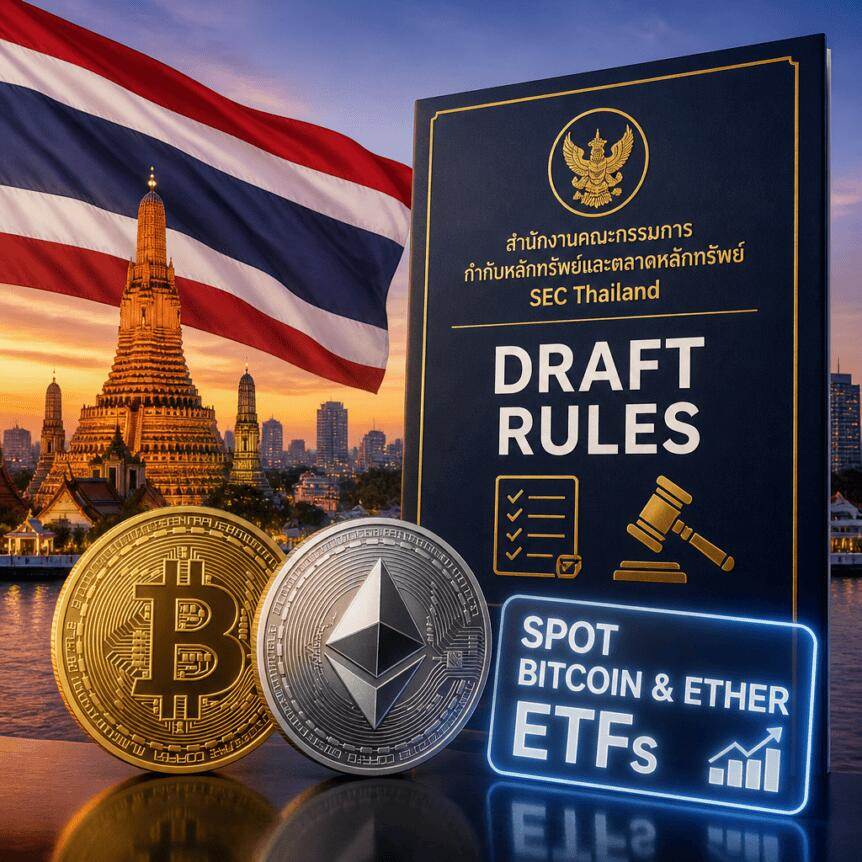
The Securities and Exchange Commission of Thailand (SEC) is advancing the process of allowing the country to list spot bitcoin and Ethereum exchange-traded funds (ETFs), and has shifted from a proposal in principle to drafting specific rules and revised the way digital assets are held.
In an announcement issued on Monday, the regulator said it was publicly soliciting opinions on two independent consultation documents: one document lists draft rules for Thailand's listed spot cryptocurrency ETFs, and the other proposes qualification principles for overseas digital asset custodians used by mutual funds that invest in digital assets and private equity funds. The deadline for both rounds of consultation is September 20.
Core Points
Thailand-listed spot Bitcoin and Ethereum ETFs will be listed and traded on the Stock Exchange of Thailand (SET), with each ETF tracking only a single asset. The draft rules require that an ETF's average net exposure to the cryptocurrencies it tracks must reach at least 80% of its net asset value during each fiscal year.
Thailand's SEC is revising its custody framework after listening to feedback on the concept of custody during an April consultation. In the initial stage, the ETF structure is expected to rely mainly on domestic digital asset custodians, allowing the use of qualified overseas custodians only when necessary.
Mutual funds and private equity funds can invest in cryptocurrency ETFs registered in Thailand, and regulators currently have no plans to launch alternative product structures linked to overseas cryptocurrency ETFs during the initial launch.
Draft rules for spot ETFs listed on SETs
According to the SEC's draft rules, passive ETFs that track Bitcoin (BTC) or Ethereum (ETH), which are currently the only two eligible cryptocurrency assets under the framework. The SEC said these ETF products will only be traded exclusively on the Stock Exchange of Thailand (SET).
Each proposed ETF will focus on a single cryptocurrency, and the draft rules include an exposure requirement designed to maintain a high degree of consistency between the fund's performance and the underlying assets. Specifically, an ETF needs to have an average net exposure to the cryptocurrencies it tracks to reach at least 80% of its net asset value during each fiscal year.
The SEC's regulatory thinking also clarifies how these cryptocurrency ETFs registered in Thailand can integrate into the broader fund industry. The draft rules allow mutual funds and private equity funds to invest in Thailand-registered cryptocurrency ETFs. In addition, they also allow investment in approved overseas cryptocurrency ETFs within existing investment limits.
SEC: Adjustments based on early feedback
This draft is based on an earlier round of SEC consultations in April that set broader principles for the overall ETF framework. In Monday's update, regulators said a majority of respondents supported the proposed framework, but feedback, particularly on custody arrangements, prompted the SEC to adjust its approach to custodians.
This shift is significant for investors and operators because custody is at the core of ETF risk control. The framework's requirements for custody standards will affect which fund promoters can participate, what infrastructure must be used, and how regulators believe investor assets should be protected. The SEC's revised direction is intended to reflect these feedback while continuing to advance a feasible structure for exposure to Thailand-listed spot cryptocurrencies.
Revised custody standards: domestic priority, overseas only for necessary circumstances
In addition to the ETF rulebook, the Thailand SEC is also revising its custody proposal. Regulators said that the revised plan will retain domestic digital asset custodians as the main service providers in the initial stage of cryptocurrency ETFs.
The SEC said in a statement: "Under the revised plan, cryptocurrency ETFs will continue to be required to use mainly domestic digital asset (DA) custodians, and the SEC may allow the use of qualified overseas digital asset custodians when necessary and deemed appropriate based on current circumstances."
For another advisory document on overseas digital asset custodians used by mutual funds and private equity funds, the SEC's conditions are more clear. Offshore custodians must be supervised by a regulatory body with legal powers and must meet regulatory and investor asset protection standards deemed adequate by the Thailand SEC.
In short, Thailand is building a two-tier structure: ETFs should mainly use domestic custody capabilities in the early stages of launch, while overseas custody can be used for other digital asset fund activities under certain circumstances. This difference may affect the timeline for product approval, as custody capabilities and regulatory oversight are often key constraints on the launch of spot cryptocurrency ETFs.
Initial Permits and Restrictions
The SEC's draft rules outline the ETF investment paths it plans to prioritize. Mutual funds and private equity funds in Thailand can invest in Thailand-registered cryptocurrency ETFs, or they can invest in approved overseas cryptocurrency ETFs within existing investment restrictions.
However, the regulator's initial roll-out plan drew boundaries on certain indirect structures. In the first phase, the SEC will not allow the launch of alternative products linked to offshore cryptocurrency ETFs, including depositary receipts that track such offshore funds. For market participants, this suggests that Thailand aims to launch with a direct exposure model rather than allowing more complex product structures that could add additional counterparty and structural risk.
Why Thailand's ETF framework attracts much attention
Thailand's SEC is not operating in isolation. The regulator's ETF work is part of Thailand's broader efforts to position itself as a center for institutional digital assets. The SEC's framework aims to provide investment channels for spot Bitcoin and Ethereum through regulated exchange-traded vehicles. If implemented properly, this approach may expand institutions 'participation outside traditional cryptocurrency trading venues.
Investors following this process should pay close attention to the custody advisory document and how the SEC defines "necessary and appropriate" use of offshore custody institutions. These wording may determine whether Thai sponsors face obstacles in introducing international custody arrangements in the first batch of approved products, or whether domestic custody capabilities are sufficient to meet the needs of the first batch of listings.
As the two consultation documents are open for public comment until September 20, the next step for market participants is to review how feedback will further improve custody rules, product qualifications, and the actual operating mechanism of ETFs exposure to listed on SET-especially around the "domestic first" stance that appears to be at the core of the SEC's revised plan.