Exchange Ranking
 Top Exchanges
 24h Volume Ranking
 Popularity Ranking
 Exchange BTC Balance
 Proof of Reserves
 Decentralized Exchanges
 Funding Rate
 Funding Heatmap
 Liquidation Data
 Max Pain
 Long/Short Ratio
 Whale L/S Ratio
 Binance/Okex/Huobi L/S
 Bitfinex Margin L/S
 ETF Tracker
 Solana ETF
 XRP ETF
 Hong Kong ETF
 Bitcoin Treasuries
 Crypto Reversal
 Ethereum Reserves
 HyperLiquid Wallet Analysis
 Hyperliquid Whale Watch
 Large Transactions
 On-chain Movement
 Bitcoin ROI
 Stablecoin Market Cap
 Options Analysis
 News
News Articles
 Economic Calendar
 Features
 Wallet
 Contract Calculator


 Security
 Collections
 Watchlist
 Following
 BTC
BTC  ETH
ETH  SOL
SOL  ZEC
ZEC Market reactions to the release of U.S. inflation data are mixed
The U.S. inflation data released today has complicated market sentiment. Although the core monthly inflation reading was higher than economists had expected, the overall data was mostly in line with market expectations. Bitcoin fell slightly early in the news, then rebounded quickly, and its price once again approached the $79,000 mark as the broader market digested its impact on the Federal Reserve's interest rate decision next week.
According to data released by the Bureau of Labor Statistics on Friday, the consumer price index (CPI) rose 3.4% year-on-year and 0.4% month-on-month, both in line with consensus expectations. The annual growth rate was the same as in July. The core CPI excluding food and energy showed mixed signals: the annualized core inflation rate fell to 2.4% from 2.5% in July, the lowest level since 2021; however, the monthly core reading reached 0.3%, higher than analysts 'expectations of 0.2%, which is the focus of the market's attention.
The Fed's interest rate decision approaches, and the probability of a rate hike still exists
The report was released five days before the Fed's September 15 - 16 meeting, which was the last major data point the committee under Chairman Kevin Walsh saw before voting. CME FedWatch data, which tracks the implied probability of 30-day federal funds futures, shows that the probability of a 25 basis point rate hike is about 69%. Forecasting the market is a little cautious: Polymarket prices the same outcome at 62%, while Myriad, a platform operated by Decrypt's parent company Dastan, puts it at 61%.
Three regional Fed presidents had opposed maintaining the status quo and supported raising interest rates at their July meeting, so the results were not entirely unexpected. In his first keynote speech at the Jackson Hole Annual Conference, Walsh also said that the Fed still has "work to do" to curb inflation.
Crypto market performed strongly, sentiment turned to greed
Although cryptocurrencies initially responded negatively to the data, overall it seemed to have absorbed this information smoothly. Ethereum led the gains in major currencies, rising 7.48% on the day to regain its footing at $2,611;Solana rose 4.53% to return above $100. Zcash performed most prominently among the top 10 currencies, rising 23.09% in the past week and reaching a single-day gain of 4.71%. The total crypto market value also rebounded to nearly US$2.7 trillion.
Market sentiment fluctuates significantly with price movements. The Crypto Fear and Greed Index, which had dropped to 56 due to Thursday's high producer price index report, has jumped to 73, firmly in the "greedy" range; while the Altcoin Season Index is at 38, indicating that Bitcoin still dominates the ecosystem and traders do not yet have enough risk appetite.
The spot Bitcoin ETF still showed a net outflow of approximately US$330.5 million on the day, reminding the market that this round of rebound has not yet attracted new institutional funds. At the same time, derivatives activity warmed up with the rebound. Open interest in crypto futures increased 1.52% to US$429.99 billion, and 24-hour trading volume increased 2.27% to US$877.11 billion. The volatile trading day triggered $970.9 million in liquidations, of which $493.85 million was cleared for long positions and $403.24 million was cleared for short positions.
Technical analysis: The gold cross is established, key support levels are to be held
Bitcoin opened at US$76,529 on Friday and briefly fell to an intraday low of US$76,040 within minutes of the CPI data release, showing an initial hawkish reaction, before the market reversed. Bulls currently dominate, with BTC hitting a high of US$79,837 in this round of trading and now trading around US$79,007, a one-day gain of 3.24%, approaching the psychologically meaningful US$80,000 mark. 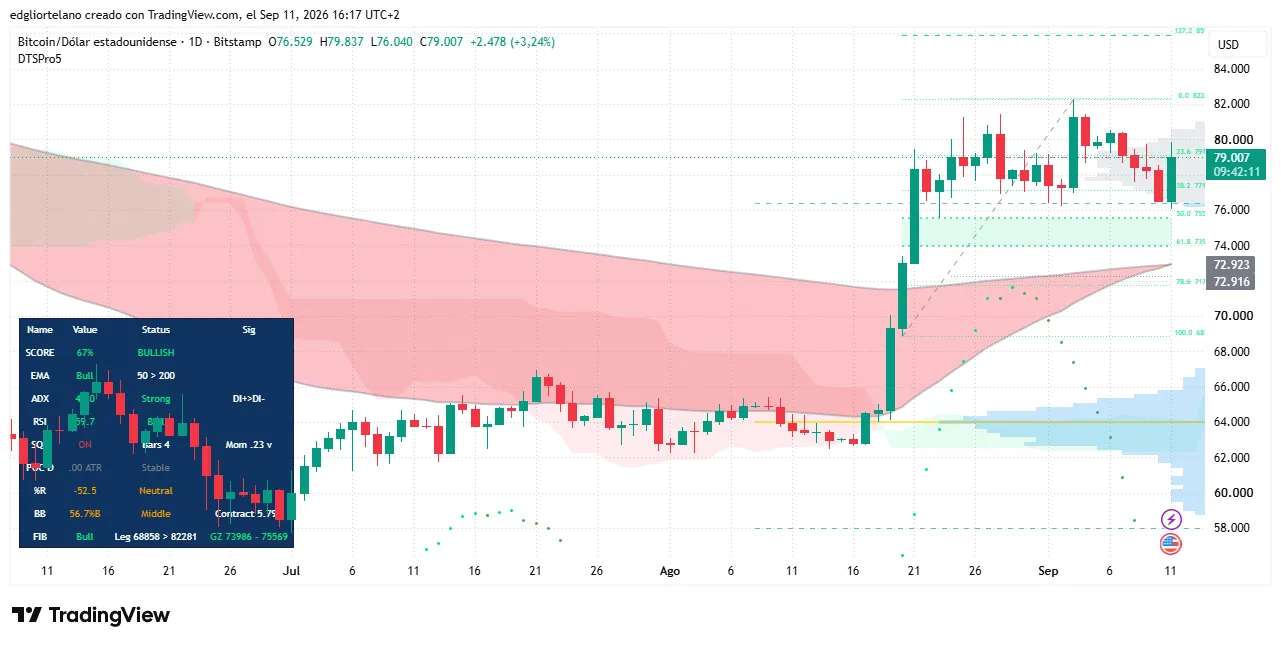
The largest structural change in the chart is reflected in the exponential moving average (EMA). Bitcoin's 50-day exponential moving average has now crossed the 200-day exponential moving average, forming a "golden cross." Traders typically interpret this as confirmation that the medium-term trend has turned bullish, rather than a warning of a reversal (the latter will be indicated by the opposite "death cross" signal). Since this form has just been formed, it has not yet been fully confirmed technically. There is no significant gap between the two moving averages, so traders are advised to be cautious and not celebrate too early for the time being.
The Relative Strength Index (RSI) is at 59.7, in bullish territory and well below the 70 reading that marks overbought. The average Orientation Index (ADX), which measures the strength of trends (regardless of direction), is in a range of just over 40, comfortably above the 25 threshold that distinguishes true trends from noise, and the DI+ line is higher than the DI-line, confirming that the buyer is still in control of the situation.
The key support area to watch for lies below current prices: The Fibonacci retracement line drawn from a summer low of $68,858 to a late August high of $82,281 shows that Bitcoin's "golden zone"(the retracement band that bulls need to defend) lies between $73,986 and $75,569. On top of that, the high of $82,281 set at the end of August is still the level needed to break through the current round of rally to extend further at the Federal Reserve's interest rate decision at 2 p.m. EST on Wednesday.