Exchange Ranking
 Top Exchanges
 24h Volume Ranking
 Popularity Ranking
 Exchange BTC Balance
 Proof of Reserves
 Decentralized Exchanges
 Funding Rate
 Funding Heatmap
 Liquidation Data
 Max Pain
 Long/Short Ratio
 Whale L/S Ratio
 Binance/Okex/Huobi L/S
 Bitfinex Margin L/S
 ETF Tracker
 Solana ETF
 XRP ETF
 Hong Kong ETF
 Bitcoin Treasuries
 Crypto Reversal
 Ethereum Reserves
 HyperLiquid Wallet Analysis
 Hyperliquid Whale Watch
 Large Transactions
 On-chain Movement
 Bitcoin ROI
 Stablecoin Market Cap
 Options Analysis
 News
News Articles
 Economic Calendar
 Features
 Wallet
 Contract Calculator


 Security
 Collections
 Watchlist
 Following
 BTC
BTC 比特币起源之谜:600 BTC沉睡16年后异动,能证实“中本聪”现身吗?
比特币的起源故事至今仍笼罩在神秘之中——即便是那些通常与中本聪(Satoshi Nakamoto)关联的硬币也不例外。近期,一笔约 600 BTC 的链上转账引发了市场猜测,认为“中本聪”的囤积币可能终于发生了移动。这笔资金挖掘于2010年3月,沉寂超过16年后被重新激活。然而,区块链证据虽然能够更可靠地追踪持仓和支出模式,却无法直接识别具体的个人身份。
据 Whale Alert 报道,这 600 BTC 的转账显示与广泛讨论的中本聪持仓集群没有直接联系。与此同时,区块链研究公司 Bitquery 对底层区块奖励进行了审查,发现大多数相关区块并不完全符合被称为“Patoshi”的特征性挖矿模式——这是用于关联疑似早期矿工指纹、进而指向中本聪的名称。这些发现共同揭示了一个关键局限:区块链记录的是交易,而非特定时刻谁控制着私钥。
核心要点
- 经过16年沉睡后移动的 600 BTC 来自2010年3月挖掘的12个旧区块奖励,但发送者并非确证为中本聪。
- Whale Alert 报告称,这 600 BTC 的转账与通常追踪的中本聪关联持仓之间没有任何联系。
- Bitquery 发现,此次转账涉及的12个区块中有10个不符合与中本聪相关的“Patoshi”挖矿指纹,其余两个仅呈现微弱匹配,这种匹配可能是偶然发生的。
- 即使某种挖矿模式指向某位早期操作者,也无法确认该人在2026年是否仍控制着私钥。
- Bitquery 的全面重建表明,“中本聪”持有量的估计值会根据应用指纹标准的严格程度而有显著差异。
为何长期休眠的 600 BTC 转账未能解决“中本聪”之谜
最近的动态涉及12个区块奖励,它们是在2010年3月的四天内挖掘的,直到今年9月5日一直未被触动。这些硬币在一个短暂的窗口期内被逐一花费,耗时约半小时。这一链上细节自然引发了人们的关注,即这次移动是否与比特币的最早时代有关联。
然而,多条分析线索使“中本聪醒来了”这一叙事变得复杂。Whale Alert 报告称,这 600 BTC 与已追踪的中本聪关联持仓之间没有联系。Bitquery 的审查更进一步:它指出,此次转账涉及的12个区块中,有10个与最早期区块中与中本聪相关的“Patoshi”挖矿模式不匹配。
For the two blocks that showed a weak match, Bitquery researcher Gaurav Agrawal pointed out that the match was likely accidental. Importantly, this distinction is crucial for readers trying to distinguish between "connected by pattern" and "connected by identity."
"What blockchain cannot explain is whether the hand in 2026 belongs to the person who ran the machine in 2010."
Even if coins clearly originated from early mining periods, blockchain would not reveal who held the private key when moving coins. Agrawal also emphasized that private keys can be inherited, sold, stolen or recovered from old storage media-meaning that blockchain may only show someone had control at the time of spending, not who that person was.
There is another useful clue: Expenditure transactions use modern wallet software. Bitcoin clients used in 2010 will not support the same tool. This suggests that the person who controlled the key in 2026 most likely loaded the key into the new system, but it remains unclear whether the controller was the original miner or another party who later obtained the key.
Limitations of "Patoshi" fingerprints and circumstantial evidence
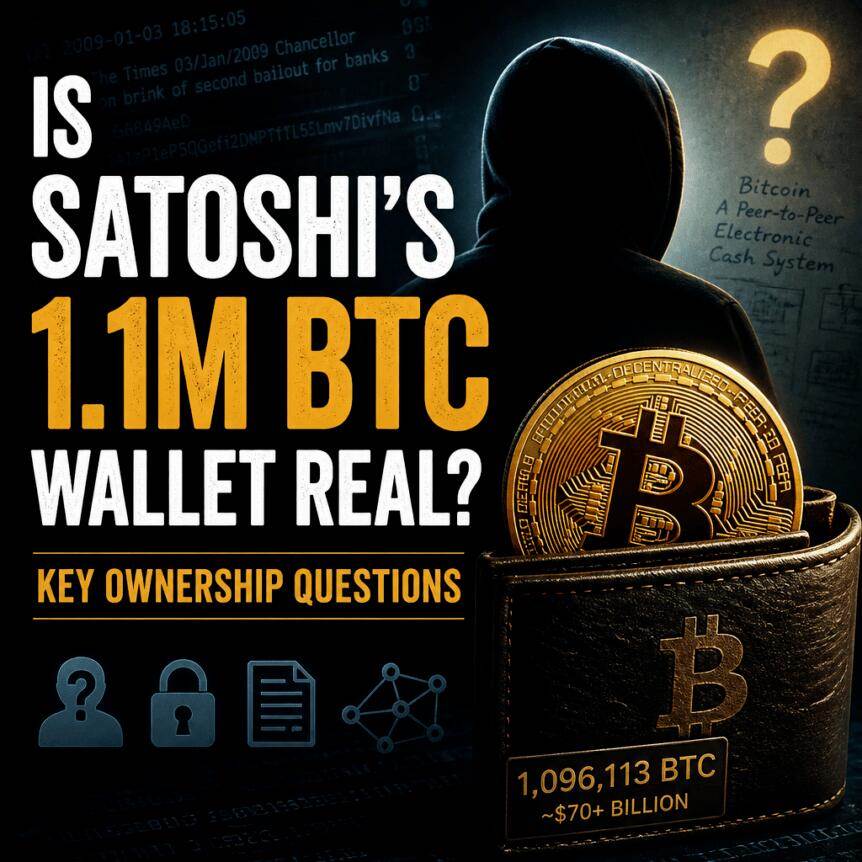
The broader claim that Satoshi Nakamoto controlled approximately 1.1 million BTC is based on forensic reconstruction rather than direct evidence. The basic approach is to identify recurring mining "fingerprints" in early Bitcoin blocks, and then attribute blocks with similar characteristics to a single operator.
In 2013, researcher Sergio Demian Lerner publicly described a unique pattern he discovered in the earliest blocks and believed it reflected the operation of a miner who was different from others. Lerner estimated that the miner accumulated approximately 1.1 million BTC and continued to insist on the calculation more than a decade later, describing it as accurate, but caveat was the evidence that was still indirect rather than a "mathematical proof" or direct eyewitness.
This argument is reinforced by additional observations that associate early recipients with the same pattern. According to Lerner, several early Bitcoin users-Hal Finney, Dustin D. Trammell, Nicholas Bohm and Mike Hearn-received transfers showing Patoshi's mining fingerprints. In his view, the transfers traced back to Patoshi's model of coinbase (Coinbase) provides "convincing reasons" to link Patoshi to Satoshi Nakamoto, although this is still not absolute evidence.
Lerner also suggested that the miner may have used specialized mining software instead of a standard client. If true, this would mean that settings were completed at an unusually fast pace after Bitcoin's early release, making it "highly unlikely" that other parties would later form a match.
Bitquery's reconstruction: An estimate of hoarding, multiple possible sizes
在 Lerner 的工作进行十三年后,Bitquery 尝试从原始早期区块对 Patoshi 指纹进行更全面的重建。在其发布的调查报告中,Bitquery 表示它对 54,316 个早期区块进行了分级,并跟踪了截至 2026 年 9 月 1 日的每一枚硬币。
该公司报告称,其“最高等级”的重建与已发布的 Patoshi 列表在 99.2% 的区块上一致。它还表示,在 5,836 个相邻区块对的timestamp排序测试中发现了零例外,Agrawal 表示:“我不知道有更强的测试方法。”
尽管如此,这项工作也突出了估计值的敏感性。虽然 Bitquery 的重建支持集中早期挖矿起源的观点,但归因硬币的总数取决于应用模式标准的严格程度。
Agrawal 表示,对指纹的严格解释涵盖略低于 90 万 BTC,而“最宽松的解释”约为 117 万。他强调,大约在 100 万至 113 万之间的已公布估计值都落在这个范围内,因此该公司的分析并没有“改变数字”,而是澄清了不确定性的边界。
对于投资者和市场观察者来说,实际的结论很简单:“110 万 BTC”这个数字最好被理解为基于模式匹配规则得出的估计值,而不是精确的、既定的账本事实。
区块链可以确认什么——以及什么是不可知的
Agrawal 将“中本聪拥有 110 万 BTC”的主张框架为三个叠加在一起的独立断言。第一是硬币可能来自一台挖矿机——得到了更强的证据支持。第二是该机器属于中本聪——作为间接证据提出。第三是密钥仍由中本聪控制,仅仅因为硬币历史上未动过就无法证明这一点。
Bitquery 还报告了一起 2010 年的交易,其中 600 BTC 分两次转移,间隔约一小时。第一次在 UTC 时间 22:04 移动,花费了价值 500 BTC 的 10 个区块奖励;第二次在 UTC 时间 23:07 移动,花费了价值 100 BTC 的两个区块奖励。这些奖励是在 2009 年的各个时间点挖掘的,涵盖了比特币第一年的开始和结束阶段。
Agrawal 认为,这个 2010 年 5 月的时刻是“最清晰”的时刻,此时区块链本身(而非统计模式匹配)表明这些区块属于一起——有效地达到了区块链接近确认跨越 2009 年的区块最终落入同一个钱包的程度,这与更广泛的 Patoshi 模式对整个集合的主张相符。
然而,这并不能回答 9 月 5 日转账的个人身份问题。Bitquery 表示,本月移动的 600 BTC 不属于 Patoshi 矿工,并且它报告说没有新证据将此活动与“中本聪”的囤积物联系起来。正如 Agrawal 所说:“数学中没有东西能解决这个问题,所以我们永远不会确定。”
读者接下来应该关注的重点,与其说是“中本聪”的硬币是否会移动,不如说是研究人员如何完善指纹测试和归属阈值。区块链可以通过支出行为和挖矿结构缩小可能性范围,但只要密钥无法随时间链接到特定个人,最大的不确定性——谁控制着硬币——可能仍将悬而未决。