Exchange Ranking
 Top Exchanges
 24h Volume Ranking
 Popularity Ranking
 Exchange BTC Balance
 Proof of Reserves
 Decentralized Exchanges
 Funding Rate
 Funding Heatmap
 Liquidation Data
 Max Pain
 Long/Short Ratio
 Whale L/S Ratio
 Binance/Okex/Huobi L/S
 Bitfinex Margin L/S
 ETF Tracker
 Solana ETF
 XRP ETF
 Hong Kong ETF
 Bitcoin Treasuries
 Crypto Reversal
 Ethereum Reserves
 HyperLiquid Wallet Analysis
 Hyperliquid Whale Watch
 Large Transactions
 On-chain Movement
 Bitcoin ROI
 Stablecoin Market Cap
 Options Analysis
 News
 Articles
 Economic Calendar
 Features
 Wallet
 Contract Calculator


 Security
 Collections
 Watchlist
 Following
 ETH
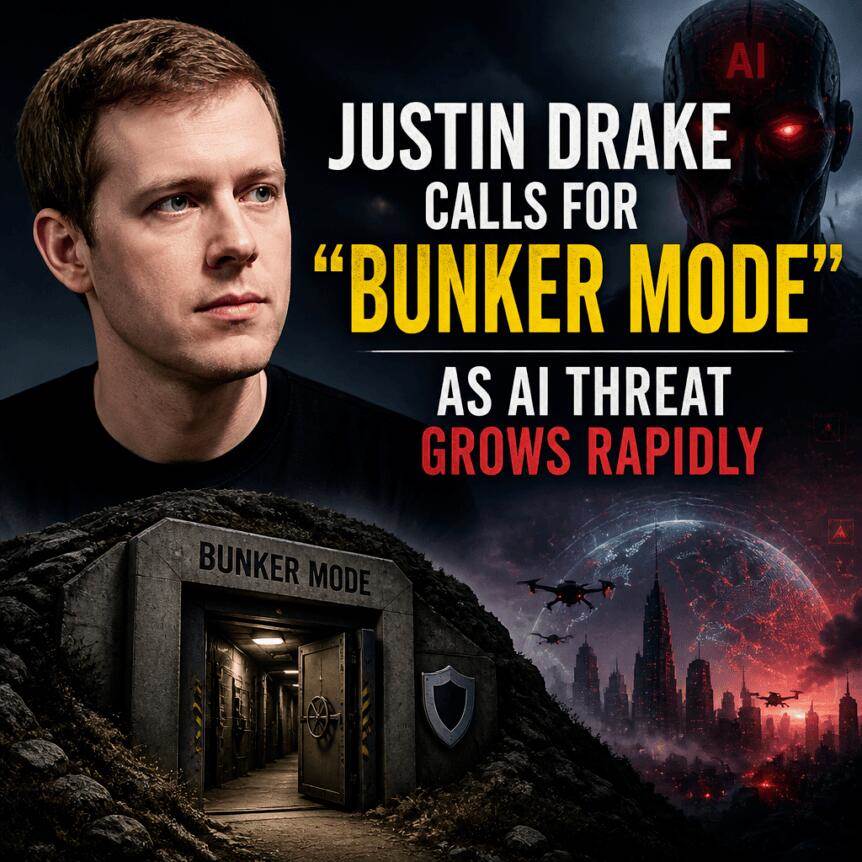
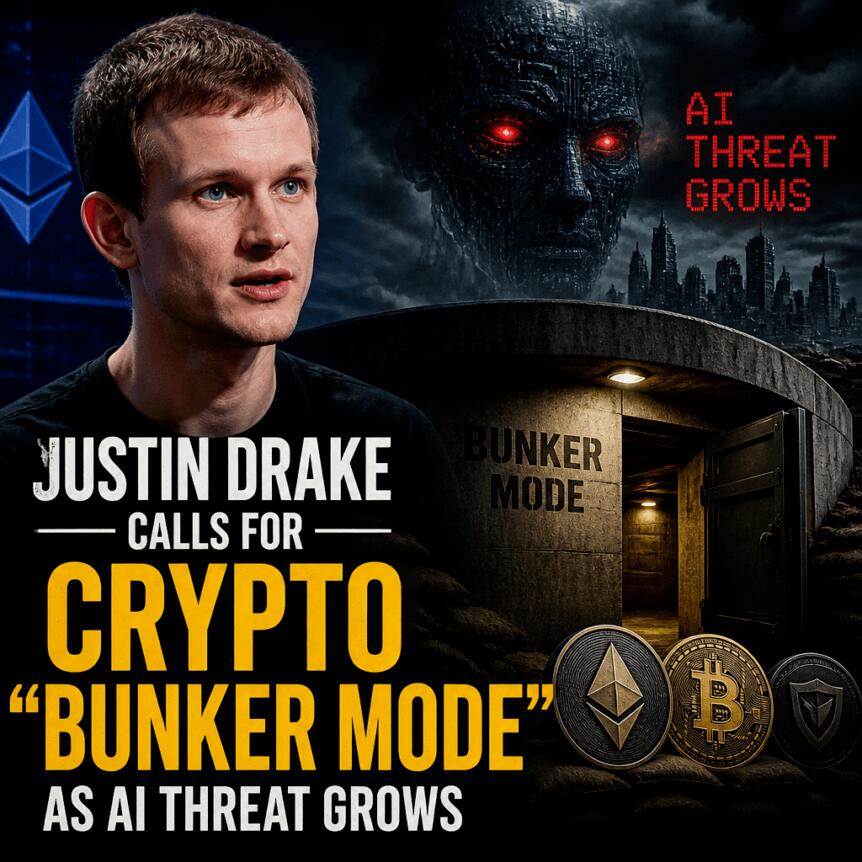
Ethereum researcher Justin Drake called on the industry to enter a "bunker model", advising users to gradually move assets to new addresses
Ethereum researcher Justin Drake urged the entire industry to prepare for a "bunker model", suggesting that users should gradually move assets to new wallet addresses amid concerns that advances in artificial intelligence could undermine the encryption technology used in today's blockchains.
On Wednesday, Drake posted on social media platform X saying that recent advances in artificial intelligence, especially the recently released mathematical breakthroughs by OpenAI, suggest that artificial intelligence may eventually crack the Elliptic Curve Digital Signature Algorithm (ECDSA) used to protect cryptocurrency wallets.
"It is now reasonable to believe that we need to be prepared for the possibility that ECDSA will be breached before quantum computers become popular, and in the worst case, this process could occur in months rather than years." Drake said.
The warning raises concerns about the prospect that before sufficiently powerful quantum computers are available, artificial intelligence may allow attackers to recover private keys from exposed public keys earlier than expected.
The challenge of mathematical superintelligence
"The past few days have been a humbling experience for human mathematical intuition. Long-standing and unquestioned assumptions are collapsing." Drake said.
On Tuesday, OpenAI released hundreds of new mathematical discoveries covering multiple fields including algebra, theoretical computer science and mathematical logic.
Last month, the company said it used a team of 10,000 autonomous AI agents working in parallel to solve the Navier-Stokes equation in just 88 hours. This is one of the most famous and difficult unsolved problems in mathematics and physics.
Drake points out that elliptic curves may be particularly vulnerable to attacks from super-intelligence.
"Curves have a rich structure that allows complex techniques such as Schoof's algorithm, Frobenius endomorphism, and pairing. (In contrast, hash functions are designed to minimize algebraic structure.)" He explained.
Controlled migration to new address
"My personal recommendation is to initiate a controlled large-scale asset migration and transfer it to the new address." Drake said.
He said that large and complex cryptocurrency holders should be the first to move funds to new addresses. He also suggested that after completing a transaction, the remaining funds should also be transferred to a new address.
The logic behind this is that for this type of address type, the new address hides the public key behind a cryptographic hash, reducing the risk of being attacked by needing to know the public key. Signing a transaction could leak the public key, so Drake recommends transferring the remaining balance immediately after the transaction is completed.
However, Drake emphasized that any relocation should be gradual and carefully managed, warning that "a hasty relocation would do more harm than good."