Exchange Ranking
 Top Exchanges
 24h Volume Ranking
 Popularity Ranking
 Exchange BTC Balance
 Proof of Reserves
 Decentralized Exchanges
 Funding Rate
 Funding Heatmap
 Liquidation Data
 Max Pain
 Long/Short Ratio
 Whale L/S Ratio
 Binance/Okex/Huobi L/S
 Bitfinex Margin L/S
 ETF Tracker
 Solana ETF
 XRP ETF
 Hong Kong ETF
 Bitcoin Treasuries
 Crypto Reversal
 Ethereum Reserves
 HyperLiquid Wallet Analysis
 Hyperliquid Whale Watch
 Large Transactions
 On-chain Movement
 Bitcoin ROI
 Stablecoin Market Cap
 Options Analysis
 News
 Articles
 Economic Calendar
 Features
 Wallet
 Contract Calculator


 Security
 Collections
 Watchlist
 Following
Ethena USDe is a stablecoin that differs from traditional fiat-based stablecoins. It is supported by both encrypted assets and hedging derivatives, and can generate income for users during the pledging process. In just a few weeks in mid-2025, the circulation of USDe increased by nearly 70%, making it the third-largest stablecoin by market value, with a value of approximately $9.5 billion. Its core advantage lies in allowing investors to earn double-digit annual interest without going through banks. This “synthetic dollar” model not only improves the efficiency of capital utilization in the crypto market but also sparks discussions about its security and potential risks.
What is Ethena USDe?
Ethena USDe was launched by Ethena Labs in March 2024. It is a native cryptocurrency-based synthetic dollar that aims to be pegged to 1 USD without the need for fiat reserves. Each USDe token is supported by a diversified portfolio of on-chain assets such as ETH, BTC, and liquid collateral tokens. Additionally, perpetual contracts are used to open opposite positions equal to the value of the USDe token. This “delta-neutral” hedging mechanism ensures that profits and losses from the futures component cancel out, thereby maintaining USDe at a stable value of 1 USD. Real-time on-chain dashboards allow anyone to see exactly how many collateral assets and short positions are supporting each token, ensuring full transparency.
USDe not only involves holding the stable currency of the US dollar, but also generates income through its dual-currency system. You can pledge USDe to create sUSDe, which will accumulate protocol revenue over time—including fees from perpetual contract positions, rewards from liquid pledged ETH, and earnings from any stablecoin reserves. When you release your pledge, you can redeem more than the initial amount of USDe, reflecting the organic interest generated by your sUSDe. This mechanism transforms assets pegged to the US dollar into income-generating assets—all managed on-chain, without relying on traditional banks.
How Ethena’s USDe works
● Delta-neutral hedging: When you create USDe (e.g., depositing 1,000 USD in ETH), Ethena will lock up that ETH as collateral and open a short position worth 1,000 USD in the ETH perpetual contract market. If the ETH price rises, the collateral asset increases in value while the short position loses an equivalent amount; if the ETH price falls, the profits from the futures position can offset the loss of the collateral asset, ensuring that the value of USDe remains fixed at 1 USD.
● Diversified collateral pool: Ethena accepts various assets such as ETH, BTC, and liquid pledged tokens like stETH. It even holds some stablecoins (USDC/USDT) as cash buffers. This diversification provides resilience to the protocol in unfavorable funding conditions and ensures that there is always a reserve to support the fixed price.
● Autonomous market stabilization mechanism: When the market price of USDe fluctuates above or below $1, arbitrageurs can profit from the difference in prices by issuing or redeeming tokens, thereby bringing prices back into a stable range. Automated monitoring and rebalancing mechanisms ensure that the size of hedges and collateral ratios remain within safe limits.
● sUSDe revenue engine: By staking USDe, you will receive sUSDe, which represents your share of the protocol’s revenue. This includes futures funding fees, ETH staking rewards, and stablecoin earnings. Over time, each sUSDe can be redeemed for more USDe than was staked initially, turning your stablecoin into a dollar-based asset with earnings.
Factors driving the growth of USDe
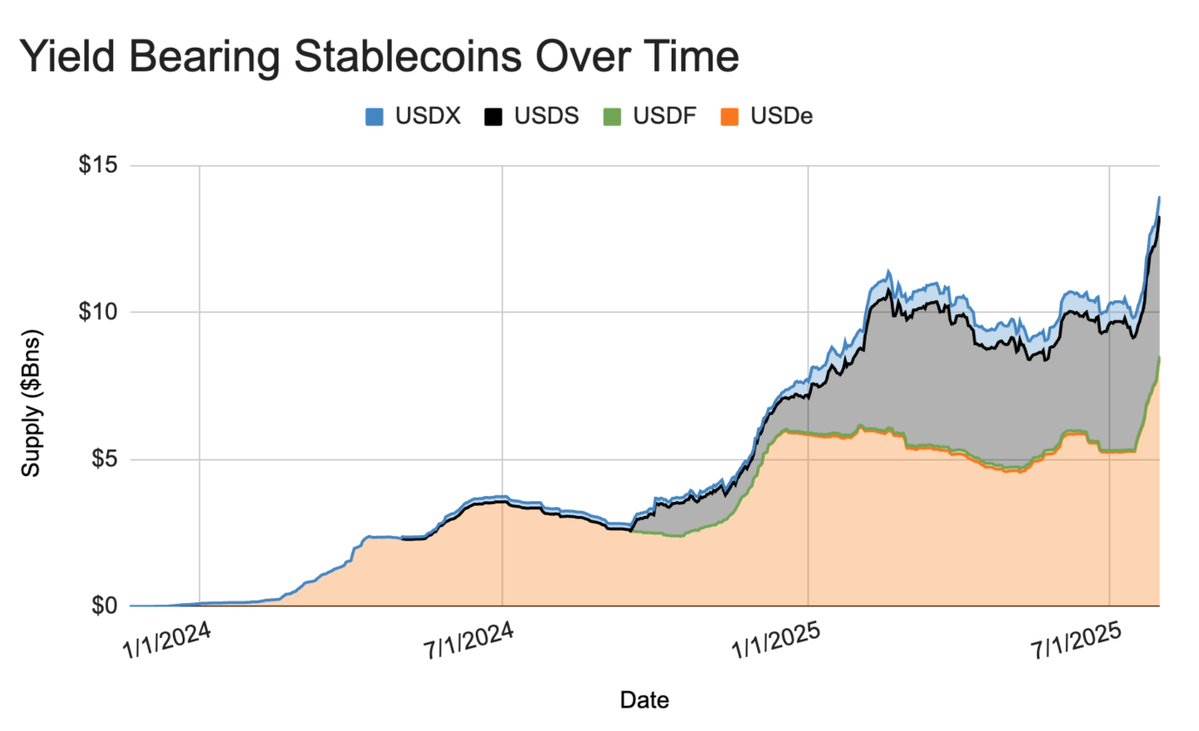
Since mid-2025, the rise of Ethena USDe has been remarkable. In July, the United States passed the GENIUS Act, which for the first time prohibited stablecoins from providing earnings to retail users. Ironically, this regulation actually led to a surge in liquidity towards alternative earning instruments like USDe. Its total supply increased by nearly 70% within just a few weeks, with its market value soaring to around $9.5 billion. This made USDe the third-largest stablecoin by market value, behind USDT and USDC. At the same time, the governance token ENA increased in value by over 60%—indicating that traders believe this is a significant moment in the evolution of earning-based stablecoins that are tied to the dollar.
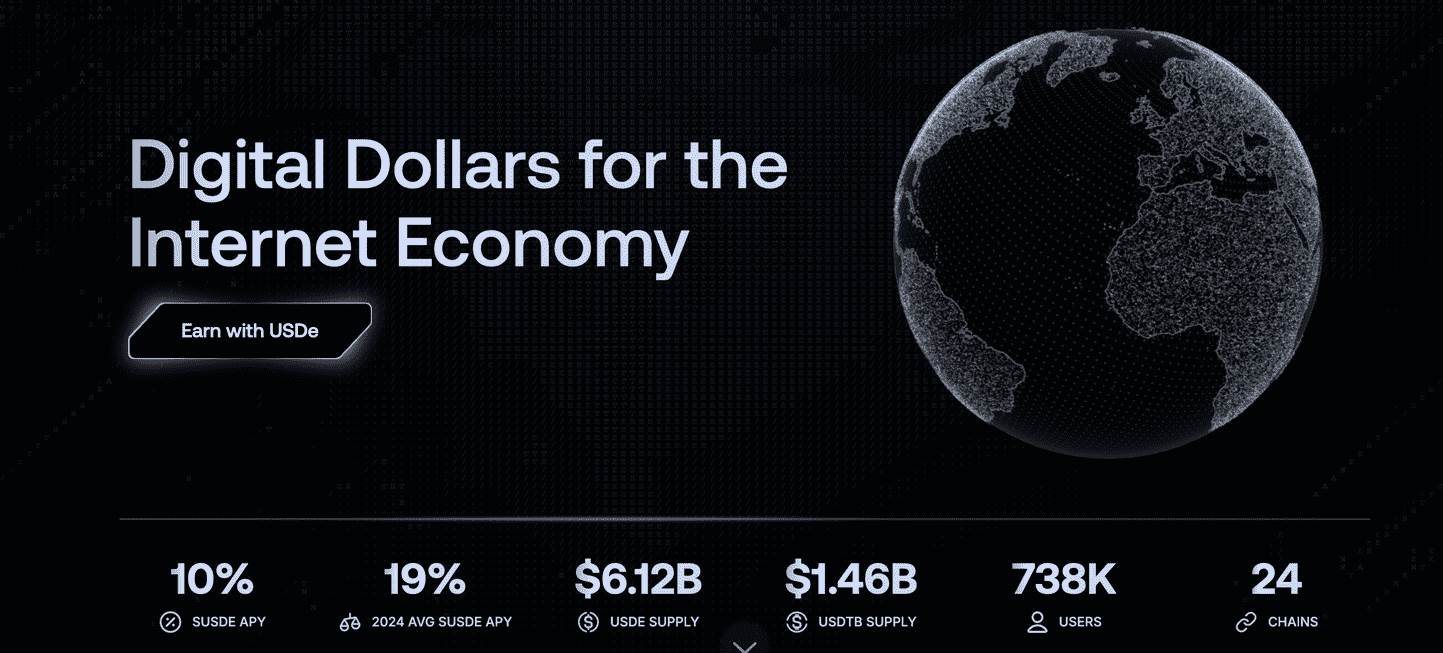
Meanwhile, Ethena Labs has increased its efforts in terms of compliance and expansion. At the end of July, they collaborated with Anchorage Digital to launch USDtb – a USDe version regulated by US authorities. This platform is supported by tokenized money market funds, rather than just cryptocurrency derivatives. This fully meets the requirements of new regulations, targeting institutional investors. In the DeFi sector, USDe has been deployed on over 24 different blockchains, with more than 750,000 independent users. It also integrates with leading protocols like Aave (including the USDe/sUSDe “liquidity leverage” feature) and Curve. Additionally, USDe connects to the TON ecosystem, allowing Telegram’s large user base to enjoy fast and low-cost transfers.
How safe is Ethena’s USDe?
Ethena reduces the risk of cryptocurrency fluctuations through a delta-neutral mechanism. However, its returns depend on perpetual contract fees. In a bear market, these fees can become negative, potentially eroding the protocol’s insurance reserves. Although Ethena holds collateral assets in the over-the-counter market and diversifies its holdings among ETH, BTC, liquid collateral tokens, and stablecoins, continuous negative fees or major exchange disruptions could put pressure on its assets or consume its reserves.
At the regulatory level, the GENIUS legislation in the United States has already prohibited the issuance of stablecoins for retail investors. This has forced Ethena to split USDtb into separate assets for institutional investors. Future regulations related to leverage, licensing requirements, and consumer protection could further limit the expansion of USDe. Although the asset-backed model of USDe differs significantly from Terra UST’s algorithm design, situations such as continuous negative funding costs, exchange failures, or sudden large-scale withdrawals still represent theoretical extreme stress scenarios. Ethena’s transparent reserve management and risk control mechanisms are indeed robust. However, like all innovative DeFi products, USDe requires users to be cautious about information disclosure and to invest only in funds they can afford to lose.
Conclusion:
Ethena’s USDe has rapidly become the third-largest stablecoin in the world, demonstrating the effectiveness of combining traditional trading strategies with decentralized finance. By using real crypto assets as collateral and employing derivatives for hedging, each USDe can be firmly pegged to one dollar, even in cases where no crypto reserves are available. Its dual-currency model—where USDe is used for payments, and sUSDe is used for staking—offers organic yields on-chain, attracting hundreds of thousands of users and billions of dollars in liquidity. This approach has achieved significant success in less than two years.
当然,创新总伴随新风险:资金费波动、交易所依赖和不断变化的监管环境,都可能考验协议韧性。Ethena以透明、多元化的抵押物和保险储备提供强力保障,但和所有先锋DeFi产品一样,用户应随时保持关注,只投入可承受损失的资金。如果USDe能持续应对市场和监管风暴,它很可能重塑链上美元资产的未来——让你的美元既稳定又能为你工作。