Exchange Ranking
 Top Exchanges
 24h Volume Ranking
 Popularity Ranking
 Exchange BTC Balance
 Proof of Reserves
 Decentralized Exchanges
 Funding Rate
 Funding Heatmap
 Liquidation Data
 Max Pain
 Long/Short Ratio
 Whale L/S Ratio
 Binance/Okex/Huobi L/S
 Bitfinex Margin L/S
 ETF Tracker
 Solana ETF
 XRP ETF
 Hong Kong ETF
 Bitcoin Treasuries
 Crypto Reversal
 Ethereum Reserves
 HyperLiquid Wallet Analysis
 Hyperliquid Whale Watch
 Large Transactions
 On-chain Movement
 Bitcoin ROI
 Stablecoin Market Cap
 Options Analysis
 News
 Articles
 Economic Calendar
 Features
 Wallet
 Contract Calculator


 Security
 Collections
 Watchlist
 Following
 DOGE
 XMR
Just last Friday, August 15th, the well-known exchange Kraken announced that it had temporarily suspended the deposit service for Monero (XMR). The reason behind this decision was that Kraken detected that a single mining pool had gained control of over 50% of the network’s computing power in a short period of time. This situation is known as “power concentration,” and it could pose a threat to the security and integrity of the blockchain. However, Kraken assured users that trading and withdrawal functions would continue as usual, while the deposit function will only be reopened once the network returns to stability. This incident serves as a reminder that although cryptocurrencies have powerful decentralized mechanisms, potential risks still need to be constantly monitored.

Qubic still holds more than three-quarters of Monero’s total computing power.
The problem stemmed from the AI-based blockchain project Qubic. Its founder, Sergey Ivancheglo, claimed that the team managed to gain control of 51% of Monero’s computing power through various tactics, and they also reorganized some of the blockchain’s data structures. As a result, Qubic’s control over the network decreased to around 27.5%, sparking discussions among investors about the security of smaller proof-of-work (PoW) networks.

Although Qubic claimed to have achieved a “51% attack,” the Monero community questioned its validity, arguing that their computing power never exceeded 35%, and that they simply employed selfish mining strategies. Some community members even launched DDoS attacks against Qubic, causing their computing power to drop significantly. As of the deadline, according to Mining Pool Stats, Qubic still accounted for 36.7% of Monero’s total computing power, which is 6.24 GH/s.
In terms of prices, XMR has risen to around $273 over the past week, indicating that investors remain confident in the project.
Qubic made a long position on XMR, achieving profits
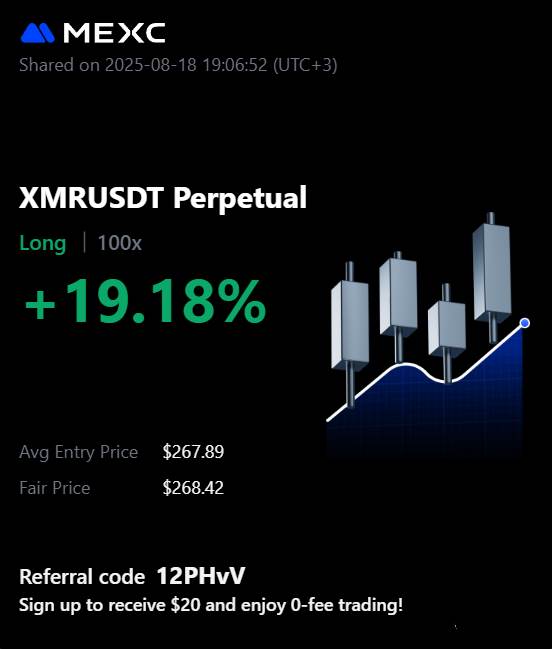
. After Qubic’s actions attracted attention, they successfully pushed up the price of XMR. Sergey Ivancheglo then said that he had 50,000 USDT ready to use for a long position on XMR. He also asked netizens which exchange would be the best choice. In the end, he chose MEXC and showed images of a nearly 20% profit. As of the deadline, the price of XMR was $271. If he didn’t sell all his positions, he could make even more money.
Dogecoin has become the next target
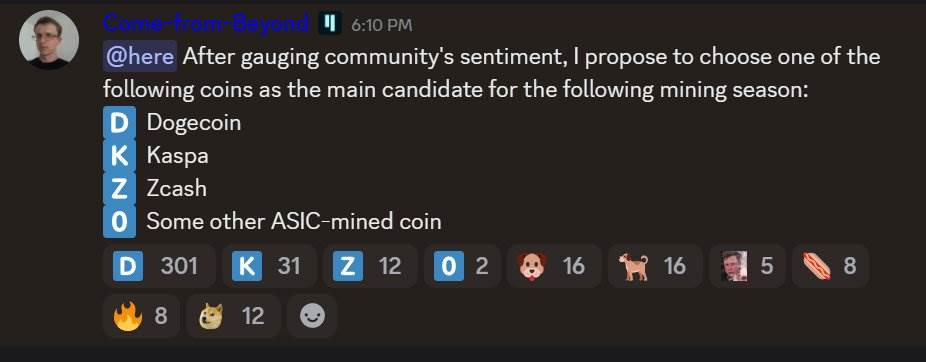
. It’s worth noting that the Qubic community voted to choose Dogecoin as the next potential target for attacks, which has drawn widespread attention to the security of small-scale PoW networks. Since Dogecoin became a target, its price has plummeted, from $0.234 on August 17 to currently around $0.218, a decrease of about 6.8%.