Exchange Ranking
 Top Exchanges
 24h Volume Ranking
 Popularity Ranking
 Exchange BTC Balance
 Proof of Reserves
 Decentralized Exchanges
 Funding Rate
 Funding Heatmap
 Liquidation Data
 Max Pain
 Long/Short Ratio
 Whale L/S Ratio
 Binance/Okex/Huobi L/S
 Bitfinex Margin L/S
 ETF Tracker
 Solana ETF
 XRP ETF
 Hong Kong ETF
 Bitcoin Treasuries
 Crypto Reversal
 Ethereum Reserves
 HyperLiquid Wallet Analysis
 Hyperliquid Whale Watch
 Large Transactions
 On-chain Movement
 Bitcoin ROI
 Stablecoin Market Cap
 Options Analysis
 News
 Articles
 Economic Calendar
 Features
 Wallet
 Contract Calculator


 Security
 Collections
 Watchlist
 Following
 HYPE
 HYPER
In the crypto market, community proposals often trigger significant reactions. Recently, a bold proposal related to Hyperliquid has sparked intense discussion: should half of the HYPE tokens be burned? This bold idea not only affects the scarcity and value of the tokens but also reflects the complex relationships between project valuation, community consensus, and market dynamics. In other words, this debate over whether to burn the tokens or not is more than just a technical decision; it represents a crucial test of Hyperliquid’s future direction.
Recently, with the rise of Perp DEX, numerous new projects have emerged, challenging Hyperliquid’s dominance as the leading project in the industry.
Everyone’s attention is focused on the innovations of new players, leaving people unaware of how the price of HYPE tokens might change. And what directly affects token prices is the supply of HYPE tokens.
There are two factors that affect supply: continuous repurchases, which reduce the amount of tokens in circulation; and adjustments to the overall supply mechanism, which essentially means reducing the total supply of tokens.
Looking closely at the current supply design of HYPE tokens, there are issues:
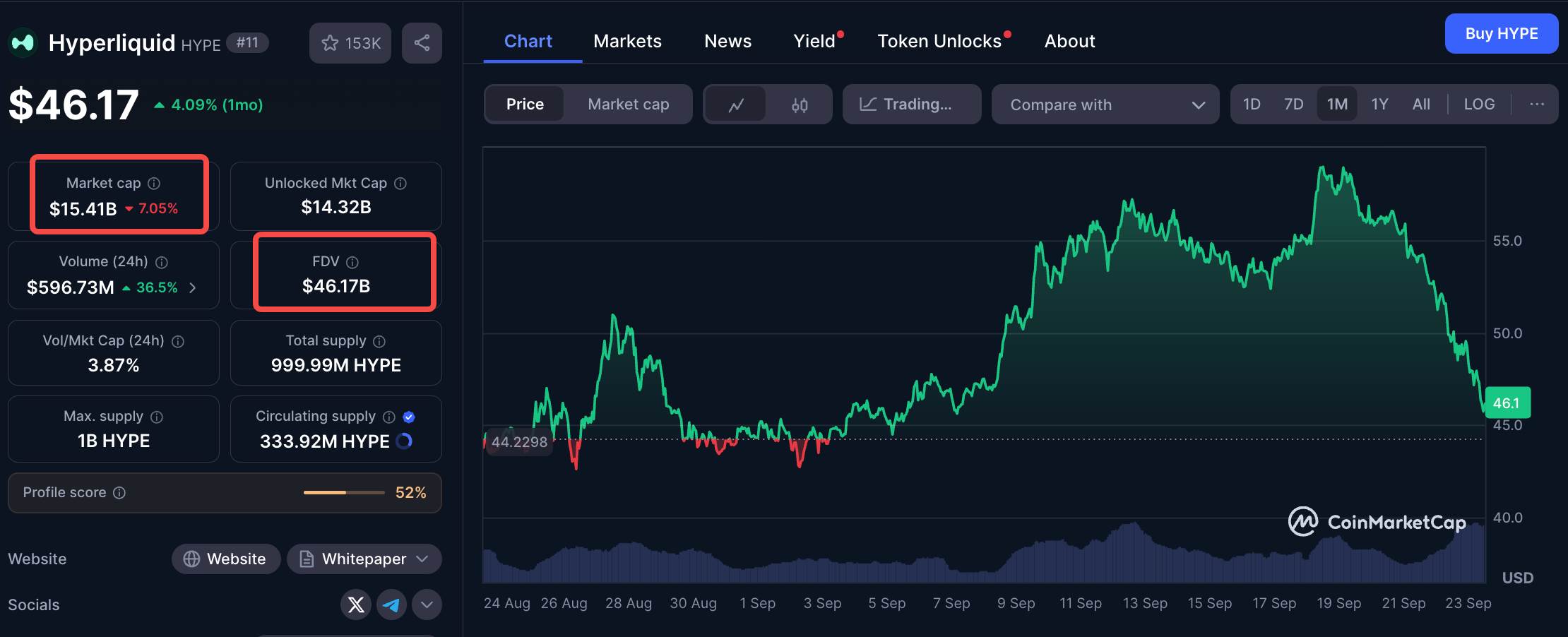
The circulating supply is approximately 339 million tokens, with a market value of around $15.4 billion. However, the total supply approaches 1 billion tokens, with FDV reaching up to $46 billion.
The nearly threefold difference between MC and FDV comes from two main sources. One portion, 421 million tokens, is allocated for “Future Emission and Community Rewards” (FECR), while 31.26 million tokens are held by the Assistance Fund (AF).
The assistance fund is an account used by Hyperliquid to repurchase HYPE tokens based on protocol revenues. It involves buying tokens daily, but without destroying them; instead, it simply holds onto them. The problem is that investors may still perceive the valuation to be too high, even though only one-third of the tokens are actually in circulation.
In this context, investment manager Jon Charbonneau (DBA Asset Management, who holds a large number of HYPE tokens) and independent researcher Hasu released an unofficial proposal regarding HYPE on September 22nd. The proposal was quite radical: they suggested burning off 45% of the current total supply of HYPE tokens, thereby bringing the FDV closer to its actual value.
This proposal quickly sparked discussions within the community. As of publication, the post had received 410,000 views.
Why did the proposal receive such a large response? If the proposal is indeed adopted, then burning off 45% of the HYPE supply means that each token would represent almost twice the original value. A lower FDV could also attract investors who were previously hesitating to get involved.
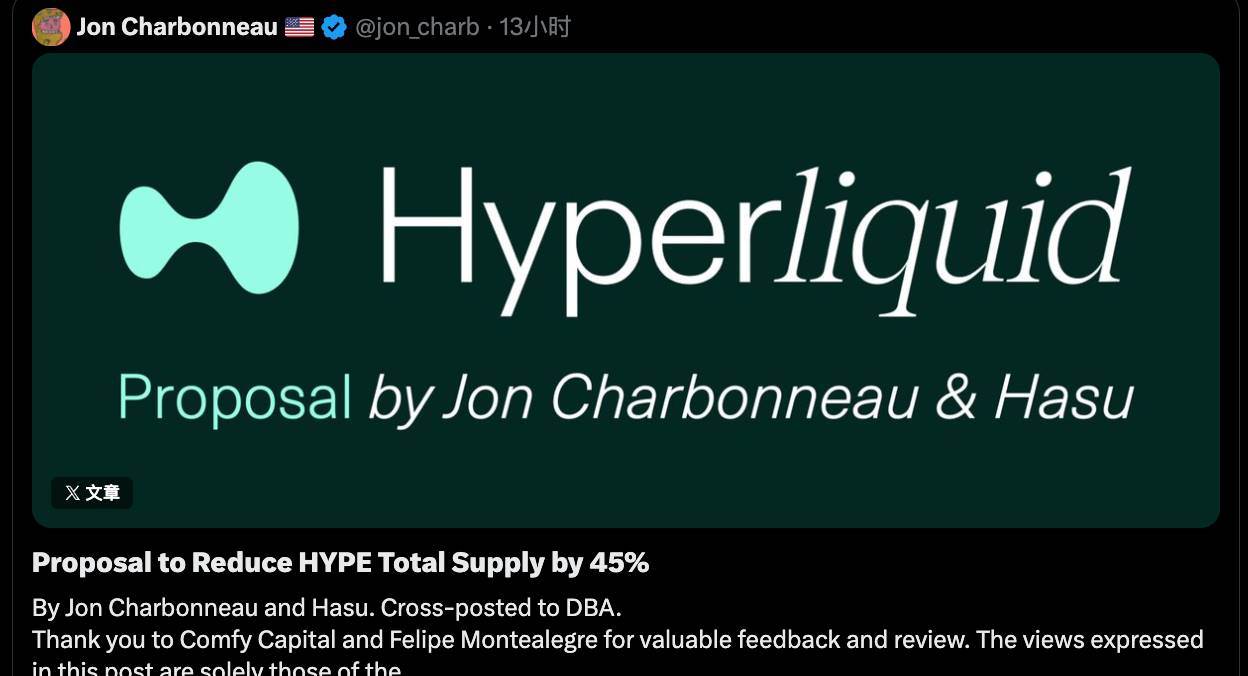
We have also summarized the original proposal below.
Reducing the FDV would make HYPE seem less expensive.
Jon and Hasu’s proposal seems simple—burning off 45% of the supply—but the actual implementation is more complex.
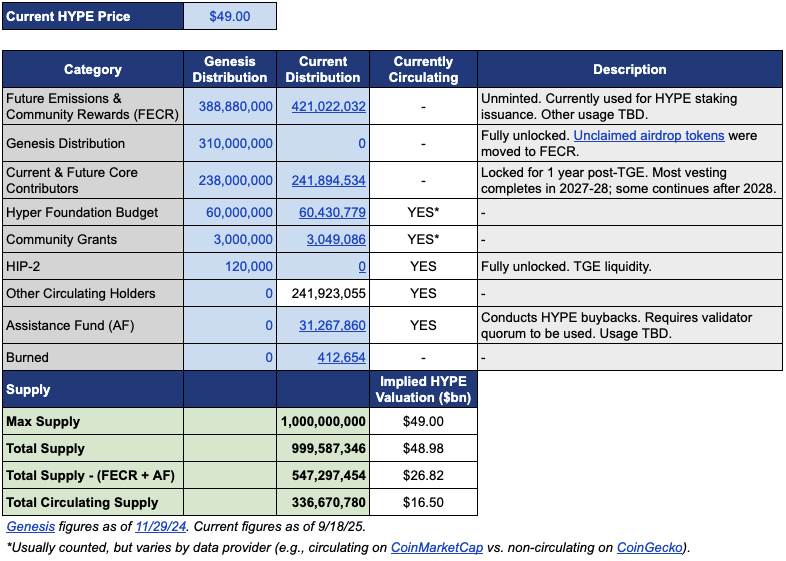
To understand this proposal, we need to first understand the current supply structure of HYPE. According to the data provided by Jon, at a price of $49 per HYPE token (the price at the time of their proposal), out of a total of 1 billion HYPE tokens, only 337 million tokens are actually in circulation, corresponding to a market value of $16.5 billion.
But where did the remaining 660 million tokens go?
The two largest portions of these tokens are as follows: 421 million tokens were allocated to the “Future Emissions and Community Rewards” program (FECR). This represents a significant reserve, but it’s unclear when or how these tokens will be used. Additionally, 31.26 million tokens are held by the Assistance Fund (AF). This fund buys HYPE tokens daily but does not sell them. In other words, it simply hoards these tokens without using them.
Let’s talk about how these tokens will be destroyed. The proposal includes three key actions:
First, cancel the authorization for the 421 million tokens in the FECR program. These tokens were originally intended to be used as rewards for future staking efforts and community incentives, but there was no clear schedule for their issuance. Jon believes that instead of leaving these tokens hanging over the market like the sword of Damocles, it’s better to cancel the authorization altogether. If necessary, the issuance can be approved again through governance votes.
Second, destroy the 31.26 million HYPE tokens held by the Assistance Fund (AF). All future purchases of HYPE by AF should also be destroyed. Currently, AF uses its daily revenue (mainly 99% of transaction fees) to buy HYPE tokens. On average, AF buys approximately $1 million worth of HYPE tokens per day. According to Jon’s plan, these purchased tokens will no longer be held but will be immediately destroyed.
Third, remove the supply limit of 1 billion tokens. This sounds counterintuitive. If we want to reduce supply, why eliminate the limit at all?
Jon explained that the fixed cap is a remnant of the Bitcoin 21 million unit model, and it has no practical significance for most projects. Without the cap, if new coins need to be issued in the future (for example, as part of staking rewards), the number can be determined through governance decisions, rather than being allocated from a reserved pool. The following comparison chart clearly shows the changes before and after the proposal: on the left is the current situation, and on the right is what would happen after the proposal is implemented.
The problem lies in the calculation methods used by large data platforms like CoinmarketCap.
The handling of burned tokens, FECR reserves, and AF holdings by different platforms varies significantly when calculating FDV, total supply, and circulating supply. For example, CoinMarketCap always uses a maximum supply of 1 billion units to calculate FDV, and doesn’t adjust even when tokens are burned.
As a result, no matter how much HYPE repurchases or burns tokens, the displayed FDV remains unchanged.
It can be seen that the biggest change under the proposal is that 421 million FECR units and 31 million AF units will be eliminated. Additionally, the 1 billion unit hard cap will also be removed, and instead, new coins will be issued through governance as needed.
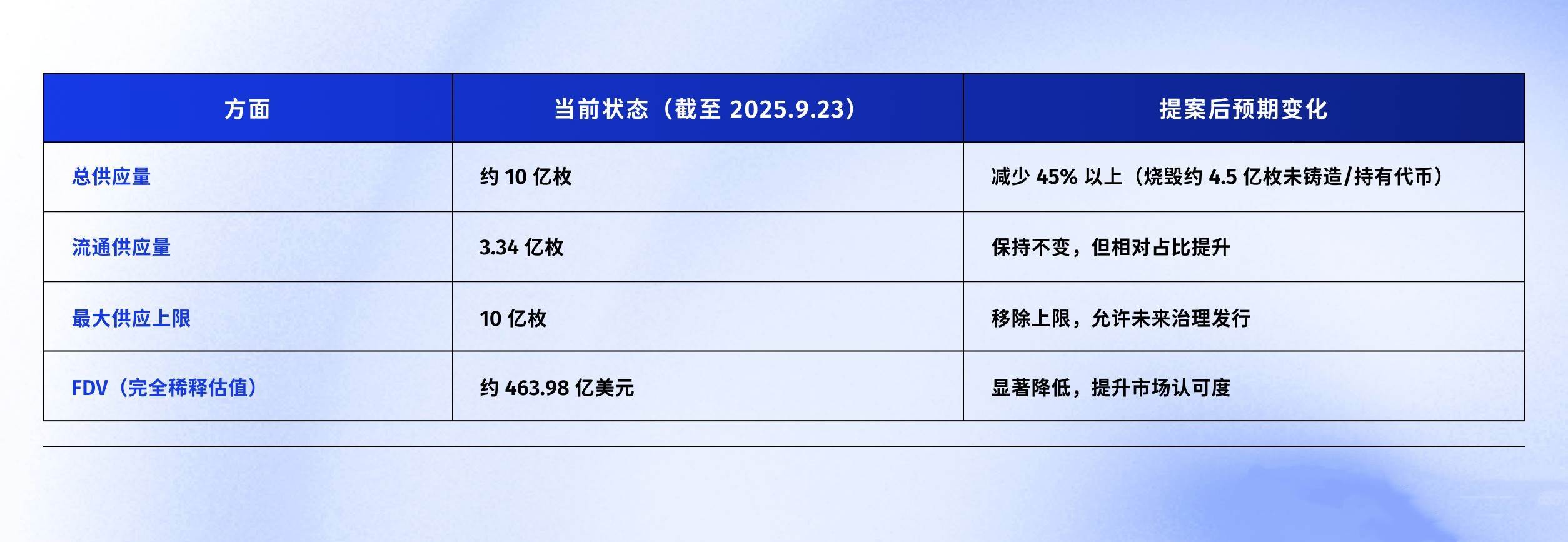
Jon wrote in the proposal, “Many investors, including some of the largest and most established funds, only look at the surface-level FDV numbers.” With a FDV of 46 billion dollars, HYPE seems more expensive than Ethereum—who would even want to buy it?
不过,大多数提案都有屁股决定脑袋的意味。Jon明确说明,他管理的DBA基金持有"material position"(重大仓位)的HYPE,他个人也持有,如果有投票,他们都会投赞成票。
提案最后强调,这些改变不会影响现有持有者的相对份额,不会影响Hyperliquid资助项目的能力,也不改变决策机制。用Jon的话说,
“这只是让账本更诚实。”
当“分配给社区”成为一种潜规则
但这个提案社区会买账吗?原贴评论区已经炸开了锅。
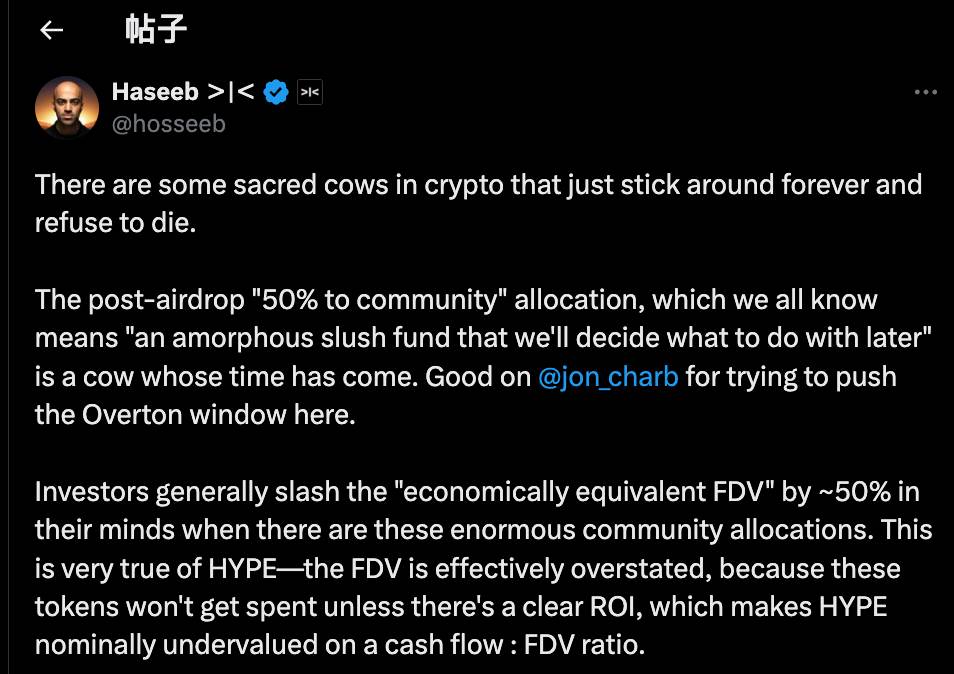
其中,Dragonfly Capital 合伙人 Haseeb Qureshi 的评论,把这个提案放到了更大的行业普遍现象里:
“加密行业有些'神圣奶牛'(sacred cows) 就是死不了,是时候宰掉了。”
他指的是整个加密行业的一个潜规则: 项目方在代币生成后,总要预留所谓 40-50% 的代币份额给“社区”。这听起来很去中心化很Web3,但实际上是一种表演艺术。
2021年时正值牛市巅峰,每个项目都在比谁更“去中心化”。于是代币经济里写到社区分配50%、60%甚至70%,数字越大越政治正确。
但这些代币到底怎么用?没人说得清。
With greater malice at heart, some project developers prefer to allocate tokens to the community in a way that allows them to use them whenever they want, and in whatever manner they see fit. This is done under the guise of “for the benefit of the community”.
The problem is that the market isn’t stupid.
Haseeb also revealed a secret: professional investors automatically discount these “community reserves” by 50%.
A project with a FDV of 500 billion, but with 50% allocated to the community, would actually be valued at only 250 billion in their eyes. Unless there is clear ROI, these tokens are merely empty promises.
This is precisely the problem faced by HYPE. Of HYPE’s 490 billion FDV, over 40% consists of reserves for future emissions and community rewards. Investors shy away from such figures.
It’s not that HYPE is bad, but the numbers are too vague. Haseeb believes that Jon’s proposal has the potential to make radical ideas that couldn’t otherwise be discussed become acceptable mainstream views. We need to question the practice of allocating tokens to “community reserves” within the crypto industry.
In summary, the supporters’ view is simple:
If you want to use tokens, then follow governance principles. Clearly explain why tokens should be issued, how much should be issued, and what the expected returns are. Transparency and accountability are essential, rather than keeping things a black box.
At the same time, due to the radical nature of this post, there are also some objections from the comments section. We can summarize these into three main points:
First, some of HYPE must be used as risk reserves.
From a risk management perspective, some believe that the 31 million HYPE in the aid fund AF is not just inventory, but also emergency funds. What if there are regulatory fines or hacker attacks that require compensation? Burning down all reserves means losing any potential buffer during crises.
Secondly, HYPE already has a well-established mechanism for destroying tokens.
Hyperliquid has three natural mechanisms for destroying tokens: fees from spot transactions, fees associated with HyperEVM gas, and fees from token auctions.
These mechanisms automatically adjust supply based on platform usage. Why intervene manually? Destroying tokens based on usage is more sustainable than doing so all at once.
Thirdly, large-scale token destruction undermines incentives.
Future emissions are Hyperliquid’s most important tool for growth, used to motivate users and reward contributors. Burning down tokens is like cutting off one’s own legs. Moreover, those who pledge large amounts of tokens will be locked in their positions. Without new token rewards, who would still be willing to pledge?
Who are these tokens intended for?
On the surface, this seems to be a technical discussion about whether to burn tokens. But upon closer examination of the various perspectives, it becomes clear that the differences lie in underlying beliefs.
Jon and Haseeb clearly support the idea that institutional investors are the main source of incremental funding.
These fund managers manage billions of dollars, and their purchases can truly drive prices higher. The problem is that they hesitate to enter the market when they see 49 billion FDV. Therefore, this number needs to be adjusted to make HYPE more attractive to institutions.
The views of the community are completely different. In their eyes, it is the individual traders who trade on the platform every day that truly form the foundation of the ecosystem. Hyperliquid’s success doesn’t come from funds like VC; instead, it relies on the support of 94,000 token distribution users. Changing the economic model in order to cater to institutional investors is a backwards approach.
This disagreement isn’t new.
Looking back at the history of DeFi, almost every successful project has faced similar decisions. When Uniswap launched its coin, the community and investors fought over control of the wallet.
The core issue remains the same: Is a project on the blockchain meant to serve large investors, or should it serve those who are part of the grassroots crypto community?
This proposal seems to target the former group. “Many of the largest and most established funds only care about FDV.” It’s clear that to attract these big investors, we need to follow their rules.
The proposer, Jon, himself is an institutional investor, and his DBA fund holds a significant amount of HYPE. If the proposal passes, the ones who benefit the most will be these big investors. With less supply, prices may rise, and the value of holdings will increase accordingly.
Considering that Arthur Hayes just sold $800,000 worth of HYPE to buy a Ferrari, it’s easy to sense the subtle timing involved. Those who were early supporters are now selling their tokens, while others propose burning them to drive up prices. Who is really being helped here?
As of publication, Hyperliquid has not made any statements yet. But no matter what the final decision is, this debate has revealed something that everyone wants to avoid facing:
With “profit” as the top priority, it seems that we never really cared about decentralization at all. We’re just pretending to care, in reality.