Exchange Ranking
 Top Exchanges
 24h Volume Ranking
 Popularity Ranking
 Exchange BTC Balance
 Proof of Reserves
 Decentralized Exchanges
 Funding Rate
 Funding Heatmap
 Liquidation Data
 Max Pain
 Long/Short Ratio
 Whale L/S Ratio
 Binance/Okex/Huobi L/S
 Bitfinex Margin L/S
 ETF Tracker
 Solana ETF
 XRP ETF
 Hong Kong ETF
 Bitcoin Treasuries
 Crypto Reversal
 Ethereum Reserves
 HyperLiquid Wallet Analysis
 Hyperliquid Whale Watch
 Large Transactions
 On-chain Movement
 Bitcoin ROI
 Stablecoin Market Cap
 Options Analysis
 News
 Articles
 Economic Calendar
 Features
 Wallet
 Contract Calculator


 Security
 Collections
 Watchlist
 Following
 BTC
The “Christmas market” in the cryptocurrency market has never been a predictable event. Over the past seven full cycles since 2018, years with increases accounted for only 57%, and the average increase was significantly driven by the extreme performance seen during the bull market in 2020, which accounted for 46.15% of total increases.

I. Historical Patterns and Cyclical Influences
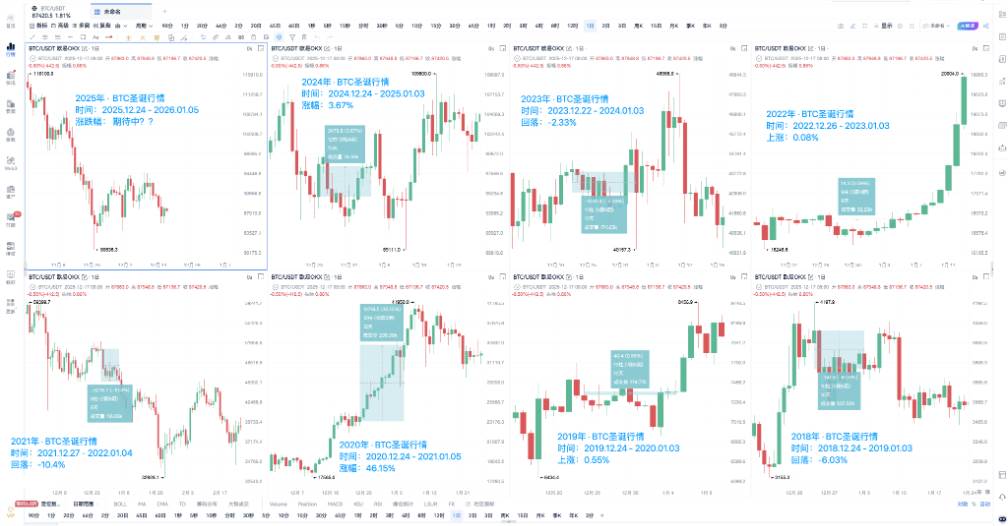
Looking back at the history of Bitcoin’s Christmas market behavior, data reveals the true nature of this seasonal phenomenon. Over the past seven years, Bitcoin’s performance during Christmas has been highly variable, with both increases and decreases being roughly equal, with an increase rate of about 57%. Performance of BTC during the last seven complete Christmas-New Year cycles (roughly from December 24th to January 3-5th of the following year):
● 2024 (December 24th → January 3rd, 2025): +3.67% (slight increase)
● 2023 (December 22nd → January 3rd, 2024): -2.33% (slight decrease)
● 2022 (December 26th → January 3rd, 2023): +0.08% (nearly unchanged)
● 2021 (December 27th → January 4th, 2022): -10.4% (significant decline)
● 2020 (December 24th → January 5th, 2021): +46.15% (massive increase)
● 2019 (December 24th → January 3rd, 2020): +0.55% (slight increase)
● 2018 (December 24th → January 3rd, 2019): -6.03% (slight decrease)
II. Different Perspectives: Optimism, Caution, and Revolutionary Interpretations
Currently, there are three clear camps in the market’s predictions regarding the “Christmas market”. Their debates go far beyond short-term price fluctuations, touching upon the fundamental understanding of the market itself.
1. Cautious Viewers: Concerns about macro-level trends and uncertainties
This is the opinion that currently holds a significant advantage in the market. The probability of a strong Christmas season for prices, as estimated by mainstream analysts, has been significantly reduced from over 70% a month ago to 30%-40%. The main reason for this is as follows:
● Doubts about macro-economic conditions: Although the Federal Reserve began reducing interest rates in December, its “pessimistic” guidance fell short of market expectations. This has shaken investor confidence in continued rate cuts, and expectations of further easing liquidity have been reduced. This weakens the core driving force behind the rise in risk assets.
● Lack of consensus on technical aspects: After its rebound, Bitcoin’s price failed to stabilize at the critical resistance level of $95,000-$97,000. In the eyes of cautious investors, this indicates that there is no unified upward momentum in the market; the rebound may simply be a technical correction.
2. Seasonally optimistic view: Historical patterns and structural improvements
This group does not blindly optimistic about the future, but rather bases their views on observations of specific market structures.
● Support from historical probabilities: Data shows that the period from Thanksgiving to Christmas is historically a time when Bitcoin tends to perform well. Some traders believe that with the overall market leverage rate having decreased significantly and potential selling pressure reduced, seasonal buying opportunities may arise.
● Link between U.S. stocks and the crypto market: There is still a correlation between the crypto market and traditional risk assets. If U.S. stocks strengthen due to factors like the “showcase effect” at the end of the year, it could provide external support for the crypto market.
3. Macro-disruptive perspectives: A perspective on liquidity that goes beyond cycles
Some KOLs, such as Arthur Hayes, former CEO of BitMEX, propose radical views that go beyond traditional analytical frameworks.
Hayes believes that relying on cyclical patterns or seasonal trends is outdated. The liquidity movements of central banks around the world—especially those in the US and Japan—are the true determinants of Bitcoin’s price. He argues that, driven by specific policy combinations worldwide, Bitcoin has the potential to reach prices between $200,000 and $250,000 by the end of the year.
While these views aren’t widely accepted, their emphasis on global liquidity becomes an important dimension in analyzing the market.
III. Institutionalization changes the rules of the game
● What sets the Christmas market in 2025 apart from previous years is the change in the main players on the market. Since the approval of Bitcoin spot ETFs, institutional funds have continuously flowed into the market through these channels, fundamentally changing the structure of participants in the market.
● In environments with low liquidity, retail traders may trigger initial price movements, but the scale and sustainability of these movements ultimately depend on the actions of institutional funds. This change makes market behavior more predictable.
● The involvement of institutions not only changes the capital structure but also affects the patterns of market fluctuations. The decrease in trading volume during holidays might result in market movements that are completely different from those seen in traditional retail markets, given the continuous accumulation of funds by ETFs.
IV. How do these three key variables come into play?
The final outcome of the Christmas market this year will depend on the evolution of several key factors.
1. The “second shoe” in terms of macro policies
● After the interest rate cuts were implemented in December, market focus quickly shifted towards whether this was a passive response to recession concerns, or a starting point for another round of monetary easing?
● Any strong data indicating an “soft landing” or no landing at all could change how markets price the Fed’s policies next year, thereby instantly altering the trends of risky assets. Macroeconomic developments remain the sword of Damocles hanging over the market.
2. The “thermometer” of ETF inflows
● This is the most direct way to gauge institutional movements. During Christmas, whether ETFs experience continuous net inflows or net outflows will be crucial in determining whether institutions choose to “hold cash during the holiday season” or “sell their positions” in order to make profits. Continuous inflows would provide strong support for prices, potentially even countering retail traders’ selling pressure; otherwise, it could signal the end of the market rally.
3. The “health” of market structure
● Leverage clearing risks: After previous corrections, the leverage ratio across the market has decreased. However, it is important to be aware that sudden price fluctuations in low liquidity environments could lead to cascading clearings, resulting in situations where “longs are killed by shorts” or “shorts are killed by longs”.
● Behavior of large investors: In blockchain data, it is important to observe whether addresses holding large amounts of Bitcoin choose to transfer them to exchanges (potential sell signals), or continue to withdraw coins from exchanges (accumulation signals). These will serve as important leading indicators.
V. The new analytical framework that investors need
● In a market where institutions play a significant role and macroeconomic uncertainties are high, investors must update their strategic tools. They should shift from guessing prices to observing signals, and consider ETF fund flows as a “heartbeat monitor” of institutional sentiment.
● Secondly, investors should be prepared for volatility, rather than simply betting on directions. During periods of low liquidity, high volatility is the norm. It’s more important to maintain flexibility through options strategies or position management, rather than predicting directions accurately.
● The global liquidity narrative proposed by KOLs like Arthur Hayes is also worth considering. Although their views may seem radical, they remind investors not to stick to a single analytical framework. In today’s environment, observing the market from multiple perspectives is more reliable than relying on a single indicator.
The “Christmas market” at the end of 2025 has evolved from past seasonal predictions, which were somewhat romantic, into a cold, complex, and highly institutionalized battle between bulls and bears. It is no longer just a simple game of historical probabilities; it represents a critical moment where global macro liquidity, emerging institutional capital allocation behaviors, and traditional market seasonal effects intersect.
For investors, the real “gift” might not be a guaranteed increase in value. Instead, it’s the opportunity to learn to understand this increasingly complex and mature financial ecosystem from a more professional and comprehensive perspective, as the market evolves over time. Whether or not “Santa Claus” visits the crypto world this year, this ongoing struggle has already taught all participants a valuable lesson: In this new era, the days of investing based solely on beliefs and calendar dates are over.