Exchange Ranking
 Top Exchanges
 24h Volume Ranking
 Popularity Ranking
 Exchange BTC Balance
 Proof of Reserves
 Decentralized Exchanges
 Funding Rate
 Funding Heatmap
 Liquidation Data
 Max Pain
 Long/Short Ratio
 Whale L/S Ratio
 Binance/Okex/Huobi L/S
 Bitfinex Margin L/S
 ETF Tracker
 Solana ETF
 XRP ETF
 Hong Kong ETF
 Bitcoin Treasuries
 Crypto Reversal
 Ethereum Reserves
 HyperLiquid Wallet Analysis
 Hyperliquid Whale Watch
 Large Transactions
 On-chain Movement
 Bitcoin ROI
 Stablecoin Market Cap
 Options Analysis
 News
 Articles
 Economic Calendar
 Features
 Wallet
 Contract Calculator


 Security
 Collections
 Watchlist
 Following
Since January 2024, the performance of cryptocurrencies compared to stocks has shown that so-called “altcoin trading” is essentially a substitute for stock trading.
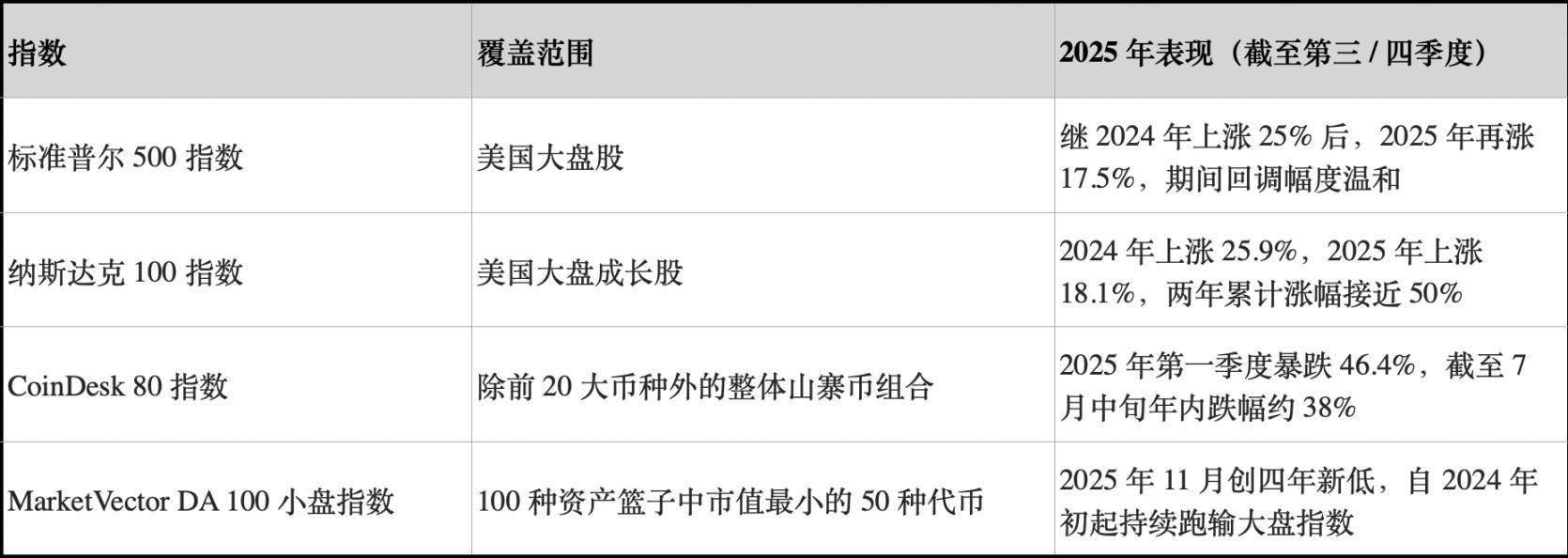
In 2024, the S&P 500 index achieved a return of approximately 25%. By 2025, this figure had risen to 17.5%, representing a cumulative increase of about 47% over two years. Meanwhile, the NASDAQ 100 index experienced increases of 25.9% and 18.1%, respectively, resulting in a cumulative increase of nearly 49%.

The CoinDesk 80 index, which tracks 80 assets other than the top 20 in terms of market value, witnessed a decline of 46.4% in just the first quarter of 2025. As of mid-July, the annual decline was approximately 38%.
By the end of 2025, the MarketVector Digital Assets 100 small-cap index fell to its lowest level since November 2020, resulting in a loss of over $1 trillion in the total market value of cryptocurrencies.
This divergent trend is certainly not due to statistical errors. The overall altcoin portfolio not only achieved negative returns but also exhibited volatility comparable to, or even higher than, that of stocks. In contrast, the U.S. stock market index managed to achieve double-digit growth while maintaining manageable drawdowns.
For Bitcoin investors, the key question is: Can allocating to small-cap tokens truly generate risk-adjusted returns? Or rather, does such allocation simply involve maintaining a similar correlation with stocks, while also incurring negative Sharpe ratios? (Note: The Sharpe ratio is a core measure of risk-adjusted returns on an investment portfolio. It is calculated as: Annualized return of the portfolio – Annualized risk-free rate / Annualized volatility of the portfolio.)
Choose a reliable altcoin index.
In order to conduct analysis, CryptoSlate tracked three altcoin indices.
The first is the CoinDesk 80 index, which was launched in January 2025. This index covers 80 assets beyond those included in the CoinDesk 20 index, providing a diversified investment portfolio that includes not only Bitcoin, Ethereum, and other leading tokens.
The second is the MarketVector Digital Assets 100 microindex. This index selects 50 of the smallest市值 tokens from a total of 100 assets, making it an important indicator of “junk assets” in the market.
The third index is developed by Kaiko. It’s a research-oriented index, not a tradable benchmark, and provides a clear quantitative perspective for analyzing small-cap assets.
These three indices provide different perspectives on the market: overall altcoin portfolios, high-beta small-cap tokens, and quantitative research insights. However, their conclusions are quite consistent.
In contrast, stock market benchmarks show a completely different trend.
In 2024, the U.S. broad index experienced a growth rate of around 25%. In 2025, the growth rate also reached double digits, with relatively limited drawdowns during this period. During this time, the S&P 500 index had its largest drawdown in the year, but it remained on a strong upward trend. The NASDAQ 100 index continued to rise steadily.
Both stock market indices achieved compound annual growth, with no significant losses in returns.
However, the performance of the overall altcoin index was quite different. Reports from the CoinDesk index company showed that the CoinDesk 80 index plummeted by 46.4% in just the first quarter, while the CoinDesk 20 index, which tracks the broader market, fell by 23.2% during the same period.
截至2025年7月中旬,CoinDesk 80指数年内跌幅达38%,而追踪比特币、以太坊及另外三种主流币种的CoinDesk 5指数同期涨幅却达到12%至13%。
CoinDesk指数公司的Andrew Baehr在接受ETF.com采访时,将这种现象描述为「相关性完全相同,盈亏表现天差地别」。
CoinDesk 5指数与CoinDesk 80指数的相关性高达0.9,意味着二者走势方向完全一致,但前者实现了两位数的小幅增长,后者却暴跌近40%。
事实证明,持有小盘山寨币带来的多元化收益微乎其微,而付出的业绩代价却极为惨重。
小盘资产板块的表现则更为糟糕。据彭博社报道,截至2025年11月,MarketVector Digital Assets 100小盘指数已跌至2020年11月以来的最低水平。
过去五年间,该小盘指数回报率约为-8%,而对应的大盘指数涨幅却高达380%左右。机构资金明显青睐大盘资产,对尾部风险则避之不及。
从2024年山寨币的表现来看,Kaiko小盘指数全年跌幅超30%,中盘代币也难以跟上比特币的涨幅。
市场赢家高度集中在少数头部币种,如SOL和瑞波币。尽管2024年山寨币交易总量占比一度回升至2021年的高点,但64%的交易规模都集中在前十大山寨币身上。
加密货币市场的流动性并未消失,而是向高价值资产转移。
夏普比率与回撤幅度
如果从风险调整后收益的角度对比,差距则进一步拉大。CoinDesk 80指数及各类小盘山寨币指数不仅回报率深陷负值区间,波动性也与股票相当甚至更高。
CoinDesk 80指数单季度就暴跌46.4%;MarketVector小盘指数在经历又一轮下跌后,于11月跌至疫情时期的低位。
整体山寨币指数多次出现指数级别的腰斩式回撤:2024年Kaiko小盘指数跌幅超30%、2025年第一季度CoinDesk 80指数暴跌46%、2025年末小盘指数再度跌至2020年低位。
相比之下,标准普尔500指数和纳斯达克100指数在两年间实现了25%与17%的累计回报,最大回撤幅度仅为中高个位数。美股市场虽有波动,但整体可控;而加密货币指数的波动则极具破坏性。
即便将山寨币的高波动性视为结构性特征,其2024至2025年的单位风险回报率,仍远低于持有美股大盘指数的水平。
2024至2025年间,整体山寨币指数夏普比率为负;而标准普尔和纳斯达克指数在未调整波动性的情况下,夏普比率就已表现强劲。经波动性调整后,二者的差距进一步扩大。
比特币投资者与加密货币流动性
The first conclusion drawn from the above data is the trend towards centralized liquidity and a shift towards high-value assets. Reports by Bloomberg and Whalebook on the MarketVector micro-cap index indicate that since the beginning of 2024, micro-cap cryptocurrencies have continued to lag behind, with institutional funds shifting towards investing in Bitcoin and Ethereum ETFs.
According to Kaiko’s observations, although the total volume of micro-cap cryptocurrencies has recovered to levels seen in 2021, funds are still concentrated among the top ten most valuable cryptocurrencies. The market trend is clear: liquidity has not completely withdrawn from the crypto market, but rather shifted towards high-value assets.
The once-booming micro-cap market was essentially a strategy based on price differentials, rather than a structural advantage of certain assets. In December 2024, the CryptoRank micro-cap index reached a high of 88 points, but by April 2025, it plummeted to 16 points, resulting in a complete loss of gains.
The micro-cap bull market of 2024 ultimately turned into a typical bubble burst. By mid-2025, the overall micro-cap index almost lost all its gains, while Standard & Poor’s and NASDAQ indices continued to grow steadily.
For financial advisors and asset managers who consider diversification beyond Bitcoin and Ethereum, CoinDesk’s data provides a clear example to follow.
As of mid-July 2025, the CoinDesk 5 index, which tracks the broader market, experienced a modest two-digit increase over the year. In contrast, the diversified micro-cap index, CoinDesk 80, plummeted by nearly 40%. However, the correlation between the two indices was still as high as 0.9.
Investors who allocated funds into small-cap altcoins did not achieve substantial diversification benefits. Instead, they faced higher returns losses and risk of capital withdrawal compared to Bitcoin, Ethereum, and U.S. stocks. At the same time, they remained exposed to the same macro-level factors that influence markets.
Currently, most investors view altcoins as tactical trading targets rather than strategic investment assets. From 2024 to 2025, Bitcoin and Ethereum’s risk-adjusted returns were significantly better, and U.S. stocks also performed well.
The liquidity in the altcoin market is increasingly concentrated among a few “institutional-level coins,” such as SOL, Ripple, and other tokens with strong positive factors or clear regulatory prospects. The diversity of assets at the index level is being squeezed by the market.
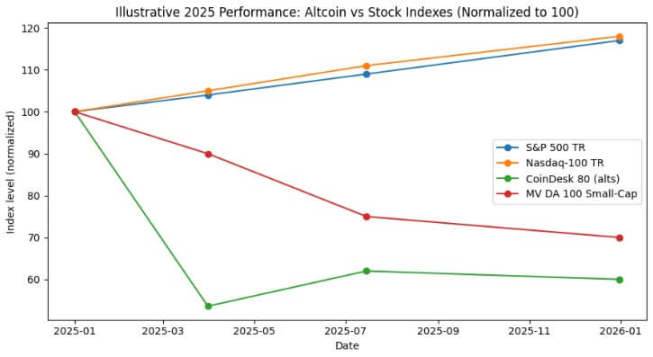
In 2025, the S&P 500 index and NASDAQ 100 index increased by approximately 17%, while the CoinDesk 80 cryptocurrency index fell by 40%, and smaller-cap cryptocurrencies decreased by 30%
What does this mean for liquidity in the next market cycle?
The performance of the markets from 2024 to 2025 has tested whether altcoins can achieve diversification or outperform the broader market. During this period, U.S. stocks achieved double-digit growth for two consecutive years, with manageable risk levels.
Bitcoin and Ethereum gained institutional recognition through spot ETFs, and benefited from a more relaxed regulatory environment.
反观整体山寨币指数,不仅回报率为负、回撤幅度更大,还与加密大盘代币及股票保持高相关性,却未能为投资者承担的额外风险提供相应补偿。
机构资金向来追逐业绩表现。MarketVector小盘指数五年回报率为-8%,而对应大盘指数涨幅达380%,这一差距反映出资本正不断向监管明确、衍生品市场流动性充足且具备完善托管基础设施的资产迁移。
CoinDesk 80指数第一季度暴跌46%,并在7月中旬录得38%的年内跌幅,这一走势表明,资本向高价值资产迁移的趋势非但没有逆转,反而在加速。
对于正在评估是否要配置小盘加密代币的比特币和以太坊投资者而言,2024至2025年的数据给出了明确答案:整体山寨币组合的绝对收益跑输美股,风险调整后收益不及比特币和以太坊;尽管与加密大盘代币的相关性高达0.9,却未能提供任何多元化价值。