Exchange Ranking
 Top Exchanges
 24h Volume Ranking
 Popularity Ranking
 Exchange BTC Balance
 Proof of Reserves
 Decentralized Exchanges
 Funding Rate
 Funding Heatmap
 Liquidation Data
 Max Pain
 Long/Short Ratio
 Whale L/S Ratio
 Binance/Okex/Huobi L/S
 Bitfinex Margin L/S
 ETF Tracker
 Solana ETF
 XRP ETF
 Hong Kong ETF
 Bitcoin Treasuries
 Crypto Reversal
 Ethereum Reserves
 HyperLiquid Wallet Analysis
 Hyperliquid Whale Watch
 Large Transactions
 On-chain Movement
 Bitcoin ROI
 Stablecoin Market Cap
 Options Analysis
 News
 Articles
 Economic Calendar
 Features
 Wallet
 Contract Calculator


 Security
 Collections
 Watchlist
 Following
Driven by expectations of regulatory放松以及本土资金的回流,韩国加密市场开始显示出“重新启动”的迹象。最新研究表明,韩元的流通量有所增加,散户投资者的参与度也有所提升。此外,稳定币的应用场景不断扩大,机构投资者进入市场的讨论也日益增多,市场结构正在悄然发生变化。经过长时间的低迷之后,韩国这个传统的“情绪风向标”再次被激活,被视为下一轮加密资产增长周期的重要前兆。
1. Introduction: The market paradigm is shifting towards a different direction.
Key indicators:
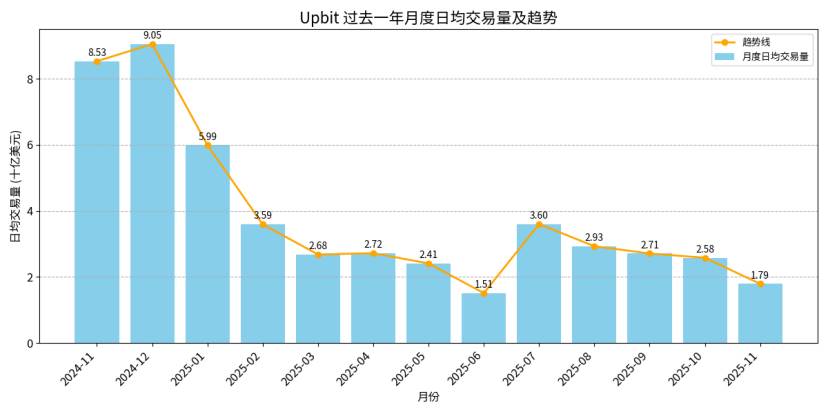
● The Korean digital assets market is undergoing one of the most significant structural transformations in its history. Upbit’s daily trading volume dropped from $9 billion in December 2024 to $1.78 billion in November 2025, a decrease of approximately 80%. This happened against the background of an overall 141% increase in the number of new coins listed on Korean exchanges in 2025. At the same time, retail investors shifted their funds into the soaring stock market. Led by Samsung Electronics and SK Hynix, the AI chip sector saw the KOSPI index rise by about 70%.
● What was once considered a hallmark of the Korean market, the “Kimchi Premium”, has now reduced to around 1.75%. This isn’t a sign of a mass exodus of funds, but rather a normalizing process where speculative bubbles are being squeezed out of the market.
● Kimchi Premium refers to the higher price difference between crypto assets like Bitcoin on local exchanges in Korea (such as Upbit and Bithumb) compared to global exchanges like Binance and Coinbase.
● 核心问题是:韩国的加密时代已经结束,还是在下一轮结构性浪潮前进行一次系统重置?
2、冻结背后:拆解韩国加密市场的放缓
这并不是一轮短期回调,而是一场由监管、资本管制和投资者疲劳共同推动的结构性再调整。
2.1 监管迟滞与不确定性
作为韩国数字资产未来核心支柱的稳定币法案,因围绕“发行主体应由银行还是非银行机构承担”的争议,已经搁置了7个月。目前共有6份不同提案在审议中,金融服务委员会(FSC)计划在2025年底前将其整合为一部统一法案。
这种监管真空放缓了机构端的创新步伐,也让正在探索代币化、结算层创新的Web2企业变得更加审慎,整体环境明显趋向规避风险。
2.2 资本外流与流动性陷阱
韩国严格的外汇管制阻挡了海外做市商和机构注入流动性,导致市场长期呈现单向资本外流。
《外汇交易法》(Foreign Exchange Transactions Act,FETA):非居民不能自由持有或灵活运用韩元,绝大多数大额外汇与资本流动都需要强制申报或事前审批,大幅限制了海外机构在韩国市场顺畅运作的能力。
The Financial Supervisory Service’s "Guidelines for Foreign Exchange Transactions" stipulate that local banks are subject to strict daily position limits, and they are generally prohibited from providing exchange rate liquidity to non-resident institutions. This makes it difficult for overseas market makers to establish positions in the Korean won, thereby preventing them from offering truly bilateral liquidity services.
Although some predictions suggest that revenue from the Korean digital asset market could reach $635 million by 2030, the issue of liquidity shortages remains significant in the short term.
Interestingly, the Korean market relies heavily on leveraged trading. If there are any catalysts, such as regulatory clarity or a significant increase in the price of Bitcoin globally, the market could experience a rapid rebound.
2.3 Constructive corrections, rather than a real crash
Instead of viewing market cooling as a sign of decline, it can be seen as a return to normalcy. Korea’s economic cycle is aligning with global trends: from speculative-driven growth, towards a phase where more emphasis is placed on practical value. Market participants are shifting their focus from short-term trading to infrastructure, custody, compliance, and real-world applications. This process may be painful, but it is necessary for sustained expansion in the future.
3. Crypto giants are flocking to Seoul
Even though the participation of local retail investors has decreased significantly, global crypto companies continue to actively invest in the Korean market. This counter-cyclical expansion indicates that external players still have high hopes for Korea’s technological capabilities and the long-term potential of its institutional market.
3.1 Key developments
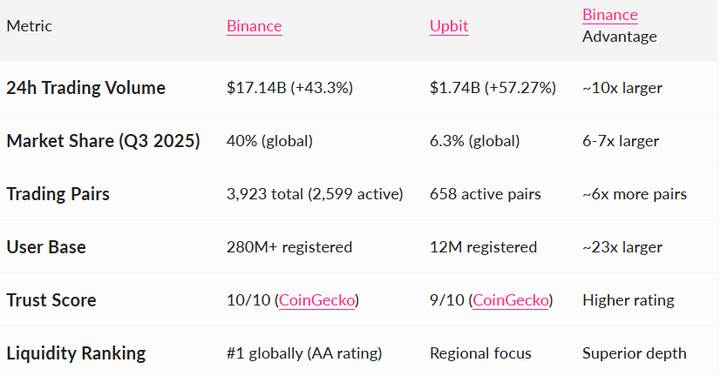
In October 2025, Binance entered the Korean market once again through the acquisition of Gopax, ending its four-year absence from the region. This move was partly due to the relaxation of restrictions on foreign investment in Korea, and it also signals that Korea is willing to further open up its markets to global crypto companies. This acquisition lays the foundation for more intense competition in the market, smoother liquidity channels, and a more sophisticated product offering. Local users will benefit from significantly improved products and services.
The core performance indicators matrix
Source: Surf AI, 2025
3.2 Why now?
This timing can be understood through three strategic factors:
● High awareness of cryptocurrencies and rapid adoption rate
Korea remains one of the fastest-growing markets globally when it comes to adopting new technologies, including AI and digital assets.
● Prospects for stablecoin integration
Local banks, fintech companies, and internet giants like Kakao and Naver are exploring pilot projects with stablecoins, which could help bridge the gap between the local financial system and the blockchain world.
● Growing demand from institutional investors
Korean institutional investors show increasing interest in custody services, asset tokenization, and compliant digital asset allocation. This creates conditions for sustained capital inflows in the long term.
4. Outlook
The current downturn is not the end, but rather a structural reset of the Korean market, shifting it from a purely speculative environment to one driven by value-based practices and better alignment with institutional needs. Stablecoin legislation, institutional custody infrastructure, and potential Bitcoin ETFs are likely to become key drivers of growth in the next phase. Korea is entering a new era, one characterized by real product value, user education, and compliant innovation.
4.1 Market Forecast
It is expected that the Korean crypto market will grow at a slow pace, with an annual compound growth rate of 2.94%. However, the real turning point may come in 2026, when a Bitcoin ETF is approved. This topic has been frequently discussed among Korean policymakers.
Once approved, the possible changes include:
● Korean pension and asset management institutions officially participate in the market.
● Large-scale entry of overseas market makers.
● Higher-quality price discovery and tighter price ranges.
This could also help Korea regain its status as a regional capital “net inflow hub”.
4.2 The Integration of Web2 and Web3 in Korea
Large Korean corporations are further integrating blockchain technology into practical applications.
Banks, fintech companies, and large tech firms are testing stablecoin initiatives and exploring payment and settlement solutions related to digital韓元.
Upbit and Bithumb have launched or expanded their institutional custody services, allowing local institutions and overseas capital to重返市场,while maintaining compliance standards.
This indicates that the market is shifting from a speculative-oriented approach to an application-based model centered around infrastructure and practical use cases.
4.3 Global Standards
South Korea’s regulatory framework is becoming more similar to that of Japan: strict yet relatively predictable. If South Korea can achieve similar clarity in regulating key issues such as stablecoins, asset tokenization, and digital asset ETFs, it has every chance of becoming one of Asia’s most balanced crypto centers, attracting institutional investors and global liquidity.
4.4 From a Web3 marketing perspective: Why South Korea places great emphasis on the actual usability of products
In the next phase of development in South Korea, one important but often overlooked structural driver is the increasing demand for products to be truly usable.
South Korea is one of the few markets where exchanges and users actively test, verify, and understand projects before accepting them into the market. This trend becomes even more evident as the market transitions towards a value-driven stage.
For example:
● Upbit’s quiz campaigns: Treating education as part of market infrastructure
● Upbit frequently conducts educational activities during the launch of new coins
Users are asked to answer questions related to:
● The technical architecture of the project
● The token economy model
● Use cases and real-world functionality
● Roadmap and risk assessment
这与其他地区常见的空投薅羊毛模式本质不同。它传递出的信号是:韩国交易所更重视验证、理解与用户教育,并要求项目方清晰、深入地讲明自己的价值。
Upbit X Surf的产品实际使用活动
2025年,Upbit与Surf合作举办了一次产品实操主题活动,鼓励用户直接使用项目产品、体验功能并产出有意义的使用结果。
这清楚地体现出一个转变:
● 韩国交易所越来越重视基于实际使用体验的验证,而不是停留在表层的曝光营销。
● 在韩国,产品能用且好用本身就是最强的营销。
● 只有叙事没有执行,无法在这里长期生存。
4.5 投资者操作手册
要在这一重置阶段中有效布局,投资者需要:
● 持续关注关键催化事件,例如:FSC法案整合进展、比特币ETF相关讨论以及即将落地的稳定币立法。
● 优先配置具有长期使用价值的项目,而非纯粹依赖情绪与炒作的代币。
● 重点关注第四季度的宏观指标,因为历史上韩国散户往往会在风险偏好回暖周期中大规模重新入场。
● 通过分散配置,降低对完全取决于政治与监管时间点的主题型叙事的单一持仓。
此外,投资者应重点关注那些在韩国提前布局、建立本地落地能力的国际生态。一个正在塑造韩国下一轮周期的关键趋势,是全球公链生态正快速与韩国大型企业建立合作关系。这预示着韩国正在从一个以交易消费为主的市场,向“共同开发与基础设施深度整合”的枢纽角色转型。
案例1:Sui x t’order
本地合作方:t’order(韩国占据主导地位的桌边点单与POS网络)
集成方式:支持与韩元挂钩的稳定币支付,配合二维码与人脸支付,商户侧零手续费,实时结算
案例2:Solana x新韩证券(Shinhan Securities)
本地合作方:新韩证券(韩国顶级券商之一)
合作方式:签署战略谅解备忘录(MOU),共同支持Web3创业者、开发者与Solana生态在韩国的发展,由Superteam Korea牵头推进
案例3:Arbitrum x乐天集团(Lotte Group)
本地合作方:乐天集团(韩国最大的企业集团之一)
集成方式:Arbitrum向Caliverse(乐天的元宇宙平台)提供重要开发者资助,用于集成Arbitrum区块链
5、韩国的加密寒冬是一场重置,而不是撤退——也是建设者的战略入场窗口
Although the market is currently contracting, South Korea remains one of the most dynamic crypto markets in the world. Stablecoins are helping large enterprises in the Web2 sector to explore on-chain settlement and infrastructure tokenization. Leading exchanges continue to expand their services related to custody and institutional offerings. The possibility of Bitcoin ETFs being approved has significantly increased the likelihood of foreign liquidity flowing back into South Korea.
South Korea’s crypto ecosystem isn’t dying; instead, it is accelerating its maturation process.
This reset means that South Korea is transitioning from a speculative-driven playground for retail investors to an economic system for digital assets, one that is structured well, supported by institutional structures, and centered around institutional participation.