Exchange Ranking
 Top Exchanges
 24h Volume Ranking
 Popularity Ranking
 Exchange BTC Balance
 Proof of Reserves
 Decentralized Exchanges
 Funding Rate
 Funding Heatmap
 Liquidation Data
 Max Pain
 Long/Short Ratio
 Whale L/S Ratio
 Binance/Okex/Huobi L/S
 Bitfinex Margin L/S
 ETF Tracker
 Solana ETF
 XRP ETF
 Hong Kong ETF
 Bitcoin Treasuries
 Crypto Reversal
 Ethereum Reserves
 HyperLiquid Wallet Analysis
 Hyperliquid Whale Watch
 Large Transactions
 On-chain Movement
 Bitcoin ROI
 Stablecoin Market Cap
 Options Analysis
 News
 Articles
 Economic Calendar
 Features
 Wallet
 Contract Calculator


 Security
 Collections
 Watchlist
 Following
 ETH
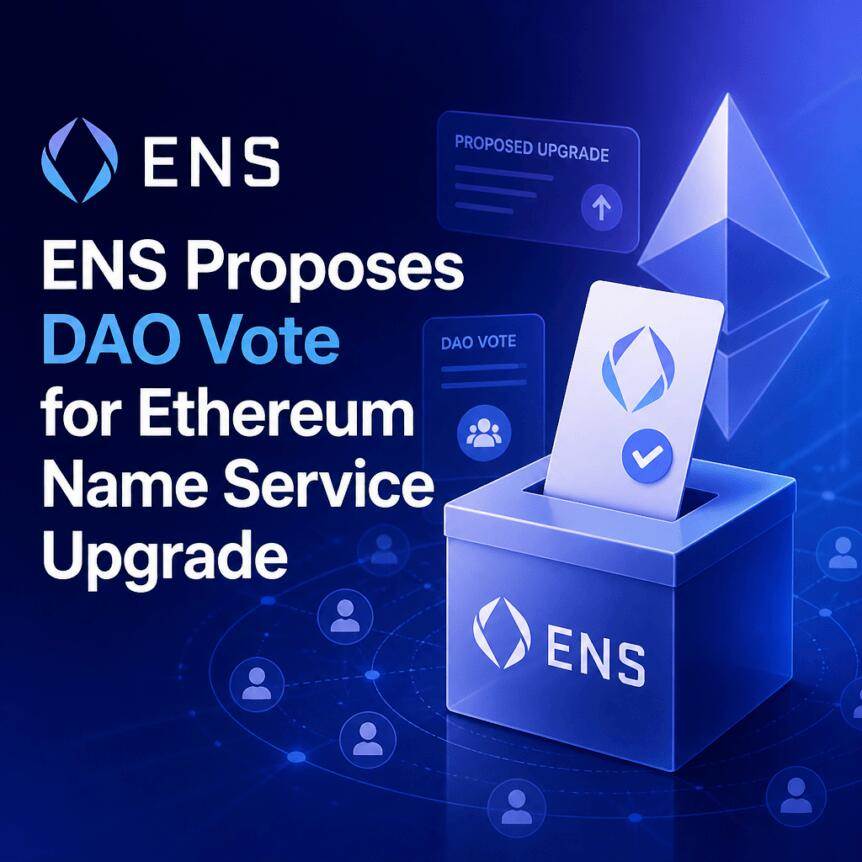
Nick Johnson, the founder of Ethereum Domain Name Service (ENS), has submitted a proposal for protocol upgrades to the ENS DAO. The proposal aims to improve the naming infrastructure on the Ethereum mainnet. If approved, ENSv2 will be activated—a upgraded version of the system, designed to enhance domain management and permission-based access mechanisms.
The proposal also includes a phased transition plan: new domain registrations will be temporarily suspended through the original ENS registrars, while existing .eth domain holders can continue to renew and use their domains without having to migrate. A short period of synchronization during the upgrade may cause temporary disruptions to new domain registrations.
Key points:
- Once ENSv2 is activated, new .eth domain registrations will no longer be accepted through the original registrars, but the renewal functionality for existing domains will remain unchanged.
- The proposal requires DAO approval to become official. Participation rates and approval thresholds must comply with ENS’s governance rules.
- The redesigned registry architecture is central to this upgrade, offering more flexible domain management and permission control.
- Once the records are synchronized, new .eth registrations will be directed to the upgraded system. However, Johnson warned that there may be several hours of downtime during the transition period.
- ENS Labs plans to transfer all remaining management rights to the DAO after the activation.
How will ENSv2 change the Ethereum mainnet?
ENSv2 is positioned as the next stage of evolution in the ENS core protocol. In the draft proposal submitted by Nick Johnson, this update is described as introducing a redesigned registry architecture, aimed at providing more flexible domain management and permission control compared to the current setup.
This difference is crucial for ENS users and developers, as the registry layer is key to determining what domain owners can do and who can manage their domains. By redesigning this architecture, ENSv2 aims to make the system more adaptable in the future. However, the proposal does not recommend that existing domains must be migrated immediately to continue functioning.
The registration and renewal mechanisms during the transition period are also covered in the proposal.
The core aspect of the proposal lies in its approach to continuity. If ENSv2 is activated, new .eth domain registrations will no longer use the original ENS registrars. At the same time, existing domain holders will not be forced to migrate: the proposal states that their domains will continue to operate normally, and the renewal feature will remain available.
Johnson’s draft also addresses how to restore newly registered domains after upgrading to the new version. It is stated that once the synchronization of domain records between systems is completed, new .eth registrations will be transferred to ENSv2. Meanwhile, Johnson warns that during the transition period, registration functions on both versions will be temporarily unavailable for several hours.
Additionally, it is reported that ENS Labs has reserved corresponding .eth domains for existing owners on the new system. This measure allows users to migrate when they are ready, rather than being forced to do so immediately, thereby avoiding operational risks or uncertainties.
The governance requirements for implementing this proposal are as follows:
This draft still does not represent an active upgrade. According to the ENS DAO documentation, the implementation of proposals must meet certain thresholds before it can be carried out.
Specifically, this process requires at least 1% participation from voters—that is, 1 million ENS votes—and majority approval within a seven-day voting period. If the proposal meets these conditions, it will also be subject to a two-day time lock limit before it can be implemented on the chain.
The voting date has not been announced yet. The timeline depends on when the ENS community schedules the vote and whether the participation requirements are met.
DAO control and its decentralized nature
In addition to technical upgrades, this proposal also includes governance and control mechanisms. The proposal states that after activation, ENS Labs plans to transfer any remaining administrative control over the upgrade contract to the DAO.
This move is significant for investors and ecosystem participants, as administrative power—who can modify or manage key contracts in the protocol—directly affects the degree of decentralization and long-term risks. By committing to transferring the remaining control after activation, the proposal aims to ensure that the lifecycle of ENSv2 is ultimately governed by community processes on the chain, rather than由公司主导的管理方式。
Nevertheless, readers should pay attention to the precise definition of “remaining administrative control” in the final implementation details, as well as how the proposal will be transitioned to online implementation once it enters the voting phase.
Next focus points
随着ENSv2走向DAO投票,关键的不确定性在于实际操作层面:同步将如何执行、数小时注册停机时间的确切时机,以及选民参与度是否能达到1%的门槛。目前,该提案为现有持有者提供了清晰的连续性计划,并为激活升级注册表定义了明确的治理路径——这两点很可能在投票安排确定后塑造用户信心。