Exchange Ranking
 Top Exchanges
 24h Volume Ranking
 Popularity Ranking
 Exchange BTC Balance
 Proof of Reserves
 Decentralized Exchanges
 Funding Rate
 Funding Heatmap
 Liquidation Data
 Max Pain
 Long/Short Ratio
 Whale L/S Ratio
 Binance/Okex/Huobi L/S
 Bitfinex Margin L/S
 ETF Tracker
 Solana ETF
 XRP ETF
 Hong Kong ETF
 Bitcoin Treasuries
 Crypto Reversal
 Ethereum Reserves
 HyperLiquid Wallet Analysis
 Hyperliquid Whale Watch
 Large Transactions
 On-chain Movement
 Bitcoin ROI
 Stablecoin Market Cap
 Options Analysis
 News
 Articles
 Economic Calendar
 Features
 Wallet
 Contract Calculator


 Security
 Collections
 Watchlist
 Following
 ZEC
The US crypto policies, which have always been known for strict regulations, are now undergoing a subtle shift in approach. In mid-December, the SEC’s crypto working group held a closed-door meeting on “financial monitoring and privacy.” Combined with the compliance guidelines and pilot programs introduced in the second half of this year, it becomes clear that regulatory priorities have shifted from focusing on penalties to emphasizing the need for both discussion and implementation. This change not only reduces institutions’ concerns about compliance risks but also affects capital flows and project locations. The United States is redefining its role as a global hub for crypto innovation.
I. The core issue of the roundtable discussion: walking a fine line between monitoring and privacy.
This roundtable meeting focused on a key dilemma: how to harness the transparency offered by blockchain technology while ensuring individuals’ legal financial privacy.
● Paul Atkins, chairman of the SEC, issued a clear warning in his opening speech. He pointed out that blockchain is essentially an unprecedentedly transparent ledger. If regulators treat every wallet as a brokerage firm and every piece of code as an exchange, then the government could turn the entire crypto ecosystem into a “financial prison.” These remarks recognize the threat of excessive monitoring to individual freedom, which is a rare acknowledgment in recent years.
● Atkins also advocates for technologies that enhance privacy protection, such as zero-knowledge proofs. He believes that these technologies provide a balanced solution: for example, they allow regulated platforms to prove that their users have been screened, without the need to provide a complete record of every payment made to the government. This provides a theoretical framework for “regulable privacy” – privacy isn’t confined to legal boundaries, but protecting legitimate privacy should be the norm, not an exception.
Second, there is a shift in regulatory paradigms: from a focus on enforcement to encouragement of innovation.
This roundtable meeting isn’t an isolated event; it represents a broader transformation in the SEC’s overall regulatory approach. By 2025, with the change of U.S. administration, the SEC’s regulatory approach will shift from the “regulation as enforcement” approach under Gary Gensler to a more flexible approach, spearheaded by President Paul Atkins, who emphasizes “targeted regulation” and “encouragement of innovation”.
One of the most significant policies is the “Innovation Exemption” policy, which is expected to take effect in January 2026. This policy aims to provide crypto projects with a temporary safe haven, allowing them to operate under simplified disclosure requirements, without having to go through the costly and time-consuming registration processes required for traditional securities offerings.
● Lowering barriers: Eligible projects can operate under a 12-24 month exemption period, with simplified disclosure requirements. They don’t need to go through the expensive and time-consuming registration procedures necessary for traditional securities offerings.
● Clarifying pathways: 豁免政策与SEC正在构建的“代币分类法”协同。根据该框架,数字资产被分为商品型、功能型、收藏型和证券型。当前三类资产网络达到“充分去中心化”时,便可脱离证券监管框架。这为项目提供了清晰的合规发展路径。
● 设置围栏:豁免并非无拘无束,项目需满足基本的投资者保护措施,如定期报告、风险提示,并执行KYC(了解你的客户)和AML(反洗钱)程序。
三、立体战略:行政、立法与机构协同
SEC的转型并非单打独斗,而是嵌入一个更为宏大的、行政与立法并行的美国加密监管新体系之中。
1、与国会立法协同:SEC的“创新豁免”与国会正在推进的《CLARITY法案》形成“临时豁免”与“永久标准”的配合。
● 该法案旨在厘清SEC与商品期货交易委员会(CFTC)的监管权责,并将为“成熟区块链”设定立法层面的去中心化标准。
● 同时,已于2025年7月生效的《GENIUS法案》已将支付稳定币排除在证券定义之外,为其设立了独立的银行式监管框架,使得SEC的创新豁免可以更专注于DeFi等新兴领域。
2、监管机构合作:The SEC and the CFTC have announced plans to strengthen their coordination, aiming to address issues related to unclear jurisdictional boundaries through joint statements and roundtable discussions. For example, both organizations have clarified that exchanges registered with either institution can facilitate the trading of certain spot-based cryptocurrency products, thereby encouraging market participants to make their own choices.
Fourth, investment trends: Under the framework of compliance regulations, new opportunities are emerging. The long-standing uncertainty in policies that has plagued the market is beginning to fade, allowing for the emergence of new investment opportunities.
1. Privacy technology sector: Moving from niche to mainstream
Discussions on privacy technologies during roundtable meetings resonate well with market developments.
● In November 2025, Grayscale, one of the world’s largest cryptocurrency asset management companies, submitted an application to the SEC to convert Zcash tokens into spot ETFs. If approved, this would make it the first ETF in the United States that is tied to privacy coins, marking an important milestone.
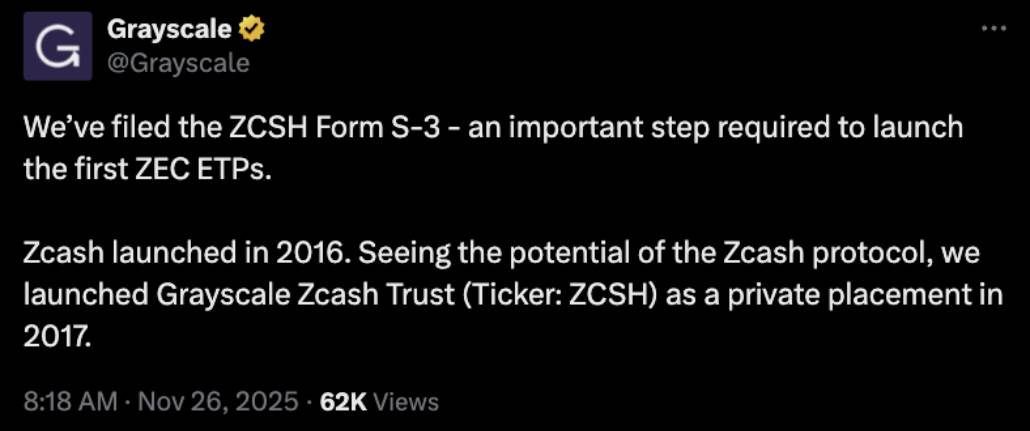
● This indicates that privacy technologies, which were once heavily regulated, are now being integrated into mainstream financial products. The value of these tokens is expected to be重新评估。The prices of tokens like Zcash have seen significant increases recently.
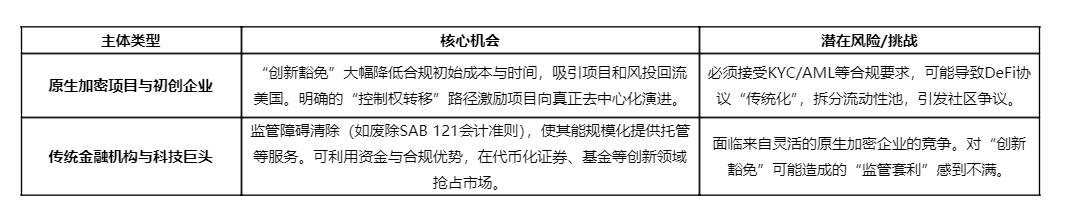
2. Compliance-driven innovation: Two types of entities stand to benefit from this new regulatory framework
Under the new regulatory framework, two types of entities will benefit from these opportunities:
3. Infrastructure and “compliance as a service”
Whether for traditional participants or those in the native ecosystem, compliance has become an essential requirement. This has created a huge market for infrastructure projects or companies that can provide the following services:
● Compliance tools: On-chain identity verification, transaction monitoring, and automated audit reporting solutions.
● Middleware: Tools that help projects meet regulatory requirements, such as gateways or data protocols.
● Professional services: Law firms and consulting agencies will see a significant increase in business related to “innovation exemptions” and compliance architecture design.
For example, Coinbase converted its KYC/Anti-Money Laundering technologies into “compliance as a service” products during its legal battles with the SEC, resulting in substantial revenue growth.
Fifth, a global competition: The rivalry between the American and European models
The shift in U.S. regulations also represents a global regulatory competition. The flexibility offered by the “innovation exemption” system contrasts sharply with the unified and pre-authorized model adopted by the EU’s Crypto Assets Market Act (MiCA).
● American model: It tolerates higher levels of uncertainty and risk in the initial stages, in exchange for faster innovation and greater flexibility. This model is highly attractive to startups and venture capital investors.
● European model: By adopting unified rules, this model provides stability and predictability, making it more popular among large traditional financial institutions that want to expand steadily.
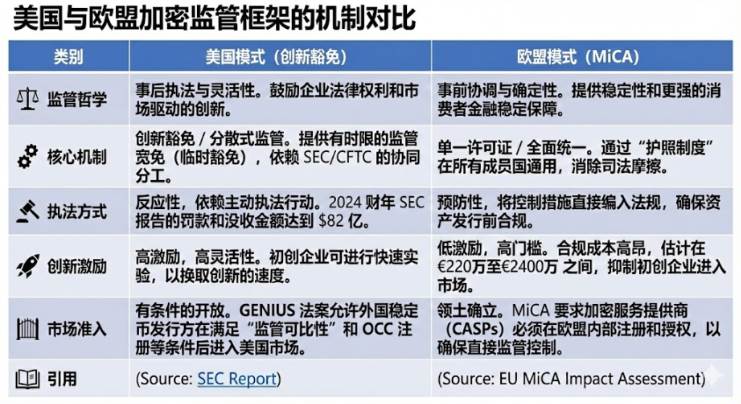
This strategic divergence means that global crypto companies may need to prepare two sets of compliance strategies. In the short term, the more relaxed and flexible US regulatory environment could attract talent and capital from around the world, thereby reshaping the geographical landscape of innovation. The EU and other regions such as the UK, Singapore, and Hong Kong may need to evaluate and adjust their policies to remain competitive.
Sixth, pragmatic outlooks and risk warnings
By 2026, with the implementation of “innovation exemptions” and the progress of the CLARITY Act, the US is expected to experience a wave of “compliance-driven innovation”. However, challenges still exist:
● The art of balance: How to achieve a lasting balance between privacy and surveillance, between decentralized ideals and necessary compliance requirements, and between encouraging innovation and protecting investors remains a significant challenge.
● Political stability: Regulatory trends are closely tied to administrative authorities, and the long-term stability of policies remains uncertain.
● Market volatility: Expectations regarding regulatory benefits have already been reflected in asset prices (such as privacy coins), but the introduction of specific rules may still cause fluctuations.
For market participants, a pragmatic strategy would involve thoroughly studying the details of regulations like “innovation exemptions,” assessing the compliance readiness of their projects; focusing on projects that have technical advantages and first-mover benefits in areas such as privacy technology and compliance infrastructure; and ensuring that compliance costs and requirements are integrated into the core business model, rather than being dealt with retrospectively.
SEC的圆桌会议和新政,标志着一个时代的拐点。加密行业正在从一个监管的“蛮荒西部”,走向一个规则逐渐清晰、但博弈依然激烈的新大陆。在这个新大陆上,创新与合规不再是选择题,而是一道必须兼顾的必答题。答案的正确与否,将决定下一个周期的赢家。