Exchange Ranking
 Top Exchanges
 24h Volume Ranking
 Popularity Ranking
 Exchange BTC Balance
 Proof of Reserves
 Decentralized Exchanges
 Funding Rate
 Funding Heatmap
 Liquidation Data
 Max Pain
 Long/Short Ratio
 Whale L/S Ratio
 Binance/Okex/Huobi L/S
 Bitfinex Margin L/S
 ETF Tracker
 Solana ETF
 XRP ETF
 Hong Kong ETF
 Bitcoin Treasuries
 Crypto Reversal
 Ethereum Reserves
 HyperLiquid Wallet Analysis
 Hyperliquid Whale Watch
 Large Transactions
 On-chain Movement
 Bitcoin ROI
 Stablecoin Market Cap
 Options Analysis
 News
 Articles
 Economic Calendar
 Features
 Wallet
 Contract Calculator


 Security
 Collections
 Watchlist
 Following
The Federal Reserve may not explicitly mention a “policy shift,” but macro analyst Lyn Alden pointed out that the recent series of minor adjustments by the central bank are signaling that liquidity is gradually returning to the financial system. Even though certain sectors of the U.S. economy remain weak, this return to liquidity means that the market may be seeing new sources of capital. Investors should keep an eye on potential asset revaluation and changes in risk preferences.

Common Questions
● What does Alden mean by “gradual printing”?
She refers to the Fed’s gradual expansion of its balance sheet to support financial systems, rather than introducing comprehensive stimulus plans.
● Why does Alden say the U.S. economy resembles an “emerging market with limited capacity”?
This is because, even though real economic activity is declining, headline data remains strong.
● What is Alden’s outlook for Bitcoin after the adjustments?
She believes that the decline is a form of deleveraging, and she believes that Bitcoin will continue to be viable in the coming years.
● Why do sovereign countries accumulate gold and, in some cases, Bitcoin?
They are diversifying their reserves into assets that cannot be frozen and serve as neutral value stores.
QT has ended. Liquidity is returning quietly, but the market is not yet ready. Alden says
In a extensive discussion with Jeremy Szafron, host of Kitco News, Lyn Alden analyzed the narrowing of economic conditions, the re-emergence of Bitcoin, the gold price reaching over $4,000, and the structural tensions that are driving policymakers towards a future where printing money is no longer an exception, but the norm.
Alden never pandered to institutional interests; she spoke frankly:
"My assessment is that the balance sheet is gradually expanding... They won’t call it a stimulus. Instead, they’ll say it’s due to financial infrastructure and technical issues."
Alden described the U.S. economy as seemingly strong from a 30,000-foot perspective, but for average families, it seemed increasingly hollow. She said that if we strip away the AI giants and the massive fiscal levers, most American companies are struggling with weak capital expenditures and diminished consumer power. She compared this situation to a developed economy adopting the characteristics of “emerging markets”—strong headline figures masking underlying weaknesses.
Alden believes that this fragmented structure creates political rather than economic pressures. Americans see new market highs, while their salaries remain tight. This disconnect begins to define emotions, rather than the data itself.
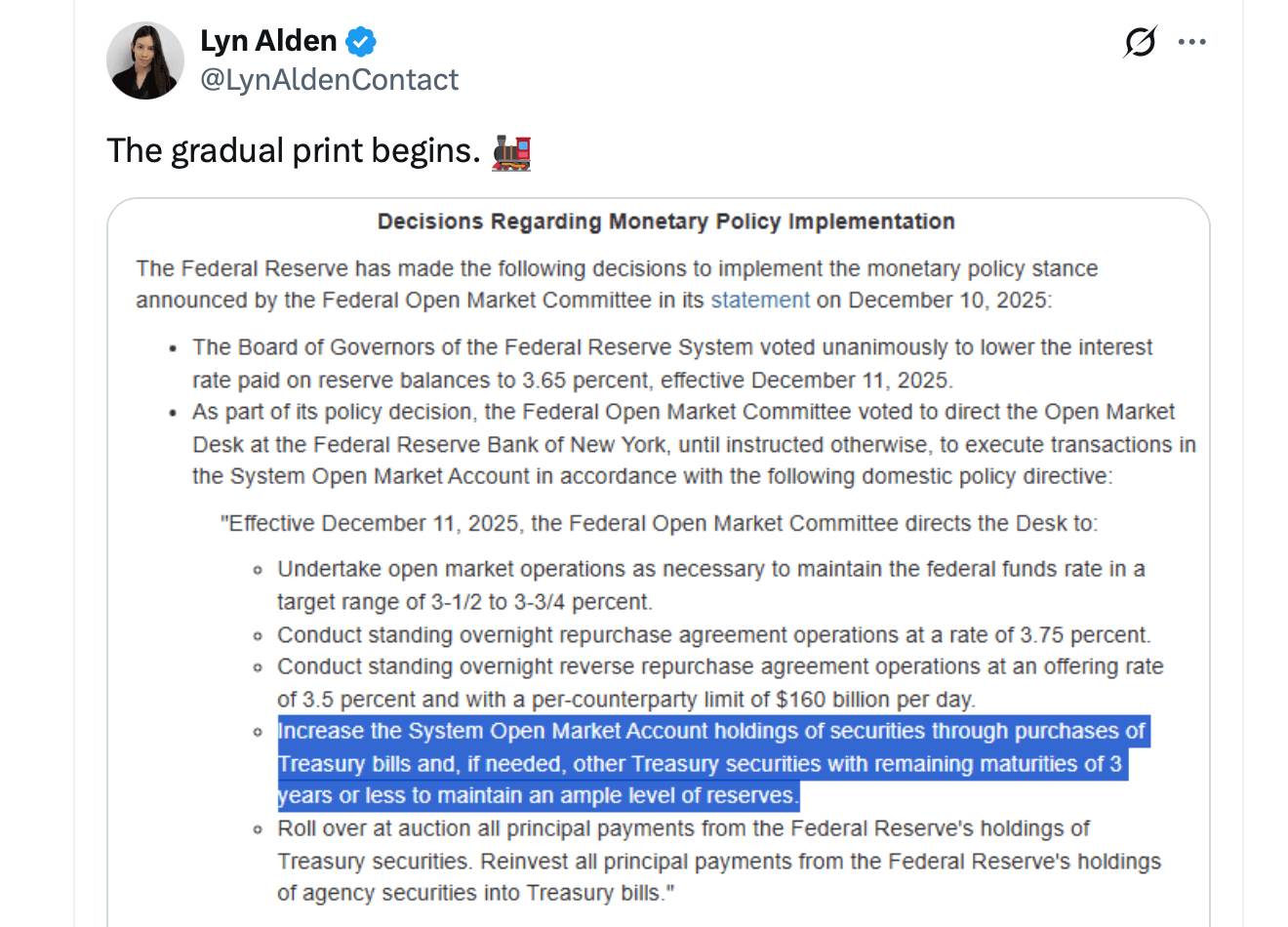
Source: Lyn Alden, via X, about the latest cuts in federal fund rates.
The most significant insights from the interview came from Alden’s analysis of the Federal Reserve’s decision to stop quantitative tightening on December 1st. She said that the liquidity pressures in the repurchase market forced the Fed to take action months earlier. This wasn’t a major policy shift; rather, it was more like an effort to prevent the Treasury market from collapsing.
Alden believed that the next step was already clear: expanding the balance sheet in line with nominal GDP growth. It wouldn’t be a sudden, dramatic change, but rather a gradual, steady process that would become habitual for institutions.
In such a world, assets related to scarcity—especially Bitcoin and gold—would often stand out.
Alden wasn’t surprised by the decline in Bitcoin’s value since its peak in 2025. She pointed out that the selling was mainly from long-term holders who had benefited from years of appreciation—a typical “distribution” pattern at the end of a cycle. Meanwhile, exchange-traded funds, corporate vaults, and retail investors were taking advantage of the situation.
Alden dismissed concerns that Bitcoin would still be subject to traditional four-year cycles, arguing that structural dynamics had changed. Michael Saylor and Tom Lee from Bitmine also shared this view. She believed that the decline was due to deleveraging, not a break with established theories. She believed that Bitcoin would remain attractive in the coming years—especially in a world defined by fiscal excesses and liquidity adjustments.
Gold has surpassed $4,000. Alden stated that this reflects the role of sovereign nations, rather than concerns about the CPI. Countries have not completely liquidated their government bonds, but their purchases have decreased—while they continue to accumulate neutral reserve assets that cannot be frozen. As global reserves become more diversified, Alden believes that the role of gold will become increasingly important in the coming years.
Bitcoin offers long-term investment opportunities, she noted, which aligns with similar discussions—especially regarding sovereign wealth funds, which tend to accumulate assets when their prices fall.
In addition to Bitcoin, Alden made a straightforward warning: the practicality of tokens is not a positive factor for investing. She believes that highly efficient blockchain technologies will eventually reduce their profit margins, just like stock exchanges and ETF issuers. What’s the use? Yes. But is holding assets in the long term profitable? Perhaps not. Bitcoin stands out because its demand stems from its monetary function, rather than its role as a payment system.
Alden said that a significant slowdown in AI spending or a change in sentiment among equity investors could shake the market’s structural balance. Currently, she sees risks in the valuation of large-cap stocks, pressure on private credit, and political pressures on the lower levels of the market. However, no clear factors have emerged that could trigger a widespread systemic collapse.