Exchange Ranking
 Top Exchanges
 24h Volume Ranking
 Popularity Ranking
 Exchange BTC Balance
 Proof of Reserves
 Decentralized Exchanges
 Funding Rate
 Funding Heatmap
 Liquidation Data
 Max Pain
 Long/Short Ratio
 Whale L/S Ratio
 Binance/Okex/Huobi L/S
 Bitfinex Margin L/S
 ETF Tracker
 Solana ETF
 XRP ETF
 Hong Kong ETF
 Bitcoin Treasuries
 Crypto Reversal
 Ethereum Reserves
 HyperLiquid Wallet Analysis
 Hyperliquid Whale Watch
 Large Transactions
 On-chain Movement
 Bitcoin ROI
 Stablecoin Market Cap
 Options Analysis
 News
 Articles
 Economic Calendar
 Features
 Wallet
 Contract Calculator


 Security
 Collections
 Watchlist
 Following
 AAVE
Aave has not only consolidated its position as a lending application, but also as a backend liquidity engine, capable of supporting capital flows for fintech companies, new banks, and institutional investors.
In the future, Aave’s growth will no longer rely solely on retail users who are familiar with cryptocurrencies. Instead, the next phase of expansion will be driven by the integration of Aave’s smart contracts into consumer applications, allowing end-users to benefit without needing to understand the underlying blockchain technology. This enables fintech companies to utilize Aave’s money market infrastructure to offer high-yield savings products and immediate mortgage loans.
One policy that I have been looking forward to seeing is the introduction of fixed-rate loans.
This is also one of the reasons why Morpho failed to become widely popular on Coinbase: floating interest rates represent a nightmare for ordinary users in terms of user experience.
Additionally, the launch of GHO stablecoins and the Horizon institutional platform signifies the company’s strategic shift towards the RWA and sovereign debt markets, bridging the gap between TradFi and DeFi. Almost everyone agrees that traditional finance and decentralized finance will eventually merge. This article analyzes the financial situation of the Aave protocol as of the end of 2025. The focus of the analysis isn’t the price movement of tokens, but rather the potential revenue models to determine whether current growth is structural or purely cyclical.
1. Revenue forecast: The forecast model uses historical rolling multipliers, with adjustments made to account for diminishing returns in mature markets.
2. Product integration: Evaluating the stability of GHO and its role in the verticalization of protocol revenue.
3. Capital efficiency: Conducting performance evaluations on the annual deployment targets of the token repurchase program. The following data aims to provide a clear and quantitative assessment of the basic value of this protocol, regardless of market sentiment.
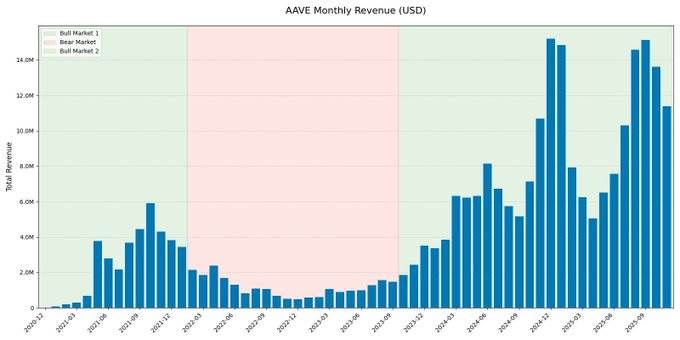
AAVE’s historical revenue data
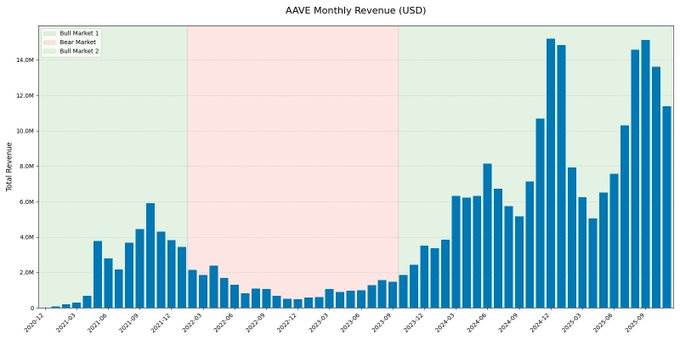
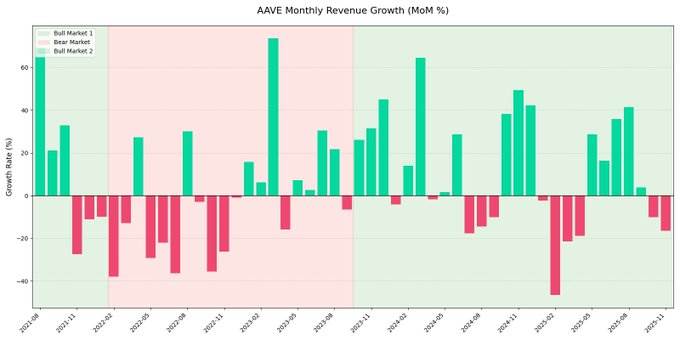
The data shows that AAVE’s business has experienced cyclical fluctuations, but it also highlights significant structural changes. During the current cycle (“Bull Market 2”), monthly revenue increased dramatically, reaching nearly $15 million, more than twice the peak level in 2021. Although the growth was exponential, monthly charts still show significant fluctuations, mainly due to market volatility rather than linear growth.
The data indicates that revenue exhibits strong reflexivity during market cycles. I suspect that even AAVE and other leading DeFi protocols will find it difficult to escape this situation during the next bear market.
Emerging protocols like Ethena or Pendle will face challenges during the next bear market, but they can thrive during bull markets.
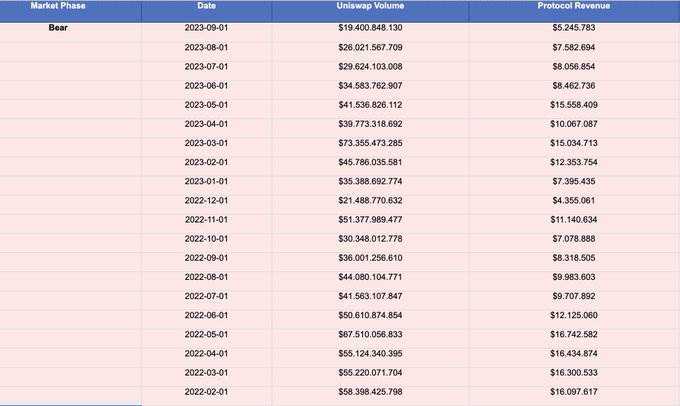
The only leading DeFi protocol whose trading volume and revenue only saw slight declines during bear markets is Uniswap:
GHO’s growth and performance
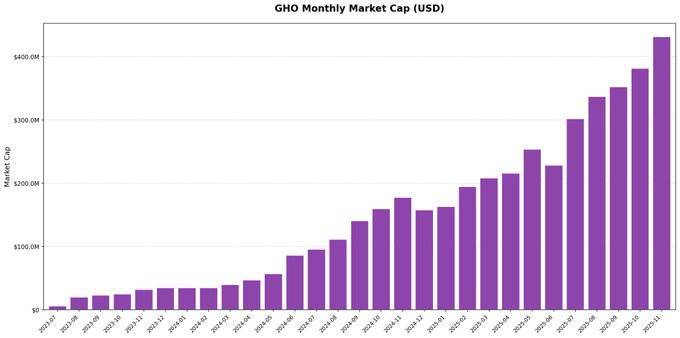
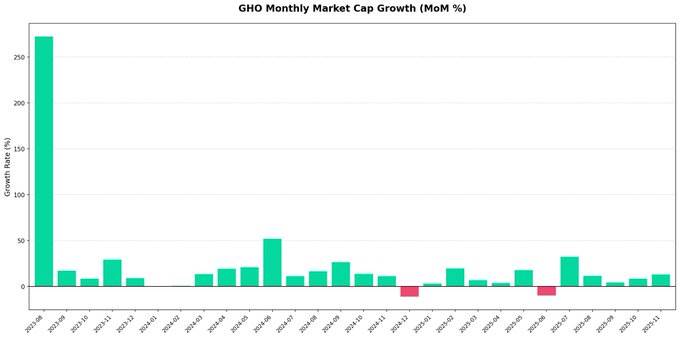
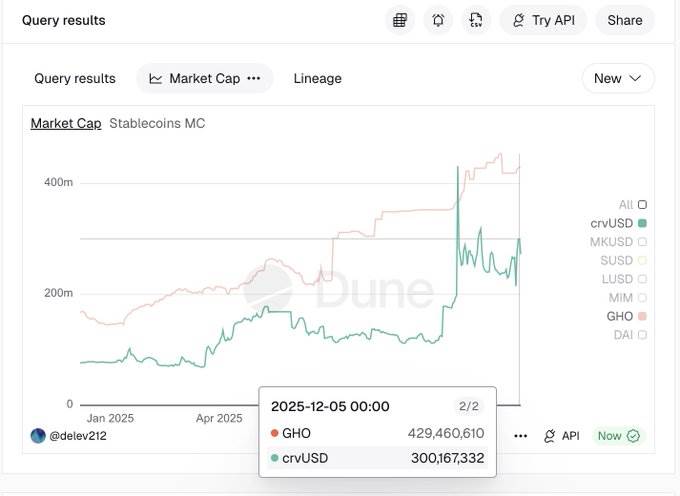
Since its establishment in the third quarter of 2023, GHO has maintained a steady upward trend. By the end of 2025, its market value is expected to exceed $400 million.
Monthly data shows extremely low volatility, with almost no capital outflows, indicating that demand is sustained rather than driven by speculative movements. This trend supports Aave’s vertical integration strategy. The growth of $GHO is natural; there is no sudden surge in TVL. There is strong demand for CDP stablecoins from leading DeFi protocols.
This trend confirms Aave’s successful integration strategy.
The growth of $GHO is natural, and there is no sudden increase in TVL.
There is strong demand for CDPs from leading DeFi protocols.
Here’s a comparison between $GHO and $crvUSD for reference:
Future revenue growth predictions for AAVE are as follows:
The method used for predicting future growth involves analyzing historical data using a “rolling window” approach. We don’t make any assumptions about future growth rates. Instead, we accurately measure the revenue performance over 12 months during previous market cycles, dividing these periods into contractionary phases (bear markets) and expansionary phases (bull markets).
For these scenarios, we selected specific benchmarks based on historical data: a conservative scenario (25th percentile), a baseline scenario (median), and an optimistic scenario.
It’s worth noting that the optimistic scenario uses the upper limit of the 60th percentile, rather than the usual upper quartile (75th percentile). This limitation is imposed to eliminate extreme outliers. In this way, the model takes into account the law of diminishing returns, ensuring that predictions reflect the growth trajectory of a mature protocol, rather than assuming that it will replicate the explosive growth seen in earlier stages.
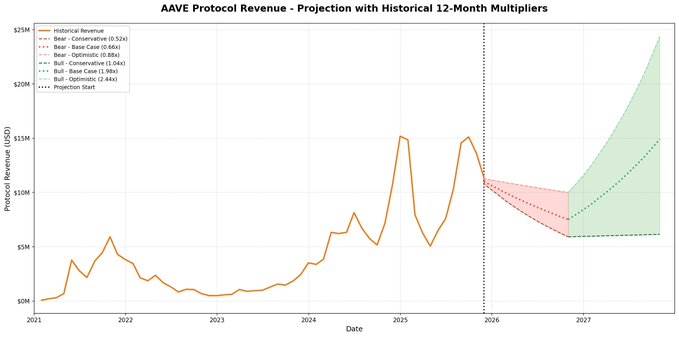
This indicates that Aave has become more mature compared to the first bear market. Income will decrease, but the decline will be more moderate. It’s worth noting that even during bear markets (with a multiplier range of 0.52 to 0.88), the expected minimum income of approximately $6 million remains higher than Aave’s peak income during the bull market of 2021.
Analysis of AAVE repurchases
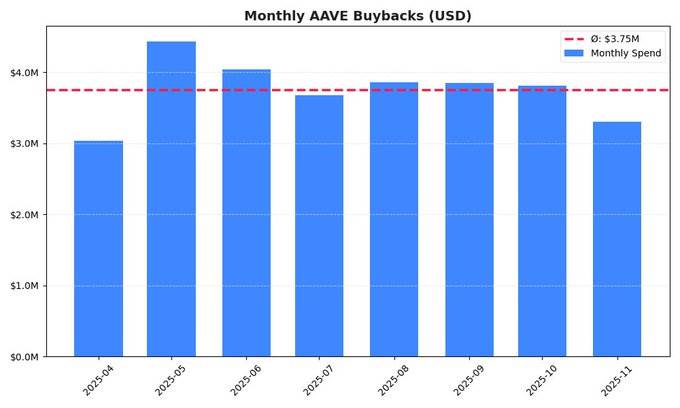
Monthly volatility charts show that the company employs a rigorous and non-speculative execution strategy. Although there are some minor fluctuations (for example, a peak in May), the overall situation remains stable.
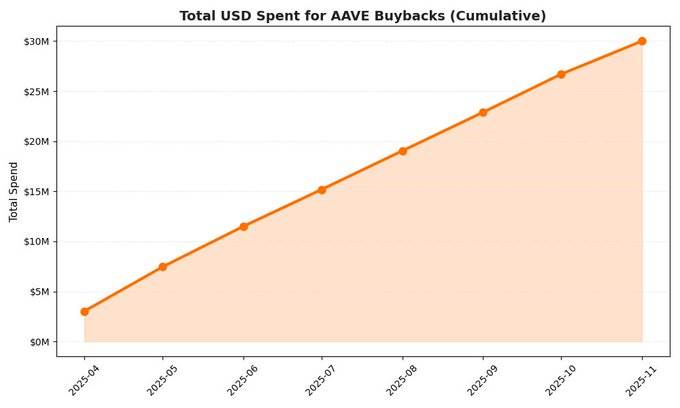
Accumulated data shows that Aave has invested $30 million in the repurchase program over the first eight months. To achieve the annual expenditure target of $50 million (set by Aave), the agreement requires an annual expenditure of approximately $4.17 million per month. Currently, the average monthly expenditure is $3.75 million. At this rate, the annual expenditure is expected to reach $45 million, which is 10% below the target of $50 million.
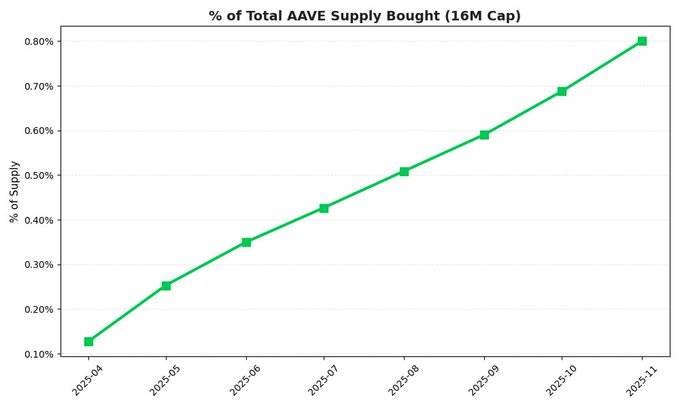
The repurchase mechanism has already created measurable deflationary pressure. In just eight months, the agreement has repurchased 0.80% of the total supply limit (16 million AAVE units).
Conclusion
From a contractual perspective, Aave is evolving from a simple lending protocol into a platform for base liquidity. The revenue model is gradually entering a more mature stage. GHO is opening up a second growth path for vertical integration. The repurchase mechanism is beginning to exert real and quantifiable deflationary constraints on the supply side. These changes cannot be fully priced within a single bullish or bearish cycle, but they are quietly transforming the long-term risk-reward structure of AAVE.
Short-term price fluctuations are inevitable. However, if we consider a longer-term allocation strategy that focuses on infrastructure-related assets, AAVE can still be a viable option.