Exchange Ranking
 Top Exchanges
 24h Volume Ranking
 Popularity Ranking
 Exchange BTC Balance
 Proof of Reserves
 Decentralized Exchanges
 Funding Rate
 Funding Heatmap
 Liquidation Data
 Max Pain
 Long/Short Ratio
 Whale L/S Ratio
 Binance/Okex/Huobi L/S
 Bitfinex Margin L/S
 ETF Tracker
 Solana ETF
 XRP ETF
 Hong Kong ETF
 Bitcoin Treasuries
 Crypto Reversal
 Ethereum Reserves
 HyperLiquid Wallet Analysis
 Hyperliquid Whale Watch
 Large Transactions
 On-chain Movement
 Bitcoin ROI
 Stablecoin Market Cap
 Options Analysis
 News
 Articles
 Economic Calendar
 Features
 Wallet
 Contract Calculator


 Security
 Collections
 Watchlist
 Following
 BTC
With the Federal Reserve signaling interest rate cuts, market sentiment has rapidly warmed up. Data shows that whenever a cycle of interest rate cuts begins, Bitcoin’s price typically experiences short-term increases—for example, during the post-pandemic easing measures in 2020, Bitcoin’s value surged by over 1500% within a year. Now, as the U.S. CPI drops to 2.6%, and the US dollar index weakens, funds are flowing back into the crypto market, pushing Bitcoin back above $100,000 per unit. However, short-term fluctuations remain risky. Institutional investors often take profits when policy changes become reality. Interest rate cuts not only bring back liquidity but also serve as a test for Bitcoin in this new round of market dynamics.
In 2019: Expectations led to an increase in price, but it dropped after the policy was implemented.
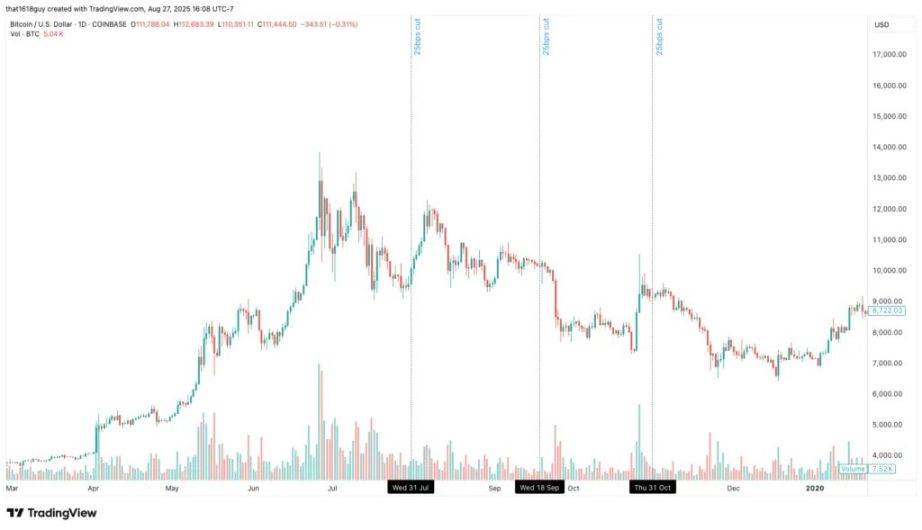
In 2019, Bitcoin’s value rose from around $3000 at the end of 2018 to $13,000 in June. The Federal Reserve announced interest rate cuts on July 31, September 18, and October 30 respectively.
Each decision to cut interest rates indicates that Bitcoin’s upward momentum is nearing its limit. Bitcoin prices increased significantly before the interest rate meetings, but they fell again after the meetings, as the reality of weak economic growth became apparent. This suggests that the benefits of interest rate cuts have been fully absorbed by the market, while the reality of slowing economic growth has dominated subsequent trends.
In 2020: An exception under emergency interest rate cuts.
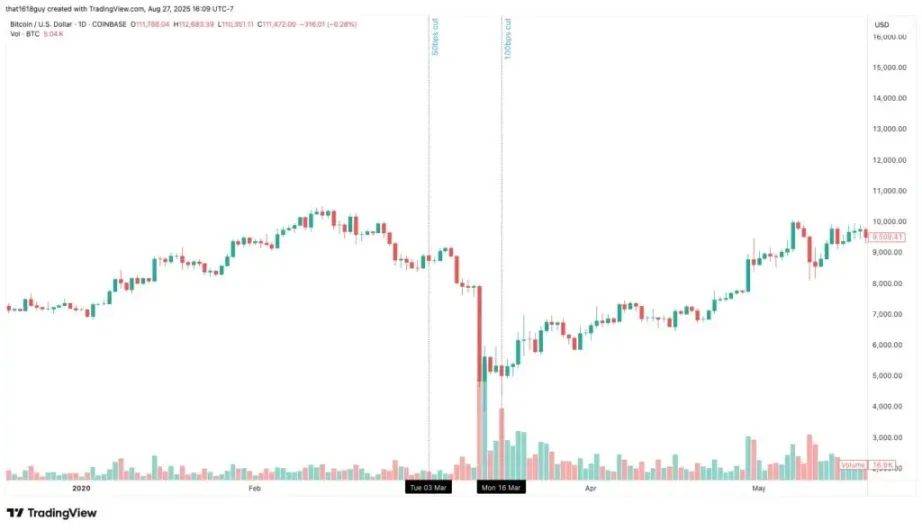
March 2020 wasn’t a typical case of a trend cycle. At that time, to address the panic caused by the COVID-19 pandemic, the Federal Reserve cut interest rates to zero.
During this liquidity crisis, both BTC and stocks experienced significant declines. However, they managed to bounce back strongly with the support of numerous monetary and fiscal policies. Therefore, this is an exceptional case driven by crises, and it cannot be used as a template for predicting market trends in 2025.
2024: Narrative factors outweigh liquidity considerations
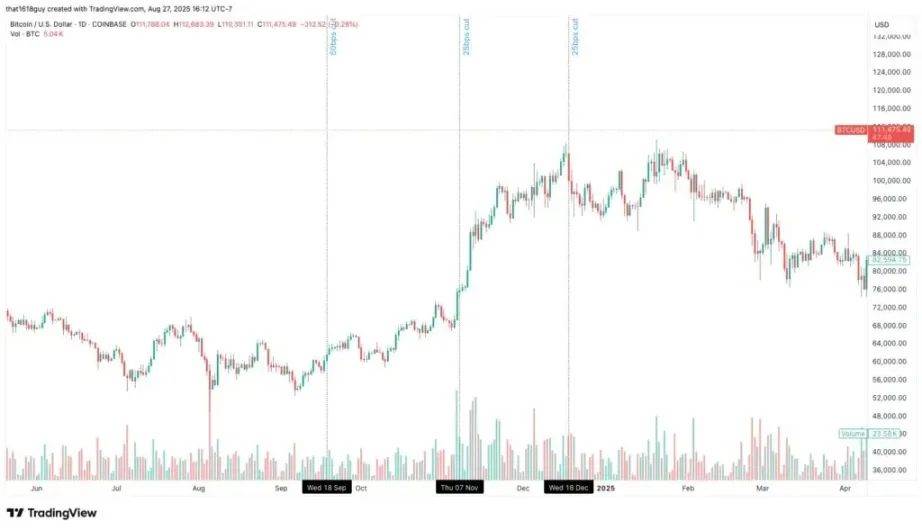
The trend in 2024 changed. After interest rates were lowered, BTC continued to rise instead of falling.
The reasons are as follows:
• Trump’s campaign made cryptocurrencies an important issue in elections.
• Physical ETFs are attracting record amounts of capital.
• MicroStrategy’s demand for purchases at the balance sheet level remains strong.
In this context, the importance of liquidity has diminished. Structural buying pressures and political factors have overpowered the effects of traditional economic cycles.
September 2025: A conditional market launch
The current market conditions differ from those seen during previous cycles. Since late August, Bitcoin has remained stable, and inflows into ETFs have significantly slowed down. Even the positive effects of corporate balance sheet purchases began to wane.
This makes the interest rate cut in September a conditional trigger point, rather than a direct catalyst.
If Bitcoin experiences a significant increase before the interest rate meeting, there is a risk of repeating past patterns—that is, traders may “sell on gains” after policies are relaxed, leading to a situation where prices fall after rising.
But if prices remain stable or slightly decline before this decision is made, then most of the excess positions might be cleared, allowing interest rate cuts to have a more stabilizing effect on the market, rather than becoming the end point of any further increases.

Key points
The current trend of Bitcoin prices may be influenced by the Fed’s September meeting and related liquidity changes. Overall, Bitcoin prices could see a surge before the FOMC meeting, but the increase might not exceed new highs.
• If prices rise significantly before the meeting, there is a high chance of a “sell-sentiment” type of pullback;
• However, if prices stabilize or decline during early September until the meeting, unexpected increases could occur due to interest rate adjustments.
Nevertheless, even if there is a rebound, markets should remain cautious. The next round of increases could result in lower highs (around $118,000 to $120,000).
Assuming such a lower high occurs, it could create conditions for further growth in the second half of Q4. At that time, liquidity should stabilize, and demand might rebound, pushing Bitcoin prices towards new highs.