Exchange Ranking
 Top Exchanges
 24h Volume Ranking
 Popularity Ranking
 Exchange BTC Balance
 Proof of Reserves
 Decentralized Exchanges
 Funding Rate
 Funding Heatmap
 Liquidation Data
 Max Pain
 Long/Short Ratio
 Whale L/S Ratio
 Binance/Okex/Huobi L/S
 Bitfinex Margin L/S
 ETF Tracker
 Solana ETF
 XRP ETF
 Hong Kong ETF
 Bitcoin Treasuries
 Crypto Reversal
 Ethereum Reserves
 HyperLiquid Wallet Analysis
 Hyperliquid Whale Watch
 Large Transactions
 On-chain Movement
 Bitcoin ROI
 Stablecoin Market Cap
 Options Analysis
 News
 Articles
 Economic Calendar
 Features
 Wallet
 Contract Calculator


 Security
 Collections
 Watchlist
 Following
The market on October 11th was like a sudden financial storm—cryptocurrencies plummeted, and the CS2 jewelry market also collapsed simultaneously. Investors were completely caught off guard. In just a few hours, hundreds of millions of dollars were lost. Those “middlemen” who once relied on their knowledge to make money now face the consequences of this collapse. This double collapse not only exposes the fragility of the speculative ecosystem but also reveals a cruel reality: in this new era dominated by high-frequency trading and algorithmic matchmaking, the arbitrage opportunities created through buying and selling are being gradually eliminated. The real winners may no longer be those who have access to information, but rather those who can understand the patterns of liquidity and risk.

Two “black swan” events, with the same victims.
On October 11th, when I opened the exchange in the morning, I thought it was a system bug that caused me to underestimate some fake coins. But after refreshing the page repeatedly and seeing no changes, I realized something was wrong. When I checked Twitter, I found that the market had already “exploded”.
In this “black swan” event, although retail investors suffered heavy losses, the greater losses may be borne by those middlemen in the cryptocurrency industry.
The losses suffered by middlemen during extreme market conditions are not accidental; they are an inevitable result of structural risks.
On October 11th, Trump announced the imposition of 100% tariffs on Chinese goods, triggering the largest liquidation event in the cryptocurrency market ever. In addition to the $19 billion to $19.4 billion in losses, market makers likely suffered even greater losses. Wintermute was forced to suspend trading due to violations related to risk management. Hedge funds such as Selini Capital and Cyantarb lost between $18 million and $70 million. These institutions, which usually maintain stable profits through liquidity provision, lost gains accumulated over months or even years within just 12 hours.
Advanced quantitative models, sophisticated risk management systems, and access to up-to-date market information—all these advantages became useless in the face of such unexpected events. If even these institutions can’t survive, what chance do individual investors have?
Twelve days later, a similar scenario occurred in another virtual world. On October 23rd, V社 introduced a new “replacement mechanism” in CS2, allowing players to combine five rare skins to create knives or gloves. This change immediately disrupted the existing rarity system: some knife skins dropped from tens of thousands of yuan to just a few thousand yuan, while the prices of previously unremarkable rare skins soared from a few dozen yuan to around two hundred yuan. Merchants who held high-value inventory saw their assets shrink by more than 50%.
Although I don’t own any expensive CS2 items, I still experienced the consequences of this collapse firsthand. Merchants in third-party trading markets quickly removed their products from the market, leading to plummeting sales prices. On social media platforms, merchants posted videos expressing their losses and criticizing V社. But most of them felt completely helpless and unsure of what to do in the face of such emergencies.
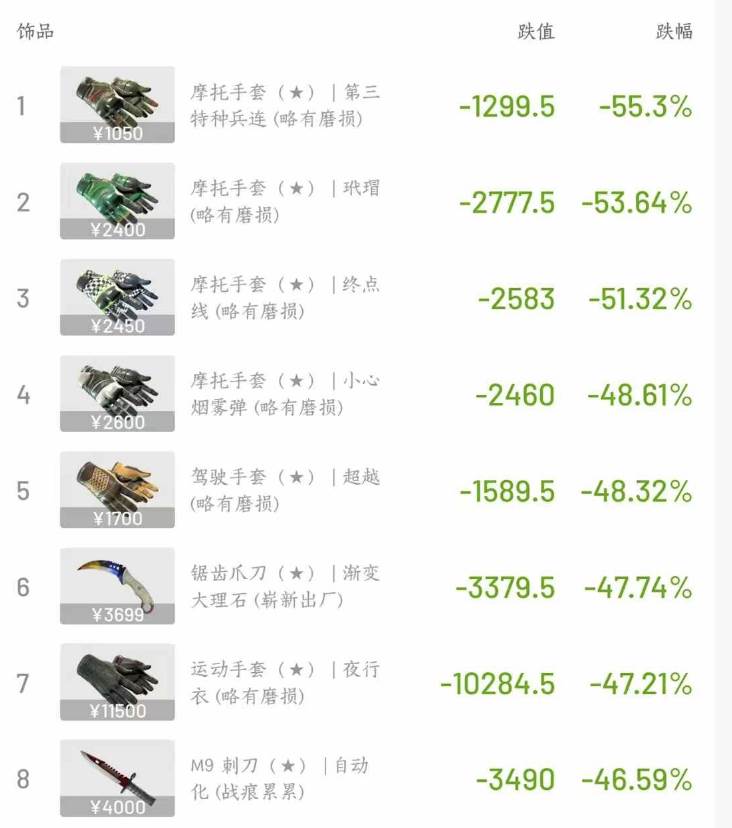
Two markets that seem unrelated actually exhibit remarkable similarities: market makers in the crypto market and merchants of CS2 jewelry. One is facing Trump’s tariff policies, while the other is dealing with changes in V Company’s rules. But their methods of death are almost identical.
This seems to reveal a deeper truth: the profit model of intermediaries inherently carries systemic risks.
The double trap faced by intermediaries
The real challenge for intermediaries is that they must hold large amounts of inventory to provide liquidity. However, in extreme market conditions, their business model exposes fatal weaknesses.
Leverage and settlement
The profit model of market makers requires them to use leverage. In the crypto market, market makers need to provide liquidity across multiple exchanges, which means they must hold substantial amounts of capital. To improve capital efficiency, they typically use 5-20 times leverage. In normal markets, this model works well, as small fluctuations generate stable price differential profits, and leverage amplifies profits.
But on October 11th, this system encountered its greatest “enemy”: extreme market conditions combined with exchange downtime.
When extreme market conditions occur, market makers borrow heavily leveraging funds, which are then settled. This leads to a flood of settlement orders in the exchanges, causing system overload and downtime. What’s more deadly is that the exchange downtime only cuts off the user interface; actual settlement continues, resulting in the most desperate situation for market makers—they see their positions being settled, leaving them unable to add more margin.
10.11日凌晨三点,BTC、ETH等主流加密货币短时暴跌,而山寨币更有甚者直接报价“归零”,做市商的多头头寸触发强平→系统自动抛售→加剧市场恐慌→更多头寸被清算→交易所宕机→买盘无法买入→更大抛压。这个循环一旦启动,就无法停止。
而CS2饰品市场虽然没有杠杆和清算机制,但饰品商人们面临的是另一个结构性陷阱。
当V社更新“汰换机制时,饰品商人们完全没有任何预警机制。他们擅长的是分析价格走势、给昂贵皮肤制作宣传素材、挑动市场情绪,但这些信息在规则制定者面前毫无意义。
退出机制失灵
除了杠杆和清算以及商业模式暴露出的结构性风险,退出机制也是造成“中间商”巨量亏损的根本原因之一,黑天鹅事件降临的时刻,正是市场最需要流动性的时刻,同时也是中间商们最想撤离的时刻。
10月11日加密市场暴跌时,做市商持有大量多头头寸,为了防止被清算需要他们追加保证金或平仓,这些做市商的风控依赖“能交易”这个基本前提,但彼时由于大量清算数据导致服务器无法处理直接切断了做市商们的方案,导致他们只能眼睁睁看着持仓被大量清算。
In the ornaments trading market of CS2, transactions rely on the funds invested by numerous ornament dealers in their “bidding” lists to maintain liquidity. Once the updated content is released, retail traders who see the news immediately sell their items to those seeking to buy. By the time the ornament dealers realize what’s happening, they have already suffered significant losses. If they also join the selling frenzy, their assets will further depreciate. Eventually, these dealers find themselves in a difficult position, becoming the biggest victims of market panic.
The business model of “making profits from price differences” relies on liquidity. However, when systemic risks arise, liquidity can disappear instantly—and it is precisely the intermediaries who hold the most assets and need liquidity the most. What’s more fatal is that their exit routes fail when they need them most.
This revelation for retail traders: In just two weeks, both popular virtual asset trading markets experienced the worst incidents in their respective industries. Such coincidences provide valuable lessons for retail traders: Strategies that seem stable often carry the greatest risks.
Intermediary strategies can generate stable, small amounts of income over time, but they face huge losses during black swan events. This asymmetric distribution of income means that traditional risk measurement indicators seriously underestimate the actual risks involved.
Such income strategies are like trying to pick up coins on a railway track: 99% of the time, you can safely collect money, but during that 1% of time, a train might come along and you won’t have enough time to run away.
From the perspective of portfolio construction, investors who rely too much on intermediaries need to reevaluate their risk exposure. The losses suffered by market makers in the crypto market during extreme events demonstrate that even market-neutral strategies cannot completely eliminate systemic risks. When markets experience extreme fluctuations, any risk management model may fail.
More importantly, investors must recognize the importance of “platform risks.” Whether it’s changes in exchange regulations or adjustments in game development processes, these factors can instantly alter market conditions. Such risks cannot be fully mitigated through diversification or hedging strategies; they can only be managed by reducing leverage and maintaining sufficient liquidity buffers.
For individual investors, these events also present opportunities for self-protection strategies. One approach is to reduce reliance on “exit mechanisms,” especially for those who use high-leverage contracts. In such short-term plunges, it’s possible that even if there’s enough capital to cover margin calls, it might still not be enough.
There are no safe positions; only reasonable risk compensation exists.
With a staggering $19 billion in margin calls, prices of certain assets dropped by 70%. This money didn’t disappear; it simply shifted from those who made profits to those who controlled the core resources.
In the face of extreme events, everyone who doesn’t have control over the core resources can become a victim, whether it’s an individual investor or an institutional player. Institutional players suffer more losses because they have larger portfolios, while individual investors suffer even worse because they don’t have alternative plans. But actually, everyone is betting on the same thing: that the system won’t collapse in their hands.
You think you’re just making profits, but in reality, you’re paying the price for systemic risks. And when those risks strike, you don’t even have the right to choose.