Exchange Ranking
 Top Exchanges
 24h Volume Ranking
 Popularity Ranking
 Exchange BTC Balance
 Proof of Reserves
 Decentralized Exchanges
 Funding Rate
 Funding Heatmap
 Liquidation Data
 Max Pain
 Long/Short Ratio
 Whale L/S Ratio
 Binance/Okex/Huobi L/S
 Bitfinex Margin L/S
 ETF Tracker
 Solana ETF
 XRP ETF
 Hong Kong ETF
 Bitcoin Treasuries
 Crypto Reversal
 Ethereum Reserves
 HyperLiquid Wallet Analysis
 Hyperliquid Whale Watch
 Large Transactions
 On-chain Movement
 Bitcoin ROI
 Stablecoin Market Cap
 Options Analysis
 News
 Articles
 Economic Calendar
 Features
 Wallet
 Contract Calculator


 Security
 Collections
 Watchlist
 Following
On October 23rd, the popular DeFi project Meteora within the Solana ecosystem held its much-anticipated Token Generation Event and distribution event. This event was seen as a chance for the project to turn around after the initial controversies—the team emphasized principles like “community priority” and “fair distribution,” hoping to restore their reputation.
However, things didn’t go as planned. This supposed exciting distribution event turned into a crisis of trust. Chain-based data showed that there were over 70,000 claims during the distribution day, indicating extremely high activity levels, which raised questions about whether the distribution was truly fair. We conducted an in-depth analysis of this distribution event to uncover the truth behind this controversy from a data-driven perspective.

This incident forced us to rethink the definition of “fair distribution.” It also served as a reminder to the entire crypto market: in a world where information is transparent and capital flows rapidly, trust remains one of the most scarce resources.
The immediate impact of the 48% “high circulation” experiment
Meteora’s Token Generation Event plan is quite unique. Its core features include “high circulation” and a distribution model based on points.
The total supply of MET tokens is 1 billion units. On the day of the Token Generation Event, 48% of the total supply (or 480 million units) was unlocked and made available for circulation immediately. The team claimed that this was done intentionally, with the aim of eliminating artificial scarcity and achieving “true market price discovery.”
This airdrop is based on the activity data as of June 30, 2025. Applications can be submitted starting from October 23rd. The eligibility criteria are determined through a points-based system. The recipients include liquidity providers, Jupiter (JUP) stakers, as well as those who previously staked in the controversial M3M3 Memecoin.
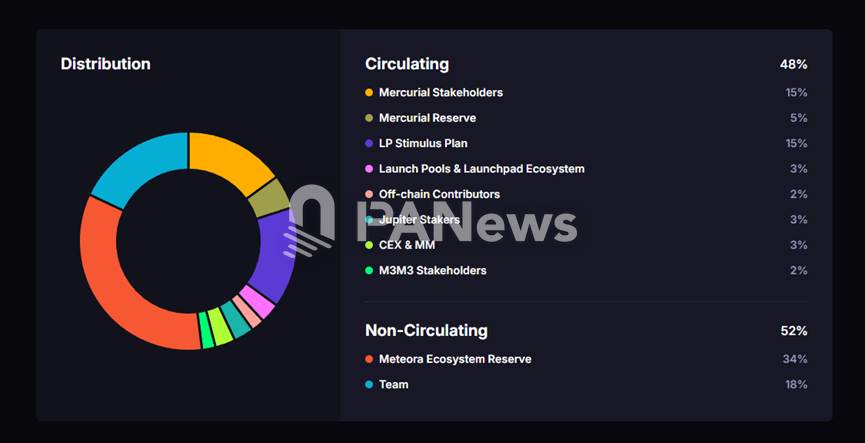
This aggressive model immediately triggered a “shock therapy” effect in the market. The massive supply of 48% of the total tokens led to an overwhelming sell-off pressure. After the TGE began, the price of MET quickly dropped from around $0.90 per token to a low of $0.51 within a few hours. The harsh reaction of the market marked the beginning of this crisis.
Four major investors received more than 28% of the airdropped tokens, while 60,000 individual investors received only 7%.
According to PANews, as of October 24th, approximately 161 million MET tokens have been distributed, with around 71,000 transactions completed. The average number of tokens per transaction was 2,277.
In terms of the scale of the airdrop, approximately $83.7 million has been distributed so far. The average value per address is about $1.18 million. On average, it seems that the MET airdrop is a decent reward. However, a closer look at the data reveals a significant disparity between the rich and the poor among the major investors.
Among all the addresses that received tokens, one address received the most, amounting to 12.15 million tokens, worth approximately $6.31 million. There were four addresses that received more than 10 million tokens each. These four large investors received a total of approximately 45.94 million tokens, accounting for 28.5% of the total tokens distributed so far.
Among the remaining addresses, there are 12 addresses that received more than 1 million tokens, totaling over 28 million tokens, accounting for 17.32% of the total. There are 109 addresses that received between 100,000 and 1 million tokens, accumulating a total of 23.99 million tokens, or 14.84%. Additionally, there are 1195 addresses that received between 10,000 and 100,000 tokens, with a total of approximately 31.29 million tokens, accounting for 19.35%. The largest number of tokens were received by addresses that received between 100 and 1,000 tokens, with a total of 37,000 such addresses, receiving 10.12 million tokens, or about 6.26%. There were also a large number of addresses that received less than 100 tokens, totaling 24,600 addresses, with a total of 1.44 million tokens, or about 0.89%. These data reveal a harsh reality: the MET distribution wasn’t a fair reward for everyone, but rather a highly unequal distribution among a few individuals. Four of these “giant whales” are particularly notable. The address that received the most tokens was 3vAauDAR8er3HT8C3Vaj7WRbDoaoebi3KnvCdWuHj6ae. This address received over 12.15 million tokens at once, valued at approximately $6.31 million. Based on discussions on social media, it seems that this address participated in the distribution of MER tokens (the predecessor to Meteora’s token, MercurialFinance) and held a large amount of JUP tokens, which it then sold on exchanges. Some analysts believe that this address may be associated with the Meteora team. In the past eight months, this address has sold over 30 million JUP tokens. As of October 25th, this address has already transferred over 3 million MET tokens to the Bybit exchange.
The addresses that ranked second and third in terms of the number of tokens received seem to be closely related to each other. From a simple perspective, both of these addresses are major holders of JUP, frequently participating in the addition of tokens to the Jupiter liquidity pool. Interestingly, the amount of JUP transferred through these two addresses consistently amounts to 2,622,632.41 tokens, and the time periods during which these transfers occur are often on the same day.


Based on their activity patterns, it appears that these two addresses are controlled by the same group.
Additionally, the fourth-ranked address, DKpWmjTTJCgHsRCznxp8UmRq6hCUK75pFw9kd1uCMUaK, is also unusual. This address received exactly 10 million MET tokens, which doesn’t seem like a normal situation for token rewards. Moreover, this address was created just a month ago, meaning it likely missed the snapshot period for Meteora. This address has never participated in any activities related to token distribution or JUP pledgeing. So far, no tokens have been transferred from this address. The details regarding this address’s token distribution and ownership remain unknown.
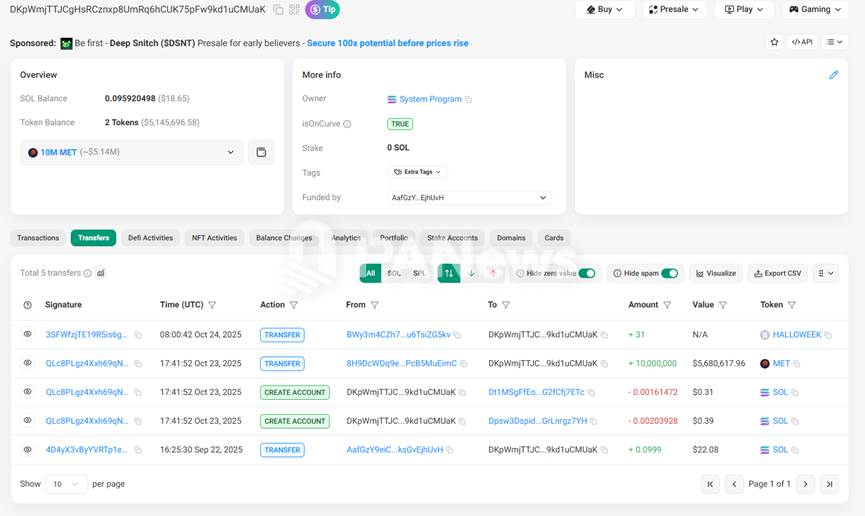
Some individuals are receiving millions in rewards through insider trading, leaving the team facing potential legal challenges.
In addition to these few exceptional cases, there are many controversial aspects related to the MET token distribution.
For example, Arkm pointed out that three addresses involved in TRUMP token-related activities received a total of $4.2 million in MET tokens. After receiving the tokens, these addresses immediately deposited all of the MET tokens into the OKX exchange.
In addition, Hayden Davis, the key figure involved in the LIBRA scandal, also received tokens worth approximately $1.5 million through MET’s token distribution program.
These token distributions sparked strong criticism from the community. Some users on social media commented, “Why would Hayden Davis receive tokens from MET’s distribution program? You must be joking… Thankfully, Meteora provided Hayden Davis another $1.5 million in tokens.”
In fact, this isn’t the first time Meteora has faced trust issues. Last December, Meteora launched the M3M3 platform and its corresponding tokens, claiming to aim to change the dynamics of meme coins. However, the project quickly collapsed, with the value of its tokens plummeting by 98%, leading to subsequent lawsuits. After the LIBRA scandal in February this year, Meteora’s team once again faced accusations of internal corruption.
In summary, Meteora’s ambitious ICO and token distribution efforts not only failed to achieve what it claimed to be a “community salvation,” but instead turned into a disaster that further deepened the gap between community members. From the sudden price collapse due to its aggressive 48% high-token circulation model, to the “insider trading” related to TRUMP tokens, and the millions of dollars in tokens given to the key figures involved in the LIBRA scandal, it seems that every step Meteora took was questioned, putting it far from its original goal of prioritizing the needs of the community.
This event, which should have been a “salvation” for the community, instead created new problems on top of the old wounds left by the M3M3 and LIBRA scandals. This has left Meteora trapped in another wave of trust crises and lawsuits. For Meteora, regaining the trust of the community seems to be much more difficult than it initially thought.