Exchange Ranking
 Top Exchanges
 24h Volume Ranking
 Popularity Ranking
 Exchange BTC Balance
 Proof of Reserves
 Decentralized Exchanges
 Funding Rate
 Funding Heatmap
 Liquidation Data
 Max Pain
 Long/Short Ratio
 Whale L/S Ratio
 Binance/Okex/Huobi L/S
 Bitfinex Margin L/S
 ETF Tracker
 Solana ETF
 XRP ETF
 Hong Kong ETF
 Bitcoin Treasuries
 Crypto Reversal
 Ethereum Reserves
 HyperLiquid Wallet Analysis
 Hyperliquid Whale Watch
 Large Transactions
 On-chain Movement
 Bitcoin ROI
 Stablecoin Market Cap
 Options Analysis
 News
 Articles
 Economic Calendar
 Features
 Wallet
 Contract Calculator


 Security
 Collections
 Watchlist
 Following
 ETH
You may not have noticed, but the number of tokens pledged on Ethereum has quietly exceeded 35 million ETH. Although the numbers vary slightly across different data sources, the trend is clear—the growth rate is slowing down. Remember, it only took about a year for the number to increase from 15 million to 25 million; however, it took almost two years to reach 35 million. The practice of pledging tokens is gradually entering a “maturity stage”. The frenzied enthusiasm seen in the early days is now over, and the system is likely to enter a phase of dynamic balance—some people pledge tokens, while others unpledge them, allowing the entire system to remain relatively stable. In the long term, this balance is actually healthy. It indicates that the Ethereum ecosystem is shifting from a phase of rapid growth to a more rational and stable development stage. In other words, the market is growing slowly, no longer driven by passion, but rather by trust and real returns.
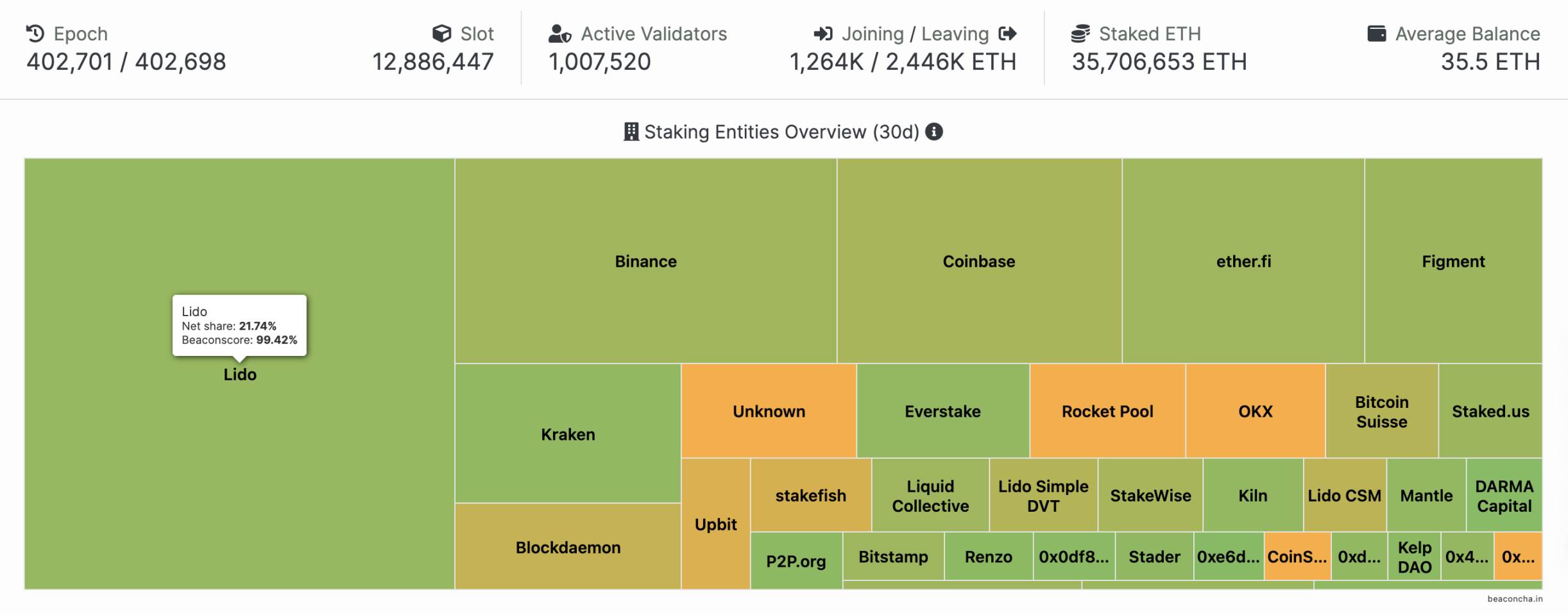
The above chart comes from beaconcha.in, an open-source browser launched by BitFly, the developer of EtherMine, one of the largest Ethereum PoW mining pools. This Austrian-based Ethereum ecosystem development company has created several browsers. ethernodes.org is a data website that provides information about Ethereum’s execution layer and consensus layer nodes. Data from this website was previously cited when discussing the fact that many Ethereum nodes are hosted on AWS.
Two years ago, more than 60% of the nodes under management were based on AWS. Today, both the distribution of nodes and the cloud service providers used have changed significantly. (All data below is as of the time of writing, excluding nodes that are not yet synchronized.)
What clients are used on these nodes?
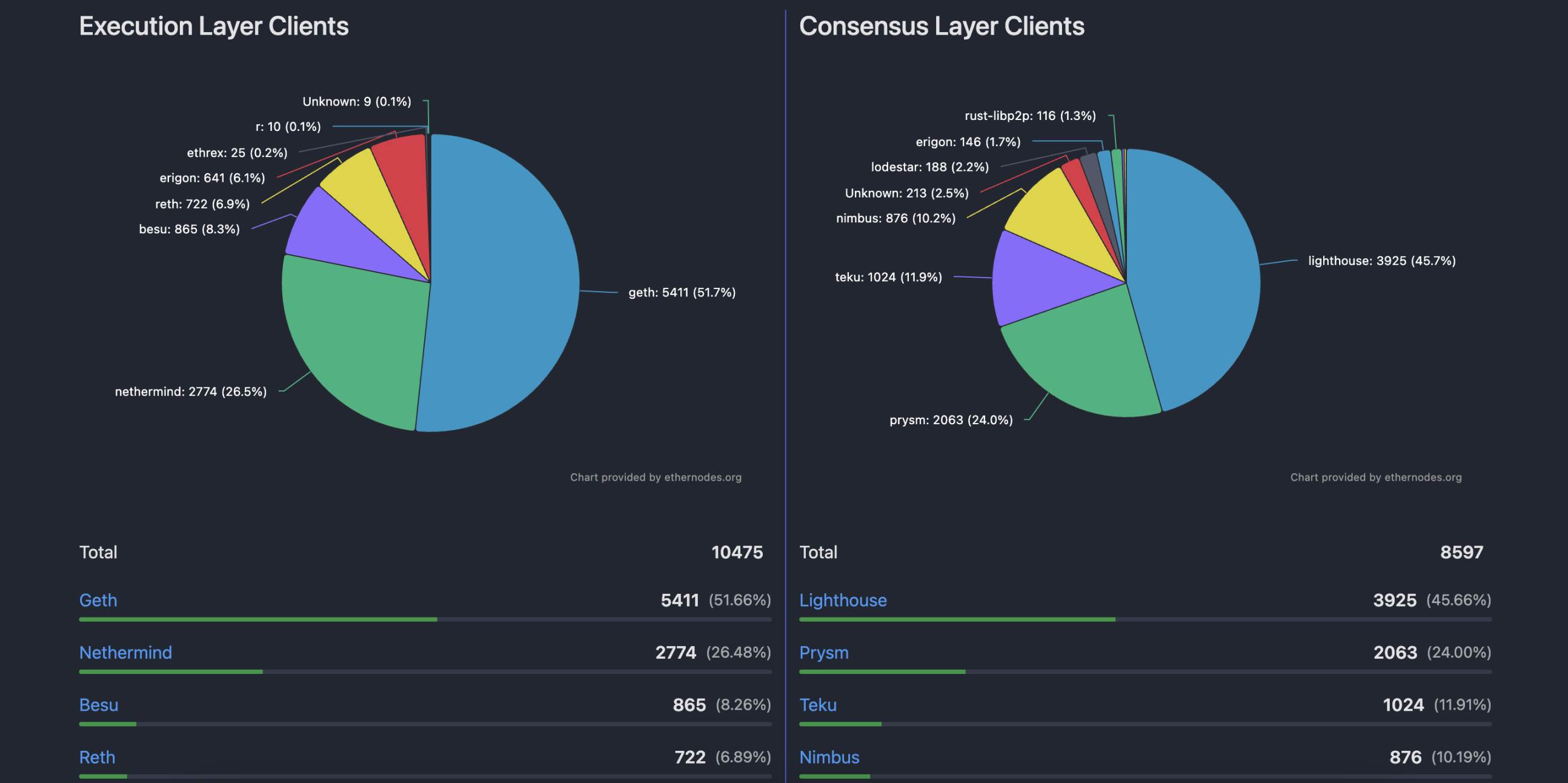
Among the 10,475 execution layer nodes included in the statistics, Geth accounted for 51.66%, which remains a relatively high percentage. The client Nethermind, developed under the leadership of Tomasz Stańczak, the new executive director of the Ethereum Foundation, ranked second, with a share of 26.48%. Besu, originally developed by ConsenSys and later moved to the Hyperledger Foundation’s GitHub repository in 2019, accounted for 8.26%. Erigon, one of the four major execution layer clients of Ethereum, developed by British developer Alexey Akhunov and originally named Turbo-Geth, was renamed Erigon in May 2021. It accounted for 6.1% of the total. This share was surpassed by Reth, launched by Paradigm, which accounted for 6.89%.
Reth has always been controversial in the Ethereum community. Banteg, a core developer of Yearn, stated that Reth heavily relied on Akula, a client implemented in Rust, and copied the architecture of Erigon. However, Paradigm did not support these developers. Although Georgios Konstantopoulos, CTO of Paradigm, responded that Reth “leverages the resources of giants,” the community did not agree, believing it to be a form of VC-style resource exploitation. This incident also led Akula’s developers to announce that they would no longer maintain the project, as they felt they could not compete with Paradigm.
Just a week ago, Ethereum core developer Federico Carrone also warned on X that Paradigm’s expansion efforts—such as hiring key researchers, funding open-source projects, and leading the development of EIPs and Reths—could threaten the decentralization of Ethereum. However, the proportion of Ethrex in the execution layer clients is only 0.2%. As for the consensus layer clients, among the 8,597 consensus nodes surveyed, Lighthouse, developed and maintained by Australian security company Sigma Prime, accounted for the highest percentage, at 45.66%. Prysm, which has a share of approximately 24%, was originally developed and maintained by Prysmatic Labs, a blockchain infrastructure company that was acquired by Offchain Labs in 2022. Teku ranks third, with a share of 11.91%; it belongs to the same development team as Besu. Nimbus, with a share of 10.19%, relies solely on funding from organizations like the Ethereum Foundation. Nimbus aims to improve resource efficiency, allowing node operators to run Ethereum client software on devices with limited resources, such as smartphones and laptops. In the Ethereum network, the top four clients account for 93.29% of the total execution layer clients and 91.76% of the consensus layer clients. This still shows a highly centralized structure. However, compared to two or three years ago, when the concentration was even more extreme, the efforts of the Ethereum Foundation to promote diversity among clients have been somewhat successful. Where are all these nodes located?
The locations of Ethereum’s execution layer nodes and consensus layer nodes are difficult to accurately determine. It is likely that these locations were identified through IP analysis, and the results may not be entirely accurate. However, they do provide us with a general idea of where these nodes are distributed. Among the nodes running execution layer clients, more than 30% have American IP addresses, with the highest concentration near Washington D.C. Additionally, there are nodes in cities like San Francisco, Los Angeles, and New York. The remaining nodes are scattered across states such as Kansas, Iowa, Texas, Florida, and Massachusetts. In Europe, Germany accounts for 13.13%, the UK 4.47%, France 4.28%, and Finland 3.78%. On a map, it can be seen that nodes are primarily located in major cities around the world, including Dublin, Ireland; Paris, France; Frankfurt, Germany; and Helsinki, Finland. In China, less than 4% of nodes have Chinese IP addresses, but they are widely distributed: from Changchun in Jilin to Hainan, from Xining in Qinghai to Shanghai and Taiwan. It’s worth noting that according to IP addresses, there are 103 nodes in Hong Kong, 97 in Taiwan, while only 204 nodes are located in other parts of China. The most concentrated distribution is found in the points with the darkest colors on the map, located in Zhengzhou, Henan Province.As for the distribution of consensus layer clients in North America and Europe, it is similar to that of execution layer clients. In China, although there are still several dozen nodes, they are not clearly visible on the map. In terms of geographical distribution, the United States and Germany rank among the top two in both execution layer and consensus layer nodes. However, Ethereum nodes can be found all over the world, including in small countries like Guatemala, Kuwait, and Montenegro. There are even nodes located in the far north, such as Iceland.
What cloud services are used by these nodes?
“Half of Ethereum nodes use AWS” is a well-known meme in the industry. It’s possible that in the past, many nodes relied on cloud services for hosting, but this situation has improved significantly nowadays.
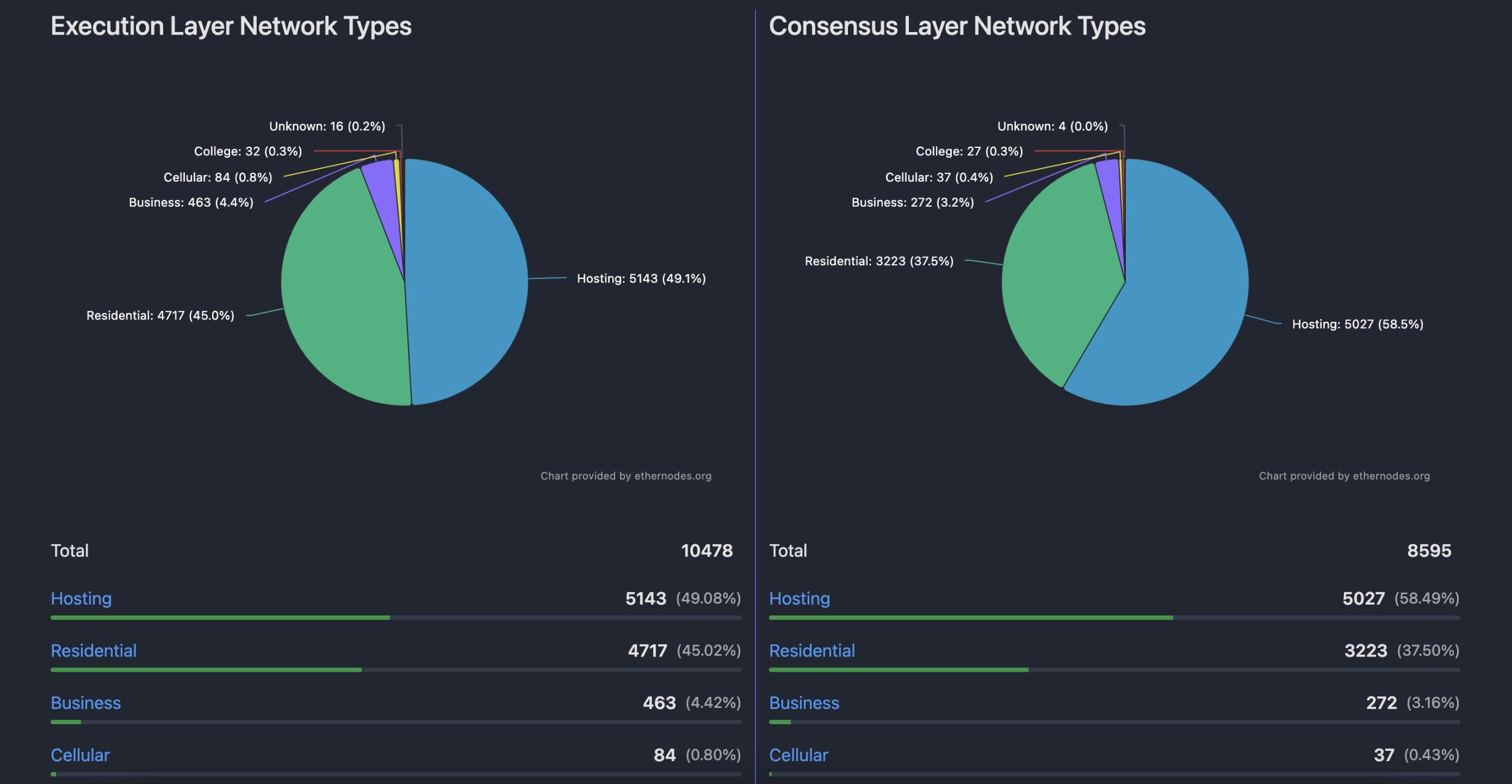
Among the nodes running execution layer clients, 49.1% are hosted by cloud providers, while 45% are self-built. For consensus layer clients, since stability is important to avoid being penalized, 58.5% are hosted by cloud providers, while self-built nodes account for 37.5%. There are many interesting details related to this issue.
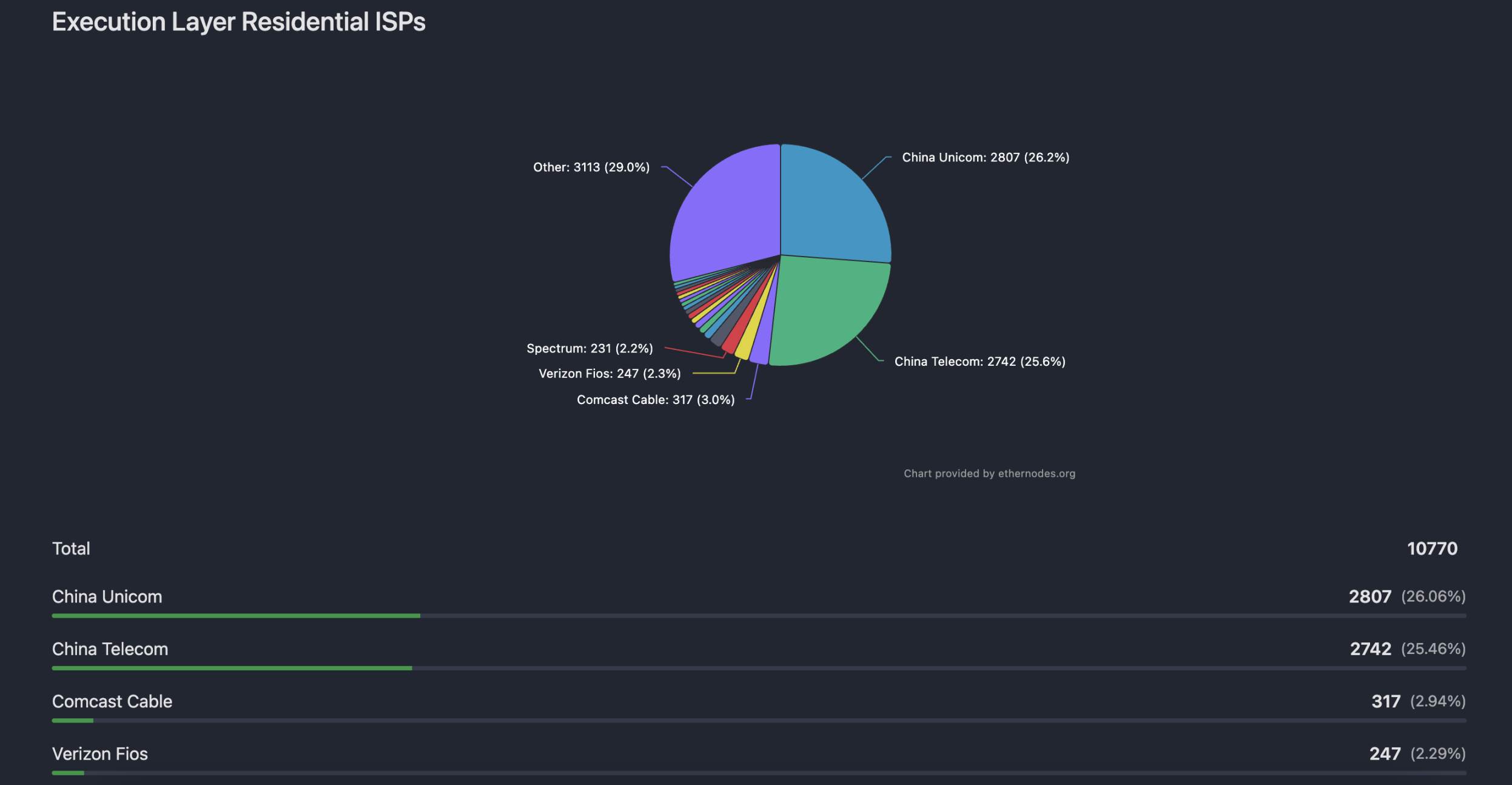
First of all, among the nodes running execution layer clients, Chinese operators such as China Unicom and China Telecom account for 51.52% of the Internet service providers. Additionally, there are China Unicom’s industrial internet backbone network, China Mobile and the China Education and Research Computer Network Center, China Unicom (Shenzhen), China Telecom’s Yunnan Province IDC1 network, China Telecom Group, and Baidu Technologies Co., Ltd.
It seems that in fact, more than 20% of the execution layer clients are running domestically, but they may be using external IP addresses. On the other hand, very few execution layer clients use networks provided by domestic internet service providers. Given that operating such clients does not generate stable profits, it is likely that the high proportion of such clients is used to meet the needs of RPC nodes, development processes, high-frequency transactions on the chain, or strategy-based trading. This clearly shows that China remains an important market for blockchain activities.
As for managed nodes that utilize various cloud services, their distribution tends to be more consistent with regional patterns.
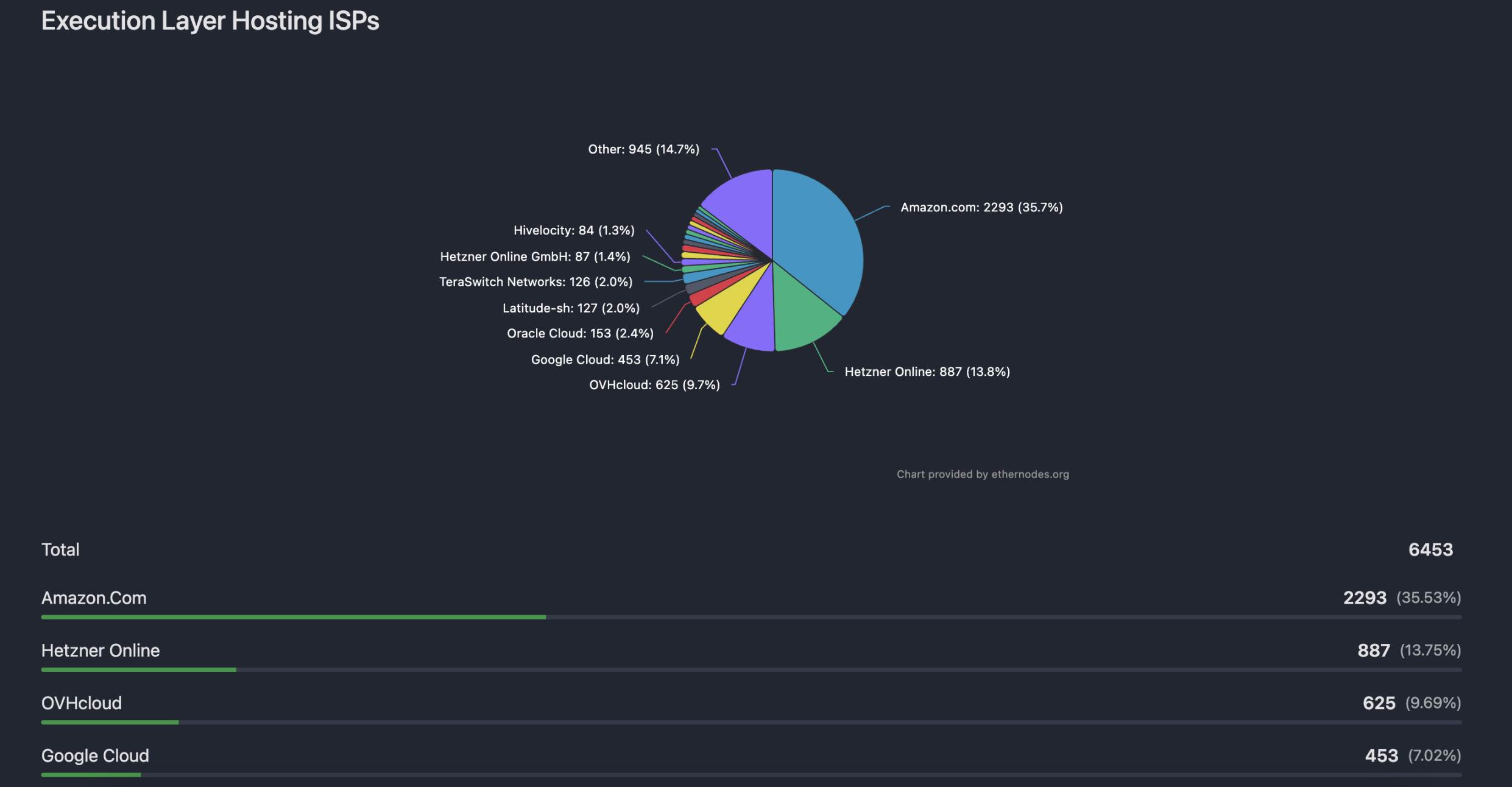
Among the managed execution layer clients, 35.53% chose AWS, 13.75% chose the German hosting provider Hetzner Online, 9.69% chose the French cloud service provider OVHcloud. Google Cloud (7.02%) and Oracle Cloud (2.37%) ranked fourth and fifth respectively, which is consistent with the regional distribution, where most services are located in the United States and Europe. The same applies to the consensus layer clients, where these five service providers also rank among the top five. Additionally, Alibaba Cloud, Tencent Cloud, and Huawei Cloud are also listed, but their proportions are very small.
Based on this calculation, the number of nodes hosted on AWS accounts for approximately 20% of the total, which is a reasonable proportion.
整体来说,运行执行层客户端的超 1 万个节点和运行共识层客户端的近 9000 个节点无论是在地域分布上,还是基于的网络服务、托管服务商等等都没有出现一家过分独大的情况。只有在客户端的选择上存在一些头部占比过高的风险,但头部的比例实际也在逐步下降,以太坊「世界计算机」的梦想正在基金会推动去中心化的行动下逐步实现。