Exchange Ranking
 Top Exchanges
 24h Volume Ranking
 Popularity Ranking
 Exchange BTC Balance
 Proof of Reserves
 Decentralized Exchanges
 Funding Rate
 Funding Heatmap
 Liquidation Data
 Max Pain
 Long/Short Ratio
 Whale L/S Ratio
 Binance/Okex/Huobi L/S
 Bitfinex Margin L/S
 ETF Tracker
 Solana ETF
 XRP ETF
 Hong Kong ETF
 Bitcoin Treasuries
 Crypto Reversal
 Ethereum Reserves
 HyperLiquid Wallet Analysis
 Hyperliquid Whale Watch
 Large Transactions
 On-chain Movement
 Bitcoin ROI
 Stablecoin Market Cap
 Options Analysis
 News
News Articles
 Economic Calendar
 Features
 Wallet
 Contract Calculator


 Security
 Collections
 Watchlist
 Following
Brazil's cryptocurrency trading volume plummets: Market restructuring under tightening regulations
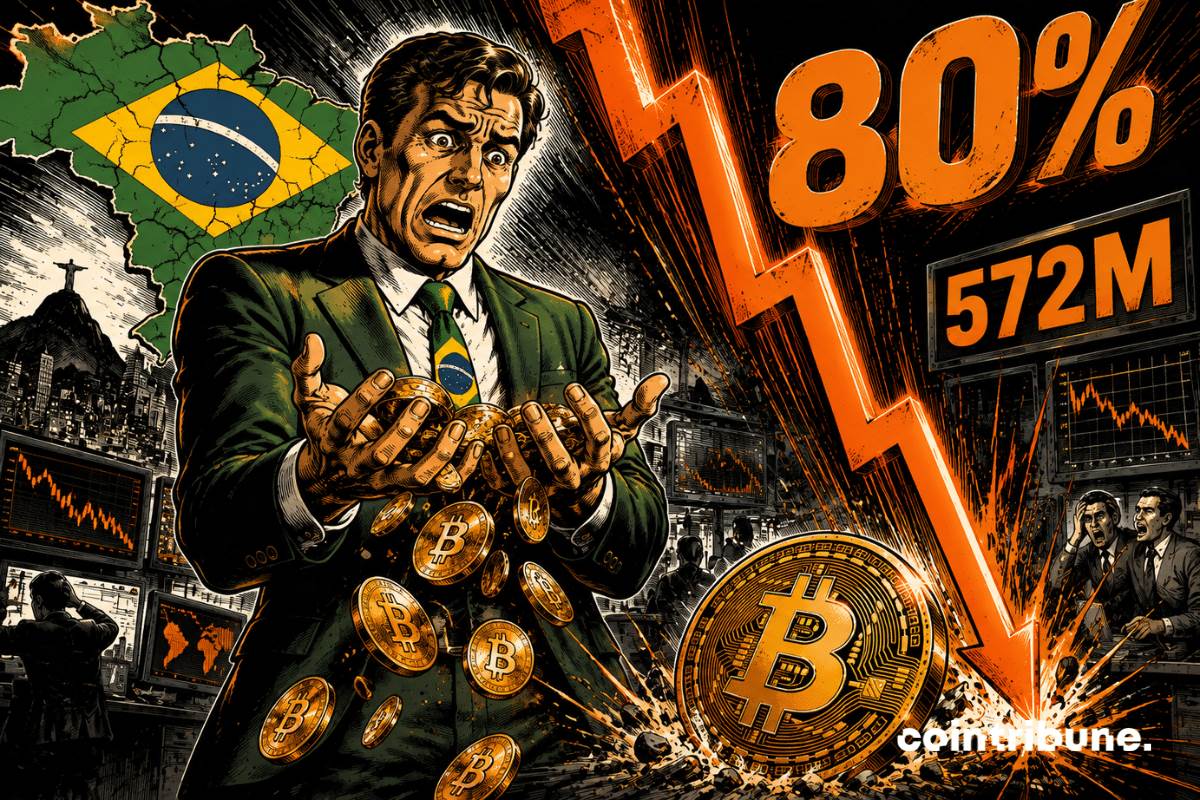
The contrast is stark. According to the balance of payments report released by the Central Bank of Brazil on August 27, the value of cryptocurrencies purchased by Brazilian residents in July was only US$572 million. A month ago, this figure peaked at $2.6 billion. In just 30 days, trading volume plunged nearly 80%. Is this just a coincidence on the calendar? I'm afraid it's hard to believe: July coincides with the first full month after local platforms began fully implementing new governance and anti-money laundering control requirements.
Summary of Key Data
- Monthly comparison: Cryptocurrency purchases fell to US$572 million in July, compared with US$2.6 billion in June.
- Year-on-year change: This amount is nearly 60% lower than the value recorded in July 2025.
- Annual cumulative: In the first seven months of 2026, cumulative transaction volume reached US$15.25 billion, compared with only US$7.61 billion in the same period last year.
stablecoins dominate
This category monitored by the central bank mainly measures the net acquisition volume of cryptocurrencies backed by corresponding liabilities, which is essentially mainly stablecoins . These data are reflected in the "Other Investments" section of the balance of payments report.
Historical background to strengthening bank supervision
Strengthening bank supervision of cryptocurrencies dates back to November 2025: Resolutions 519 to 521 establish the local status of virtual asset service providers (SPSAVs) and force platforms to assume the same anti-money laundering obligations as banks.
[TAG 30] Fernando Rocha, head of the statistics department of the Central Bank of Brazil, explained in Valor Econômico that the decline in trading volumes reflects the restructuring stage of the virtual asset market in the context of increased regulation and supervision. According to him, platform governance procedures and anti-money laundering measures are the main factors leading to this slowdown.Starting from February 2, relevant entities must obtain authorization to identify wallet holders and record the source and destination of funds, while strictly restricting transfers through unauthorized foreign intermediaries. The banking prudential regulatory framework will officially take effect in January 2027.
One point that needs to be clarified
It is necessary to point out a nuance: this decline may not be entirely due to the collapse in demand, but rather to the flow of funds to authorized channels. There is currently no official breakdown data to confirm this.
The overall trend for the year remains positive
The slowdown in July has not erased the potential upward trajectory: between January and July this year, a total of US$15.25 billion was invested in the cryptocurrency sector, compared with only US$7.61 billion in the same period in 2025. Gabriel Galipolo, governor of the Central Bank of Brazil, estimates that about 90% of the country's cryptocurrency activity is conducted through stablecoins, and stablecoins are often used as a payment rather than speculative bets.
The Central Bank of Brazil is not trying to curb the popularity of cryptocurrencies. Its main purpose is to ensure that funds flow through channels that it can monitor, which explains why stablecoins have become a focus of its attention.
Future Outlook
Let's wait and see until the end of September: the next central bank report will reveal whether July was temporary volatility or the beginning of a long-term period of plateau. Another noteworthy deadline is October 1, when Resolution 561 will take effect, banning the use of stablecoins for payments on electronic exchanges. FinTech companies will have to move to traditional exchanges, a shift in trajectory reminiscent of the introduction of European MiCA regulations.