Exchange Ranking
 Top Exchanges
 24h Volume Ranking
 Popularity Ranking
 Exchange BTC Balance
 Proof of Reserves
 Decentralized Exchanges
 Funding Rate
 Funding Heatmap
 Liquidation Data
 Max Pain
 Long/Short Ratio
 Whale L/S Ratio
 Binance/Okex/Huobi L/S
 Bitfinex Margin L/S
 ETF Tracker
 Solana ETF
 XRP ETF
 Hong Kong ETF
 Bitcoin Treasuries
 Crypto Reversal
 Ethereum Reserves
 HyperLiquid Wallet Analysis
 Hyperliquid Whale Watch
 Large Transactions
 On-chain Movement
 Bitcoin ROI
 Stablecoin Market Cap
 Options Analysis
 News
News Articles
 Economic Calendar
 Features
 Wallet
 Contract Calculator


 Security
 Collections
 Watchlist
 Following
 BTC
BTC Senator Warren's team opposes the latest ethical compromise in the cryptocurrency bill
Members of the team of Senator Elizabeth Warren, the lead Democrat on the Senate Banking, Housing and Urban Affairs Committee, are actively disputing the latest ethical compromise included in the revised Clarity Act. The bill is an important piece of cryptocurrency legislation currently before the Senate. Although Senate Republicans made significant concessions during the negotiations, resistance from Warren remained strong.
Warren's concerns about enforcement powers
Staff on Senator Warren's Banking Committee pointed out that the newly proposed state attorneys general's enforcement powers as part of the bill's amendments are largely symbolic. They argue that these mechanisms fail to give state officials a truly independent way to enforce restrictions related to digital asset activities.
In particular, committee staff believe that restrictions aimed at restricting who can issue or sponsor digital assets will primarily affect new tokens launched after the clause takes effect, while previously existing digital assets will largely remain unaffected.
Warren's team argued that the state enforcement mechanisms in the bill "do not constitute a truly independent way to enforce legal restrictions."
Opposition from state officials and industry
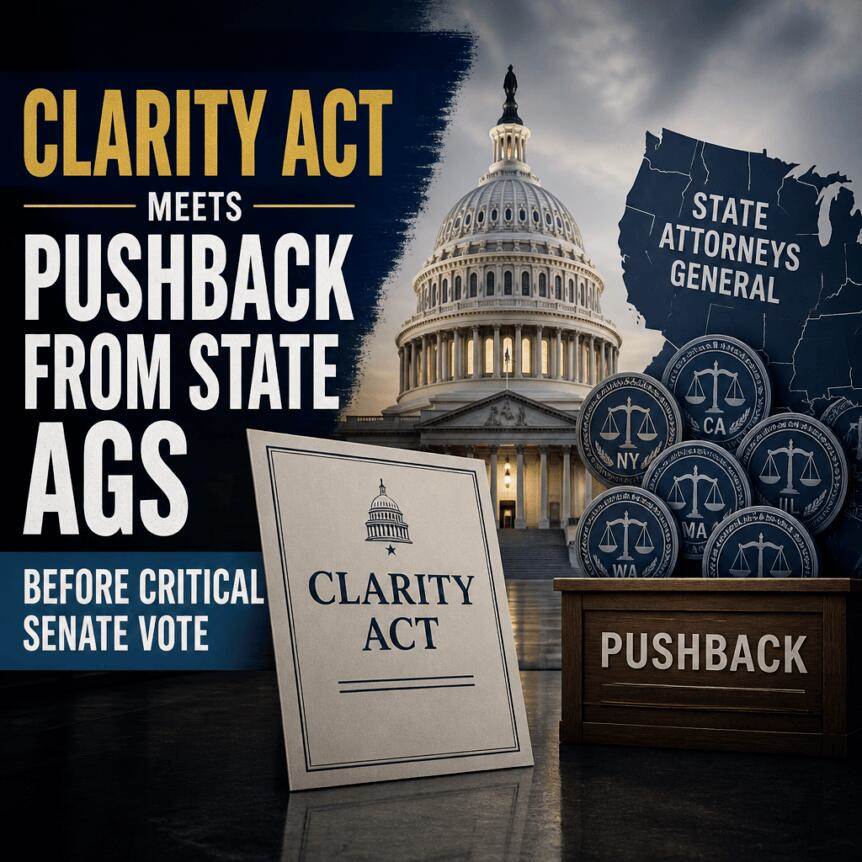
Senator Warren's skepticism is not the only source of opposition. A group of 18 bipartisan state attorneys general led by New York Attorney General Letitia James is calling on lawmakers to reject the Clarity Act. The group warned that provisions of the bill could hinder states from advancing investigations of cryptocurrency-related fraud cases. Their warnings came a day before the Senate was scheduled to vote on procedural matters.
At the same time, multiple sectors of the banking industry have also raised concerns about the bill. Eight major trade groups representing the banking industry have criticized the recently introduced "circuit breaker" clause. The clause aims to address concerns that stablecoin incentive programs may lead to outflows of community bank deposits.
In the cryptocurrency space, criticism has followed as the revised bill narrows the protections previously included in the Blockchain Regulatory Determination Act (BRCA). Some cryptocurrency policy advocates believe that these reductions could undermine the regulatory clarity of digital asset service providers.
Small Dictionary:
Blockchain Regulatory Determinism Act (BRCA): This is a proposed U.S. law designed to define and clarify which blockchain service providers are subject to money transfer regulations, with the intention of creating a more predictable legal environment for blockchain development.
Senate review prospects remain unclear
Uncertainty remains among lawmakers. Prominent Republican Senator Susan Collins of Maine said she has not yet decided whether to support the Clarity Act. Given the bill's recent changes and the fact that the latest version exceeds 600 pages, she described the bill as a "moving target."
Collins explained: "The bill contains new ethics provisions and other provisions, and I still need to evaluate whether it will cause community banks to lose deposits."
The Clarity Act is facing a critical turning point as supporters and critics step up their efforts ahead of key Senate votes.