Exchange Ranking
 Top Exchanges
 24h Volume Ranking
 Popularity Ranking
 Exchange BTC Balance
 Proof of Reserves
 Decentralized Exchanges
 Funding Rate
 Funding Heatmap
 Liquidation Data
 Max Pain
 Long/Short Ratio
 Whale L/S Ratio
 Binance/Okex/Huobi L/S
 Bitfinex Margin L/S
 ETF Tracker
 Solana ETF
 XRP ETF
 Hong Kong ETF
 Bitcoin Treasuries
 Crypto Reversal
 Ethereum Reserves
 HyperLiquid Wallet Analysis
 Hyperliquid Whale Watch
 Large Transactions
 On-chain Movement
 Bitcoin ROI
 Stablecoin Market Cap
 Options Analysis
 News
 Articles
 Economic Calendar
 Features
 Wallet
 Contract Calculator


 Security
 Collections
 Watchlist
 Following
 RLUSD
Singapore's crypto market has expanded significantly in the year ending June 2026
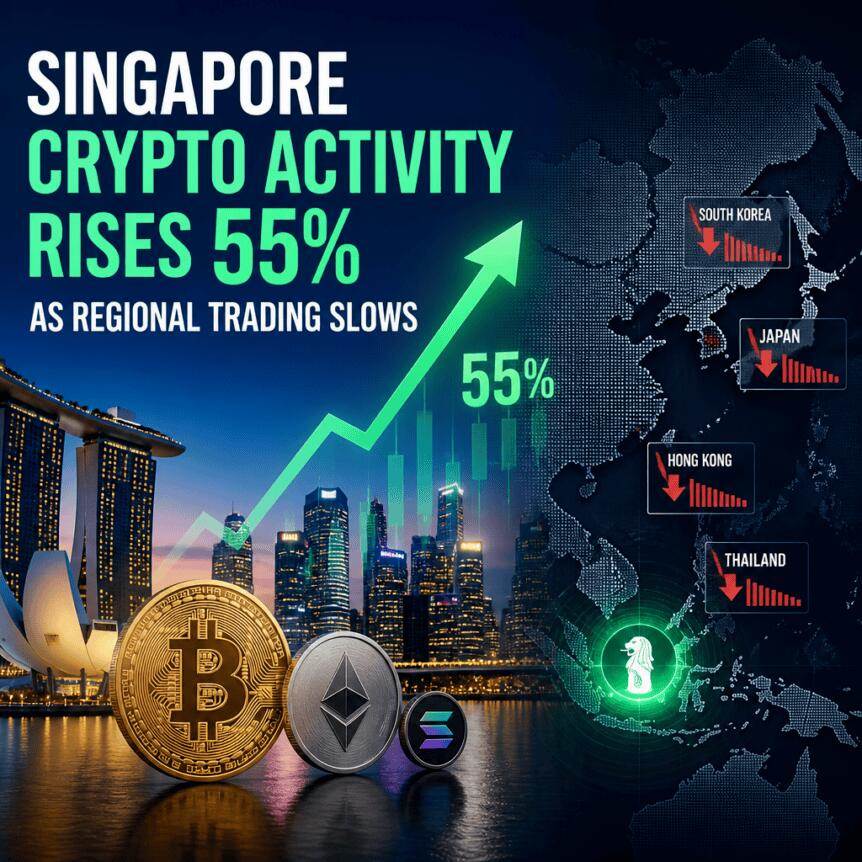
According to Chainalysis data, in the past year ending June 2026, Singapore's crypto economic activity surged by 55.4%, totaling US$284 billion. This growth helped Singapore regain its position as the largest crypto-economy in the Central Asia and Southeast Asia and Oceania (CSAO) region, although the region as a whole contracted during the same period.
Chainalysis's data also points out that the drivers of market activity are shifting: institutional platform transaction volume surged 94% to US$60 billion, while the broader CSAO crypto economy fell 6.8%. The report believes that Singapore's growth is not driven mainly by the influx of new users, but by high trading volume activity concentrated among existing institutions and over-the-counter (OTC) participants.
Key Points
- Total Growth: As of June 2026, Singapore's total crypto economic activity increased by 55.4% to US$284 billion, outperforming the overall 6.8% decline in the CSAO region.
- Institutional leadership: Institutional platform activity nearly doubled (+94%) to US$60 billion, and activity was mainly concentrated in the hands of a small number of market makers, over-the-counter trading companies and institutional brokers.
- Micro-P2P growth in the Philippines, Thailand and Vietnam: Chainalysis reported an increase in micro-P2P transactions in these three countries, with each transfer typically less than US$1000, with the average transfer amount among the three countries being US$618.
- Cross-border stablecoins are more active than domestic ones: In the CSAO markets analyzed, cross-border stablecoin activity exceeded domestic use, and was 3.2 times larger than domestic activity.
Institutional activity underpins Singapore's bucking growth with weak regional performance
Chainanalysis attributes most of Singapore's expansion to institutional platforms. Institutional platform activity increased 94% to $60 billion, with the majority of it concentrated in a small group of entities including market makers, over-the-counter trading companies and institutional brokers.
Chainalysis said the growth was "very concentrated" and mainly reflected high transaction volume transactions on existing platforms rather than the rapid emergence of new services. For market participants, this concentration is significant: it suggests that Singapore's momentum is more closely linked to established liquidity and service providers than to widespread retail expansion.
This timing is consistent with Singapore's broader regulatory direction-while strengthening supervision, continuing to make room for specific areas of innovation such as tokenization, stablecoins and digital asset settlement.
Singapore tightens regulations, MASS supports tokenization
Singapore has been actively adjusting its rules for crypto businesses. In 2025, the Monetary Authority of Singapore (MAS) will require companies serving overseas customers to either obtain licenses or withdraw from the market. StraitsX CEO Tianwei Liu said the change reduces speculative activity while allowing more institutional participants, including banks and large corporate users, to continue blockchain-based production.
At the same time, MAS has expanded plans to incorporate tokenization and settlement into its regulatory framework. Through its BLOOM program, MAS supports piloting using regulated stablecoins and tokenized bank funds. Ripple reportedly joined the program in March to test the use of RLUSD for cross-border trade settlement.
For investors and developers, this combination is noteworthy: Singapore appears to be steering momentum to institutional and settlement use cases, rather than relying on retail speculation as the main driver of measurement activity.
Micro-P2P activity rises in the Philippines, Thailand and Vietnam
While Singapore leads in institutional transaction volume, Chainalysis also saw growth in peer-to-peer (P2P) activity in the Philippines, Thailand and Vietnam. During the reporting period, a total of 5.4 million P2P transfers worth less than US$10,000 were recorded in these three countries (both domestic and cross-border).
Although these transfers are small, they account for 14.4% of the global P2P total, while the total crypto economy in these three markets accounts for only 2.5%. This imbalance highlights the fact that P2P channels are still very important in certain user needs, even if the overall market size is relatively small.
Chainalysis reported that more than four-fifths of domestic P2P transfers in these three markets were less than US$1000, with an average transfer amount of US$618, compared with US$1210 in the rest of the world. This difference suggests that local behavior favors lower-value, more frequent capital flows.
Chainalysis引用的早期报道和宏观指标为这些模式提供了背景。国际货币基金组织此前曾表示,菲律宾当局认为加密使用主要由汇款和投资驱动,世界银行数据显示,2025年个人汇款相当于GDP的8.5%。
越南的P2P市场似乎也受当地交易所流动性的影响。早些时候的报道指出,由于越南盾在直接加密货币交易对中并不广泛支持,P2P交易在该市场是一种重要的法币入口。路透社同样报道,许多越南交易者依赖海外交易所,使P2P渠道成为连接本地银行账户与海外加密货币市场的实用桥梁。
在泰国,监管观察指向稳定币驱动的活动。9月,该国证券交易委员会表示注意到稳定币交易量和价值的显著增加,特别是USDT。
稳定币日益主导跨境流动
在整个地区,Chainalysis发现稳定币在跨境活动中发挥着不成比例的重要作用。在分析的所有市场中,跨境稳定币使用量均超过国内活动,总体跨境活动是国内活动的3.2倍。
Chainalysis表示,稳定币在所有三个市场的活动份额不断增长,其采用可能与易用性、速度和低转账成本有关。
Thailand and Vietnam show considerable domestic stablecoin markets at US$10.4 billion and US$6.9 billion respectively, while in both cases cross-border stablecoin activity remains much larger than domestic activity. In the Philippines, PDAX CEO Nichel Gaba estimates that 5% to 10% of inbound remittances are settled through stablecoins, noting that major remittance companies are advancing stablecoin settlement programs.
This narrative is consistent with the development of the local banking industry. Earlier reports pointed out that the Bank of the Philippines plans to conduct a stablecoin settlement pilot, aiming to reduce the cost and processing time of making overseas payments to Filipino freelancers and remote workers.
Future Outlook
Chainalysis's findings raise a clear question for investors and operators: Will Singapore's institution-led growth continue to be concentrated on existing platforms, or will regulation-backed innovation expand to more new services? At the same time, the increase in P2P volume in some regions of the CSAO and the strong cross-border appeal of stablecoins indicate that user demand for fast, low-cost value transfers continues to evolve, especially in terms of remittances and liquidity entrances.