Exchange Ranking
 Top Exchanges
 24h Volume Ranking
 Popularity Ranking
 Exchange BTC Balance
 Proof of Reserves
 Decentralized Exchanges
 Funding Rate
 Funding Heatmap
 Liquidation Data
 Max Pain
 Long/Short Ratio
 Whale L/S Ratio
 Binance/Okex/Huobi L/S
 Bitfinex Margin L/S
 ETF Tracker
 Solana ETF
 XRP ETF
 Hong Kong ETF
 Bitcoin Treasuries
 Crypto Reversal
 Ethereum Reserves
 HyperLiquid Wallet Analysis
 Hyperliquid Whale Watch
 Large Transactions
 On-chain Movement
 Bitcoin ROI
 Stablecoin Market Cap
 Options Analysis
 News
 Articles
 Economic Calendar
 Features
 Wallet
 Contract Calculator


 Security
 Collections
 Watchlist
 Following
 BTC
 ETH
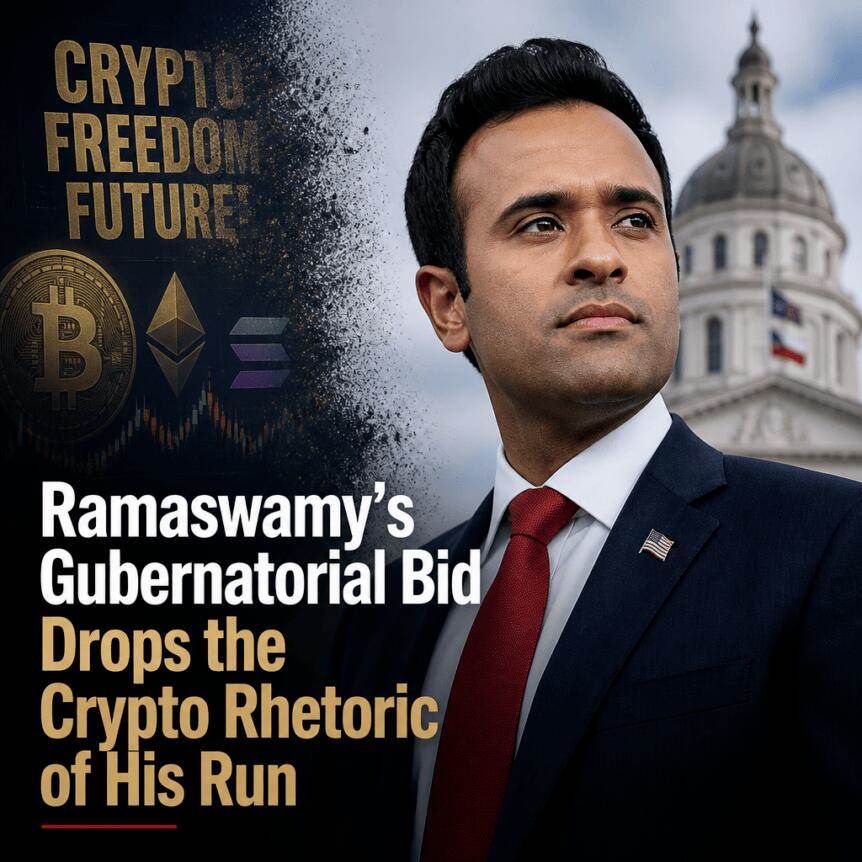
Ramaswamy's stance on cryptocurrencies shifts in Ohio gubernatorial race
Vivek Ramaswamy's political relationship with cryptocurrencies has long been known to American voters: During the 2024 presidential campaign, he frequently promoted Bitcoin and criticized central bank digital currencies, while promoting themes that were beneficial to mining and industry during the campaign. Today, as Ramaswamy enters the Ohio gubernatorial race, his attitude towards digital assets is still visible, but the daily publicity surrounding the issue does not seem to be as prominent as he was in the White House race.
Core Points
Ramaswamy's early presidential campaign relied heavily on the theme of cryptocurrency, but after entering the Ohio campaign, the recent communication of information about digital assets appears to have cooled down.
His campaign still interacts directly with cryptocurrencies, including accepting campaign donations in the form of digital assets.
Cryptocurrency policy signals in support of Ramaswamy continue, including support for an Ohio bill that would allow the creation of strategic bitcoin reserves.
Early polls showed that Ohio voters had a relatively negative view of cryptocurrencies, and data centers had become a controversial election issue.
Ohio's election dynamics-coupled with the huge industry-related spending seen in recent years-suggest that even if cryptocurrency is not always the headlines, it is part of political calculations.
From the presidential podium to the Ohio ballot box
In his attempt to win the Republican presidential nomination in 2024, Ramaswamy has made cryptocurrency a regular theme. He has repeatedly opposed central bank digital currencies, praised Bitcoin and mining, and even appeared at industry events as a keynote speaker. After Donald Trump won the election, Ramaswamy was assigned to co-lead the Department of Government Efficiency (DOGE) with Elon Musk, although he left before officially becoming a member of the executive team.
When he turned his attention to Ohio, he didn't completely disengage from the topic of cryptocurrency-he continued to post in support of state-level digital asset initiatives. Before running for governor in February 2025, he publicly supported the Ohio Strategic Cryptocurrency Reserve Act, a state bill that would allow the creation of strategic bitcoin reserves.
At the same time, the tone was different from his presidential campaign. According to reports, as of September 2026-just weeks before the election-Ramaswami's public statements on digital assets and related policies have been "weakened" compared to his remarks in 2024 and 2025.
Investment exposure, industry connections and campaign finance
拉马斯瓦米的竞选活动与加密货币的联系不仅仅停留在口号层面。他的竞选网站接受加密货币捐赠,候选人还从与世界 liberty 金融(World Liberty Financial,一家与特朗普家族有关的加密货币公司)有关联的人物那里获得了财政支持。文章指出,三位联合创始人——Chase Herro、Zak Folkman 和 Zachary Witkoff——每人捐赠了最高允许的16,615美元。
除了个人捐款外,与行业相关的团体也向拉马斯瓦米的超级政治行动委员会“V-PAC:胜利者而非受害者”投入了大量资金。文件显示,主要加密货币关联支持者进行了捐款,包括苏富比国际集团联合创始人杰夫·亚斯(Jeff Yass)捐赠的2,000万美元、NYDIG创始人罗斯·史蒂文斯(Ross Stevens)捐赠的600万美元,以及埃隆·马斯克捐赠的500万美元,此外还有比特币选民项目捐赠的5,000美元等额外捐款。这些数字归因于竞选财务记录。
Ramaswamy also maintains a stake in Strive, an asset management company he co-founded in 2022. According to sources, Strive held 23,156 bitcoins worth approximately $2 billion as of August 28; filings filed with the U.S. Securities and Exchange Commission in August showed that Ramaswami owned 5,693,897 shares in the company, valued at more than $170 million as of September 26. The report further noted that according to an Ohio disclosure document hosted by Signal Ohio, Ramaswamy himself reported that as of April, he held more than $1,000 in Bitcoin and Ethereum through the Coinbase wallet.
Ohio voters: Suspicion of cryptocurrencies and boycott of data centers
Part of the reason cryptocurrencies may no longer be central to Ramaswami's current propaganda is voters 'reaction to infrastructure related to digital assets. Compared with other states, Ohio shows signs of suspicion about cryptocurrencies. Data shows that a poll conducted by the Digital Currency Group in May 2024 showed that Ohio respondents "have a more negative attitude towards cryptocurrencies": 79% said they had never owned cryptocurrencies, and 77% expressed a negative view of cryptocurrencies.
In the 2026 campaign environment, political controversy is not just about the assets themselves, but also about the physical expansion surrounding them. Data centers have become the focus of Ohio politics. Data shows that as of April, Ohio had 166 data centers, more than any other state. The state also owns cryptocurrency mining businesses such as Cipher Mining, Bitdeer and BIT Mining.
Polls also show that many Ohio residents oppose building data centers in their communities. Ramaswamy reportedly promised in August that any data center built in Ohio communities would exempt residents from electricity bills and reduce property taxes. His Democratic opponent, Amy Acton, proposed that data centers and their investors bear the cost of gas, water and electricity needed for the data center, rather than Ohio taxpayers or communities.
Why the timing of 2026 looks different
Even though cryptocurrency is not always a central talking point, it still exists in Ohio politics. The state has been a target of industry-related political spending. Data shows that industry-aligned groups spent more than $40 million in 2024 to support Republican Bernie Moreno's Senate race. After Moreno defeated incumbent Democrat Sherrod Brown, Brown appeared on the ballot again-this time against Republican Jon Husted-and cryptocurrency-related groups are positioning the contest again. Fairshake promised to initially spend $30 million against Democrats and has reported buying $11 million in advertising, the report noted.
Market-style election odds tracked through event contracts and polls add to Ohio's sense of intense competition. Data shows that as of September 22, Acton leads by one point. The Kalshi incident market contract was also cited, when reports at the time showed bets of more than $2 million, with a 66% probability of favoring Acton, as were similar odds on Polymarket.
At the same time, sources point to a potential contrast between Ramaswamy's early cryptocurrency rhetoric and later political posturing. In September 2026, Ohio's Secretary of State announced that it would accept cryptocurrency to pay state fees and taxes, but as of the time of the report, Ramaswamy had not responded to this notice-an emphasis that Ohio's cryptocurrency debate is increasingly entangled with national policy implementation, rather than just campaign branding.
As the Ohio gubernatorial race intensifies, watch whether Ramaswamy returns to more direct cryptocurrency policy propaganda or continues to shift to specific infrastructure issues such as data center and local costs that may drive voter sentiment. Statements and debates in the next few weeks should clarify whether cryptocurrencies are an item on the governance agenda or whether they become a more secondary issue in a competition shaped by community influence.