Exchange Ranking
 Top Exchanges
 24h Volume Ranking
 Popularity Ranking
 Exchange BTC Balance
 Proof of Reserves
 Decentralized Exchanges
 Funding Rate
 Funding Heatmap
 Liquidation Data
 Max Pain
 Long/Short Ratio
 Whale L/S Ratio
 Binance/Okex/Huobi L/S
 Bitfinex Margin L/S
 ETF Tracker
 Solana ETF
 XRP ETF
 Hong Kong ETF
 Bitcoin Treasuries
 Crypto Reversal
 Ethereum Reserves
 HyperLiquid Wallet Analysis
 Hyperliquid Whale Watch
 Large Transactions
 On-chain Movement
 Bitcoin ROI
 Stablecoin Market Cap
 Options Analysis
 News
 Articles
 Economic Calendar
 Features
 Wallet
 Contract Calculator


 Security
 Collections
 Watchlist
 Following
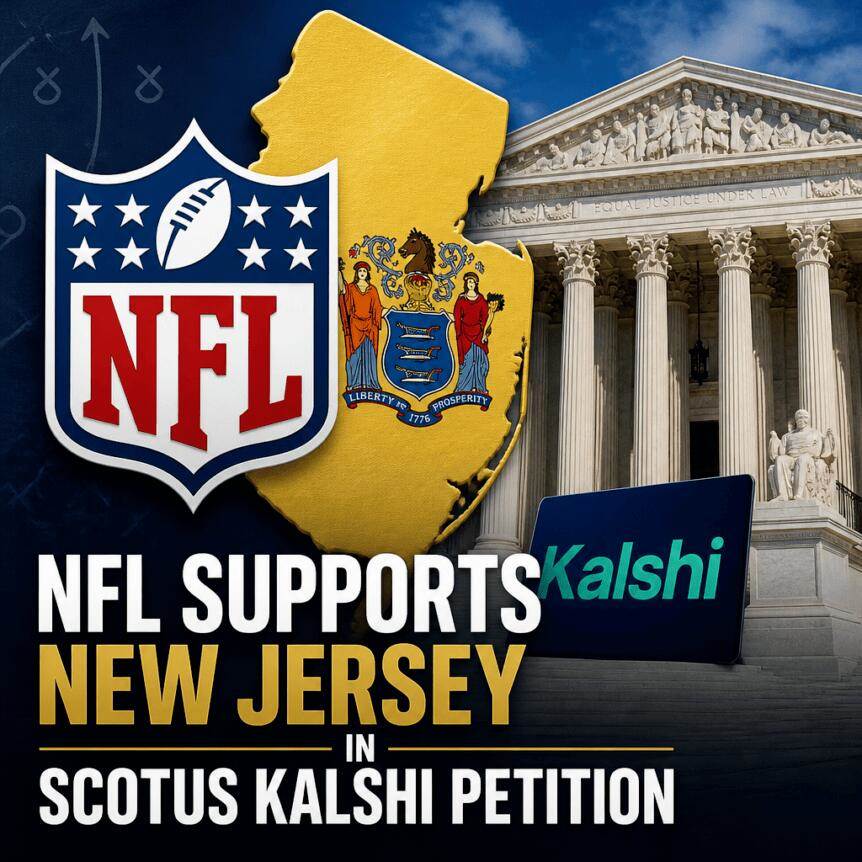
NFL backs New Jersey petition filed with Supreme Court over Kalshi prediction market platform
The NFL has filed an amicus curiae brief urging the U.S. Supreme Court to hear a case related to New Jersey's challenge to prediction market platform Kalshi. The NFL argued in its opinion that Supreme Court review was crucial to clarifying the classification of event contracts and determining regulatory jurisdiction-that is, whether state authorities or the Federal Commodity Futures Trading Commission (CFTC) were responsible. [TAG
In the opinion filed Wednesday, the NFL sided with New Jersey Attorney General Jennifer Davenport and interim Game Enforcement Director Mary Jo Flaherty, who had previously asked the Supreme Court for permission to review. Their petition seeks to clarify whether prediction market firms are subject to state or federal regulation, a dispute that is becoming increasingly important for an industry built on contracts that link transactions to real-world outcomes.
Key Points
- The NFL supports New Jersey's petition to the Supreme Court in the Kalshi controversy, which centers on predicting whether the regulatory body of the market is the state government or the CFTC.
- The league believes that certain sports event contracts are "extremely susceptible to manipulation" and may undermine "the integrity of the game."
- The NFL argues that the dispute also involves the issue of labeling-whether event contracts on prediction platforms should be regarded as "swap contracts."
- The New Jersey case is part of a broader regulatory divide; another 39 states and Washington, D.C., filed another independent amicus curiae opinion warning of a "national turf war."
The NFL supports New Jersey's push for the Supreme Court to provide clear guidance
According to amicus curiae documents filed by the NFL, the Supreme Court should respond to New Jersey's request to grant a writ to resolve issues related to forecast market jurisdiction. The league said the case should be reviewed to "maintain the integrity of the game" and "protect customers," adding that the way the contracts are regulated will affect sports governance and consumer safeguards.
The NFL also pointed out its own influence in predicting market activity. Cited data showed that on the first Sunday of the season,"more than half of all forecast market trading volume" was related to the NFL-about $1.8 billion, while total trading volume was $3.3 billion, as described in the briefing sheet. This emphasis may be aimed at highlighting the actual stakes: If NFL-related contracts are in a regulatory gray area, the consequences can ripple into huge trading volumes.
"Manipulative" event contracts and integrity arguments
A core theme in the NFL document is that certain contracts are particularly vulnerable to manipulation, especially when the outcome may be influenced by someone with internal control of performance. The NFL specifically describes the risks that a "single person" can affect the outcome, giving examples, such as players changing performance, coaches changing team lineup, or officials making (or not making) certain penalties.
The NFL's position is that these are one of the biggest threats to the integrity of games on prediction market platforms. In addition to being framed as a matter of fairness in competition, manipulation arguments have also been used as a reason to strengthen regulatory review and clarify which types of event-based contracts are allowed.
Classification,"Swap Contracts" and the Role of the CFTC
In addition to manipulation concerns, the NFL also said the case raised issues involving contract labeling for sporting events. The Alliance believes that reviewing how the nature of these contracts is defined is crucial to determining the appropriate legal treatment and regulatory framework.
The opinion also highlights the federal regulatory structure. It argued that the CFTC lacked what the NFL called "reasonable safeguards" for event contracts and viewed federalization of sports betting regulation-rather than leaving it mainly to states-as a "significant issue" suitable for the Supreme Court's consideration.
This expression is important because prediction markets are at the intersection of commodity regulation, state rules of the game and broader consumer protection expectations. If the Supreme Court decides that the CFTC's powers are broader than states assume (or narrower than the CFTC claims), it could reshape the way these platforms operate in various jurisdictions.
States warn of escalating regulatory conflicts
The Supreme Court dispute is not just a story between New Jersey and federal agencies. According to a document released in the Supreme Court file, 39 U.S. states and Washington, D.C., filed an amicus curiae opinion supporting New Jersey's position before the NFL filed its opinion. In the opinion, states described the conflict between the CFTC and state authorities as a "national turf war" that cannot be resolved without guidance from judges.
States warn that waiting could lead to an escalation of disputes, arguing that this creates a lack of certainty about the applicable law and to whom it applies. They also described the matter as a divisive issue in the circuit courts-suggesting that different legal interpretations across the country have led to inconsistent decisions by platforms and regulators. States are asking the Supreme Court to clarify the powers of the CFTC and provide direction to lower courts.
For Kalshi, the regulatory patchwork is part of his argument. After New Jersey filed a lawsuit in September, Kalshi spokesman Dani Lever said the company could not be regulated by "50 different regulators." The Supreme Court's involvement will largely determine whether this conflict is resolved through federal decision-making rules or whether litigation continues to be pursued in a parallel state-to-state framework.
The next step in the Kalshi case
As of Thursday, the Supreme Court had not said whether it would approve the review. Kalshi has been given an extension to respond to the New Jersey filing, and the company has until November 9 to resolve issues related to jurisdiction, allegedly manipulable incident contracts and consumer protection.
Traders, platform operators and sports stakeholders will be watching closely whether the Supreme Court agrees to hear the case and, if so, how it will resolve classification and regulatory authority issues at the heart of the dispute.