Exchange Ranking
 Top Exchanges
 24h Volume Ranking
 Popularity Ranking
 Exchange BTC Balance
 Proof of Reserves
 Decentralized Exchanges
 Funding Rate
 Funding Heatmap
 Liquidation Data
 Max Pain
 Long/Short Ratio
 Whale L/S Ratio
 Binance/Okex/Huobi L/S
 Bitfinex Margin L/S
 ETF Tracker
 Solana ETF
 XRP ETF
 Hong Kong ETF
 Bitcoin Treasuries
 Crypto Reversal
 Ethereum Reserves
 HyperLiquid Wallet Analysis
 Hyperliquid Whale Watch
 Large Transactions
 On-chain Movement
 Bitcoin ROI
 Stablecoin Market Cap
 Options Analysis
 News
 Articles
 Economic Calendar
 Features
 Wallet
 Contract Calculator


 Security
 Collections
 Watchlist
 Following
 EURC
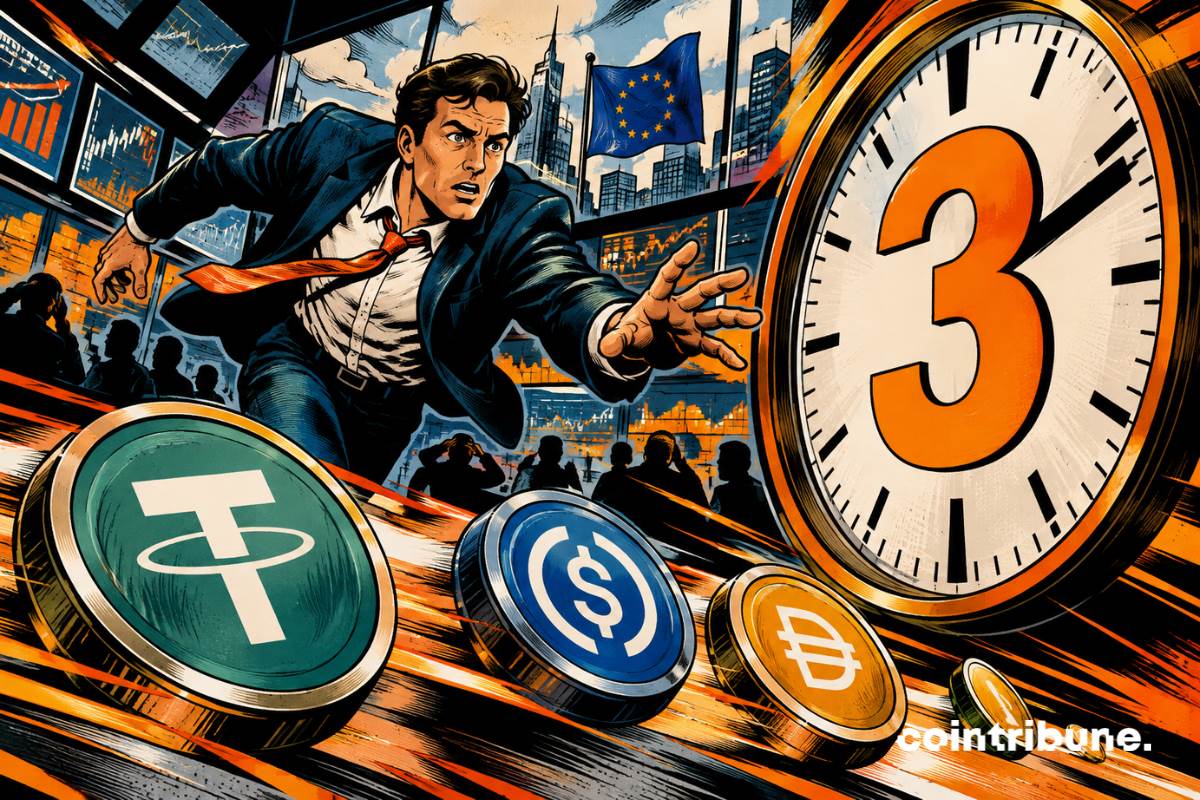
The European Securities and Markets Authority issued an opinion: Non-compliant stablecoin services will face comprehensive restrictions
On October 8, 2026, the European Securities and Markets Authority (ESMA) issued an important opinion, which essentially denied the EU's authorization of crypto service providers to provide almost any services to stablecoins that do not comply with the Cryptographic Asset Markets Regulation (MiCA). The core case points to the USDT of Tether, the world's largest stablecoin by market capitalisation. As of October 8, 2026, according to CoinGecko data, the USDT market size is approximately US$184 billion and has not yet been authorized for Electronic Money Tokens (EMT) in the EU.
Regulators from various countries such as the German Federal Financial Supervisory Authority (BaFin) will be required to clear up remaining positions on the platform within three months of the issuance of the opinion, that is, no later than January 8, 2027. For the holder, this does not mean that the account will be frozen immediately. Instead, it's a one-way street: Selling, exchanging, transferring and withdrawing cash will still be possible, but purchasing more or continuing transactions on authorized EU platforms will no longer be allowed. The length of time the service provider retains this window is not determined by ESMA, but by BaFin and the service provider itself. In similar cases, some exchanges closed the window well before the deadline.
Core content of ESMA's October 8, 2026 opinion
The document is numbered ESMA75-113276571-1742 and is titled "Opinions on the Provision of Cryptographic Asset Services Related to Non-MiCA-compliant Asset Reference Tokens and Electronic Currency Tokens." An opinion is a formal statement issued by ESMA to national regulatory authorities aimed at establishing consistent regulatory practice across the EU; its legal basis is Article 29(1)(a) of the ESMA Regulation, or Regulation (EC) No. 1095/2010.
The key sentence is located in paragraph 12, with concise and powerful wording: ESMA believes that crypto service providers should not provide crypto asset services on ARTs (asset reference tokens) or EMTs (electronic currency tokens) that fail to meet MiCA requirements. There are no grace periods, no grandfather clauses, and no exemptions for tokens that operate only at the technical level. This opinion is based on the previous European Commission Question and Answer 2404 and ESMA's earlier public statements, and has significantly tightened its position.
One point needs to clarify the background: In paragraph 7, ESMA made it clear that it did not change its existing position, nor did it claim that every personal service surrounding such tokens automatically constitutes an offer or listing to the public within the meaning of MiCA Articles 16 and 48. Instead, it raises broader regulatory expectations: whether authorized providers can continue to provide such services depends on whether they comply with their obligations under MiCA Title 5.
ARTs and EMTs: Which tokens are covered by the opinion?
MiCA recognizes two types of stablecoins. Asset Reference Tokens (ARTs) maintain value stability by referencing a basket of multiple assets, currencies or commodities. Electronic money tokens (EMT) refer to only one official currency, such as the euro or the U.S. dollar. Classic dollar stablecoins fall into the second category.
According to the footnote in the opinion, if the conditions for a legal public offer or listing in the EU under Title 3 or Title 4 of MiCA are not met (including any exemptions and transition clauses), they are considered non-MiCA-compliant tokens. In practice, it boils down to a single question: whether the issuer holds an EU authorization and has notified the white paper.
The opinion deliberately did not mention any specific token name. It is a regulatory benchmark, not a list. Which tokens are bound by it depends on the regulatory register and the platform's own announcements, not the document itself.
USDT, PYUSD and MiCA authorization status
CoinDesk reported on October 8, 2026 that USDT was the main case: it is the largest stablecoin and is not authorized in the EU. The media also pointed out that PayPal's PYUSD is another unauthorized token. According to multiple industry publications, Tether has never applied for authorization as an e-money token, citing MiCA's reserve requirement that most of the backing assets must be placed in bank deposits within the EU.
On the other hand is a growing group of authorized tokens. Circle's USDC and euro stablecoin EURC are issued by Circle Internet Financial Europe SAS, an electronic money institution authorized in France and supervised by the ACPR; its white paper was notified on July 1, 2024 (the date the MiCA stablecoin rules come into effect). Other examples routinely listed as EMTs in trade news include Société Générale's EURCV, EURI, and EURQ and USDQ tokens issued by Quantoz Payments. Total data varies, ranging from about 25 authorized issuers to about 30 authorized e-money tokens; only regulatory registers can provide reliable answers to individual cases.
According to CoinGecko data, as of October 8, 2026, the market value of USDC is approximately US$73 billion. The gap is huge compared to the USDT, and this is where the opinion puts real pressure: the most liquid tokens mean they will disappear from the EU order book. The impact of spreads and trading pairs will not become apparent until large platforms announce switch dates.
One nuance that can easily be concealed by headline noise is that the opinion has no ban on individual users. It binds authorized providers. Holding, receiving or sending USDT, or redemption on a decentralized exchange, is still allowed for users. It is service, not ownership, that is prohibited. Tether's clause on freezing addresses clearly illustrates the embarrassment that can arise from controlling such balances.
Until January 8, 2027, the window will remain open: you can sell, exchange, transfer and withdraw cash. But you can't buy more.
MiCA Article 66 as leverage: Notices and warnings are insufficient to respond to ESMA's requirements
Legally, this opinion relies on MiCA Article 66(1). The clause requires encryption service providers to act honestly, fairly and professionally in the best interests of their customers. According to ESMA's interpretation, CASPs (crypto asset service providers, i.e. authorized crypto service providers) are violating this responsibility if they know that customers will be at risk due to the unregulated status of the token. This refers to the issuer level safeguards required by MiCA: reserve support, redemption rights, governance and ongoing reporting obligations.
The most striking thing is paragraph 19. ESMA here closed the escape routes the industry had counted on: risk warnings, additional disclosures and customer confirmations that were deemed insufficient by authorities. Warnings do not prevent tokens from continuing to be available. The provider's own risk assessment presupposes complex legal and operational judgments, which will vary from company to company. As a result, it is difficult for customers to accurately assess the importance of missing safeguards.
Paragraph 21 broadly delineates the scope of affected services. Including trading platform operations, exchange services, order execution, order receiving and transmission, crypto asset placement, consulting, transfer services, custody and portfolio management. Under Article 22, companies should implement technical, contractual and organizational controls to prevent EU customers from establishing or increasing positions in such tokens. This is a directive for the system architecture, not a detailed rule.
第20段增加了一个很少引起关注的监管论点:只要不合规代币通过授权公司运行,国家当局就无法执行白皮书质量和营销沟通,也无法监控交易是否损害持有者的利益。因此,该意见不仅着眼于投资者保护,还着眼于规则本身的可执行性。
三个月的最后期限将于2027年1月8日到期
硬数字位于第27段。当国家当局发现剩余的遗留持有时,应要求其尽快清算,最迟不得晚于意见发布后三个月。意见于2026年10月8日发布,因此2027年1月8日是最后期限。任何服务的延续应严格限于销售、交换、转账和提现,限时、基于风险且受到密切监督。
在此背景下,三个月并非宽松的过渡期,而是上限。“尽快”一词排在前面,是实际需求;截止日期是限制,而非目标。一家等到一月初才行动并援引1月8日截止日期的公司,恰恰没有满足意见的预期。
在实际操作中:预计日期将早于2027年1月8日。在第24段中,ESMA要求将这些残余服务清晰地传达给客户。因此,你通过电子邮件或账户收到的来自交易所的通知日期才是对你适用的日期,而不是头条新闻中的日期。如果你在圣诞节期间不看你的投资组合,你可能会错过仅开放几周的切换窗口。
Paragraph 28 Closed Loop: ESMA intends to work with national authorities to monitor whether opinions are quickly applied. Authorities that set deadlines and measure compliance themselves leave little room for quietly delaying.
Sell only: Selling, redemption, transfer and withdrawal are still allowed
Paragraphs 23 and 24 of the opinion provide for a narrowly drawn exception. National authorities may allow providers that have not yet met the requirements to provide strictly limited residual services as long as they are necessary for orderly liquidation and avoid harm to customers. Actions allowed under this rule include clearing, exchanging, withdrawing, transferring money and custody of existing positions. "Sell only" accurately describes this state: trading pairs remain open for sale, but the system no longer accepts purchase orders.
Acts not allowed in the same paragraph include new acquisitions, advertising, transactions, active distribution and continued market availability of tokens. For holders, the most important point in this paragraph is that escrow appears on the list of allowed services: your balance does not disappear overnight, and withdrawing it into your own wallet is a clearly envisioned path.
The difference between this and ordinary removal lies in the motivation. Providers that remove trading pairs for commercial reasons can resume it. There is a regulatory expectation behind this that applies to every authorized provider in the EU. Therefore, moving to the next platform within the EU will predictably lead to the same results.
Opinion is directed to national regulators, not holders and Tether. In Germany, BaFin is implemented from here.
BaFin implements the Opinion in Germany
According to paragraph 9, the Opinion is first addressed to the competent national authority. For Germany, this is the Federal Financial Supervisory Authority (BaFin). In accordance with paragraph 25, BaFin shall evaluate whether authorized providers within its jurisdiction provide services involving non-compliant tokens or maintain their availability to customers in the EU, and ensure that the company implements appropriate controls in accordance with paragraph 26.
This produces a sequence worth noting: ESMA sets benchmarks, BaFin applies them to specific business models, and then the platform gives you dates. There is a period of time between October 8, 2026 and your provider's notification that is currently uncertain. How BaFin directly decided to authorize was demonstrated in this fall's bitcoin.de and its denied MiCAR license case.
There are two questions worthy of answering separately for your provider. First: Is it authorized in the EU? Only in this way can the opinion be directly applied. Second: Which entity holds your account? Large providers often serve EU customers through a dedicated European entity, the only entity that is regulated here. These two details appear in your contract documents and regulatory registers, not in the app's promotional materials.
Providers without EU authorization are not what they appear to be safe harbors. ESMA already includes reverse solicitation, the practice of third-country companies serving EU customers, in its regulatory plans. Moving accounts outside of the European framework only transfers the problem, not solves it.
Holding periods and exemption thresholds: Converting USDT is considered a sale
Tax considerations are more uncomfortable than it initially seems. In Germany, anyone who converts USDT to USDC or euros constitutes a disposal of assets. The applicable rules are Article 23 of the German Income Tax Law and its one-year holding period: If there is less than one year between acquisition and disposal, the income is subject to tax, and the tax exemption threshold for private disposal is € 1000 per year. Beyond this threshold, the entire proceeds will be taxed, not just the portion above the threshold.
For U.S. dollar stablecoins, the instinct is that there will be no gain. The price is displayed as one dollar and is consistent. But in Germany, calculations are done in euros, and the euro-dollar relationship may have changed significantly between acquisition and conversion. This is where the taxable gain or loss comes from, even if there is no change in the dollar price of the token.
Recording is the next step. Forced conversions initiated by the platform are tax-wise like any other sale, requiring the acquisition date, acquisition price and disposal price. Before downloading transaction data, make sure that the transaction pair has not been closed and the account has not been migrated, otherwise the acquisition process may become cumbersome. Pull reports while they are still available. Tools to automatically collect history can be found in our comparison of cryptocurrency tax tools and combination trackers.
One note that is often missing here is that this article does not constitute tax advice and the handling of the case depends on your acquisition history. However, the direction is clear. Conversation is not a neutral administrative step, but a transaction with tax consequences.
USDT余额的三条路径
第一条路径是兑换为授权稳定币。余额留在加密市场中,保留了欧洲平台的流动性,并触发上述税务后果。如果目的是以欧元计价,可以考虑欧元EMT;如果涉及美元交易对,则考虑授权美元代币。
第二条路径是以欧元提现。如果你无论如何都将余额作为停放头寸,你只会失去随时交易的能力,而银行帐户享有存款保险,这是稳定币从未有过的。税务后果与兑换相同。
第三条路径是提取到你自己的托管中。它保留了代币,但没有改变其状态:此后你将无法在授权的欧盟平台上交易它。选择这条路,你自己承担密钥的责任,且转错地址无法撤销。设备概览可在我们的硬件钱包比较中找到。
哪条路径适合取决于你的目的。如果你将USDT作为两个头寸之间的中转站,兑换为授权代币是最干净的解决方案。如果余额已经闲置数月,提现是更简单的步骤。在你的交易所发送通知之前做出决定,而不是之后:在仅卖出的窗口中,你是在许多人同时想要同一事物的市场中交易。
ESMA稳定币最后期限:退出通道至2027年1月8日开放
The opinion was released on October 8, 2026, the deadline for clearing is January 8, 2027, and the dates applicable to your account come from your platform. There are three steps to avoid falling into the final window:
- Determine your position and the status of your provider. Open your account and notice what stablecoins are there and which entity your contracts run through. If the provider is authorized in the EU, this opinion applies directly.
- Save your trading history. Download the full report while the transaction pair is still active because the acquisition date and acquisition price determine the tax consequences of the redemption.
- Select a path and execute it. Make the decision between authorizing stablecoins, euro withdrawals, and your own custody, and take action before the date set by your provider. For the third path, hardware wallets are more helpful in selecting devices.