Exchange Ranking
 Top Exchanges
 24h Volume Ranking
 Popularity Ranking
 Exchange BTC Balance
 Proof of Reserves
 Decentralized Exchanges
 Funding Rate
 Funding Heatmap
 Liquidation Data
 Max Pain
 Long/Short Ratio
 Whale L/S Ratio
 Binance/Okex/Huobi L/S
 Bitfinex Margin L/S
 ETF Tracker
 Solana ETF
 XRP ETF
 Hong Kong ETF
 Bitcoin Treasuries
 Crypto Reversal
 Ethereum Reserves
 HyperLiquid Wallet Analysis
 Hyperliquid Whale Watch
 Large Transactions
 On-chain Movement
 Bitcoin ROI
 Stablecoin Market Cap
 Options Analysis
 News
News Articles
 Economic Calendar
 Features
 Wallet
 Contract Calculator


 Security
 Collections
 Watchlist
 Following
 BTC
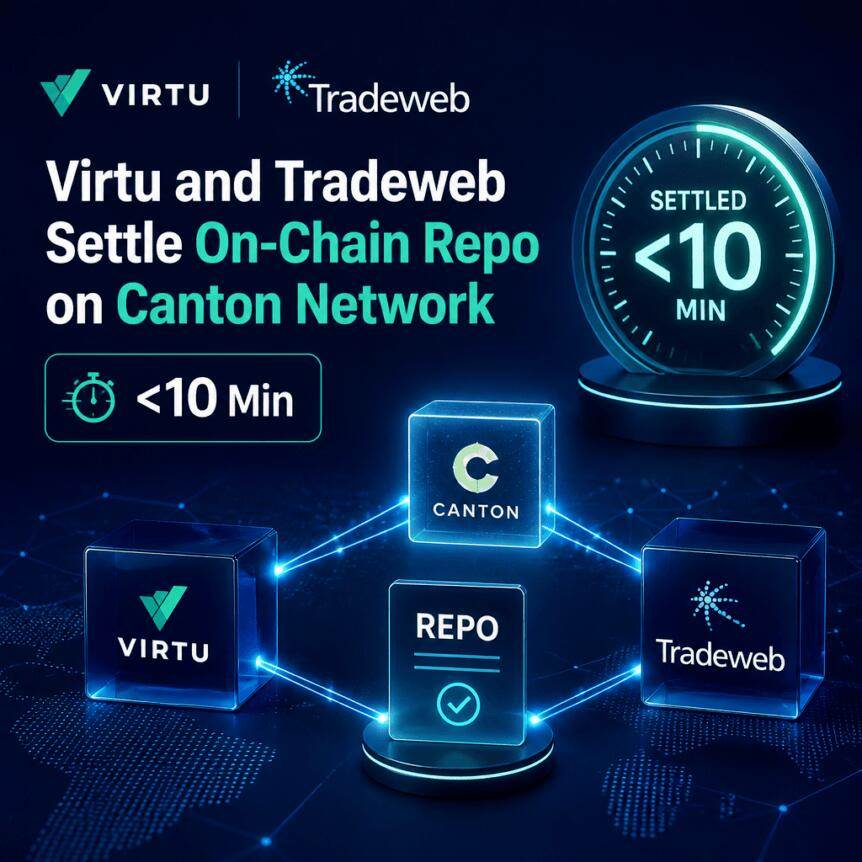
BTC Virtu Financial and Tradeweb complete the first full chain repo transaction
Virtu Financial and Tradeweb have completed what is known as the first full chain repo transaction, settled with sovereign digital bonds issued by the Marshall Islands, marking a tangible step in bringing institutional fixed income infrastructure to the public blockchain track.
What did Virtu and Tradeweb accomplish in an on-chain repo transaction
A repurchase agreement is a short-term secured borrowing: a party sells securities and agrees to repurchase them at a later date at an agreed price, using the securities as collateral for cash. This is one of the largest and most regular basic markets in traditional finance.
In this transaction, Virtu and Tradeweb executed the transaction entirely on-chain. Both companies are well-known institutions in electronic trading and market-making, making the deal more iconic rather than experimental.
Why Marshall Islands digital bonds are crucial in this structure
In repo transactions, collateral is the key. When the collateral is a tokenized sovereign bond, the securities themselves can be moved and settled on the same ledger as the cash portion, which is a defining detail rather than a secondary footnote.
Details of this digital tool are set out in the Marshall Islands USDM1 white paper as part of the jurisdiction's broader effort to build a tokenized real-world asset infrastructure. Programmable on-chain tools like this follow the trend of tokenized finance and attract companies including Ripple to enter the institutional product line.
The structural difference from traditional repo lies in settlement. Traditional workflows rely on independent custody, clearing and messaging systems for off-chain reconciliation; on-chain repos can atomically settle securities and payment portions on a shared ledger, shortening the time lag between transaction and settlement.
What does this mean for institutions to adopt on-chain markets
Since the participants are recognized market institutions and the transaction is an actual execution rather than a simulation, the transaction can be viewed as a real use case rather than a theoretical pilot. This distinction is critical for institutions that are assessing whether the on-chain track can carry real secured financing flows.
This falls entirely under the category of crypto news, as it connects the core traditional market structure-the repo market-with blockchain execution. The same institutional adoption line is reflected in strategies such as BlackRock's reduction of its IBIT self-custodial transfer minimum and Strive's $50 million bitcoin fundraising.
Summary of Points
Virtu and Tradeweb executed a fully on-chain repurchase transaction.
The collateral is the sovereign digital bonds of the Marshall Islands.
This structure suggests that institutions are experimenting with tokenized settlements rather than the proven large-scale adoption.
sees it as an incremental milestone in the market infrastructure space. It is worth noting next whether these institutions will move from single transactions to repeatable and scalable on-chain repurchase activities, and whether other sovereign or corporate issuers will follow the Marshall Islands digital bond model.