Exchange Ranking
 Top Exchanges
 24h Volume Ranking
 Popularity Ranking
 Exchange BTC Balance
 Proof of Reserves
 Decentralized Exchanges
 Funding Rate
 Funding Heatmap
 Liquidation Data
 Max Pain
 Long/Short Ratio
 Whale L/S Ratio
 Binance/Okex/Huobi L/S
 Bitfinex Margin L/S
 ETF Tracker
 Solana ETF
 XRP ETF
 Hong Kong ETF
 Bitcoin Treasuries
 Crypto Reversal
 Ethereum Reserves
 HyperLiquid Wallet Analysis
 Hyperliquid Whale Watch
 Large Transactions
 On-chain Movement
 Bitcoin ROI
 Stablecoin Market Cap
 Options Analysis
 News
News Articles
 Economic Calendar
 Features
 Wallet
 Contract Calculator


 Security
 Collections
 Watchlist
 Following
 ETH
ETH  SOL
SOL  USD1
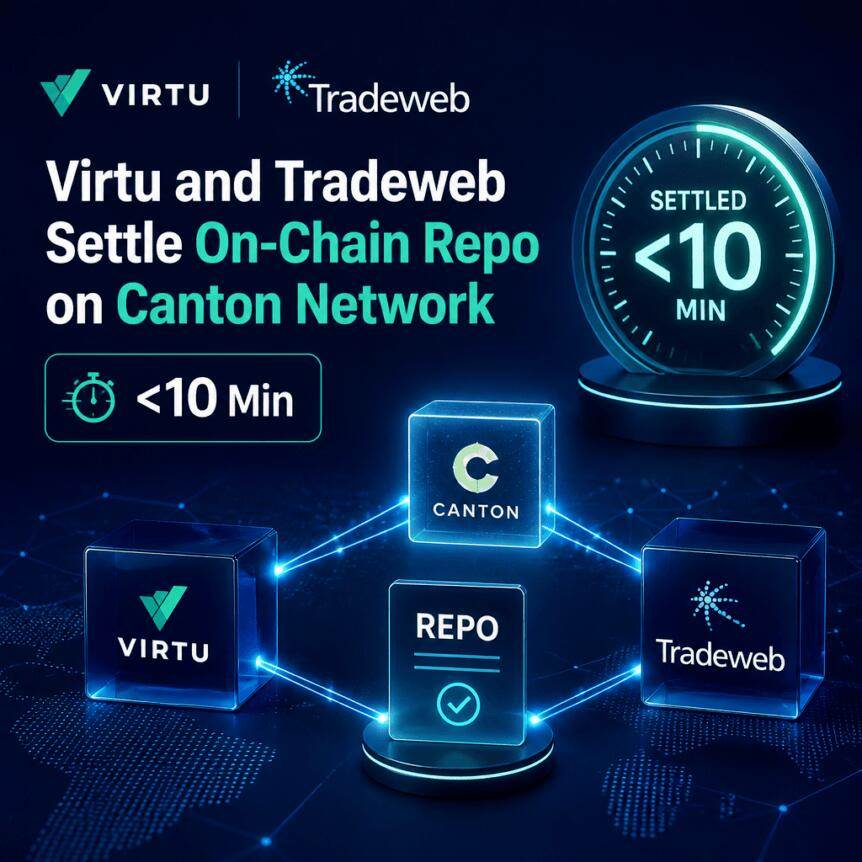
USD1 Virtu Financial, M1X Global and Tradeweb complete online repurchase agreement
Virtu Financial, M1X Global and Tradeweb recently completed a transaction based on the online repurchase agreement (Repo), which uses sovereign digital bonds as collateral and completes full-process settlement on the Canton Network. According to the relevant announcement, the deal is unique in that it combines natively issued sovereign collateral with full-chain atomic settlement.
The collateral for this transaction is USDM1, a dollar-denominated sovereign bond issued on the chain by the Republic of the Marshall Islands. The bond is backed 1:1 by short-term U.S. Treasury bonds and still pays a coupon while it is held as collateral. Under New York law, the bond is designed as a fully collateralized sovereign debt instrument.
Key Points
Repo settlement is completed completely on-chain: The complete repurchase and repurchase cycle is completed via atomic settlement on Canton, which takes less than 10 minutes.
USDM1 is used as collateral rather than simply a tokenized asset: The bond is used to support the institutional financing process.
Transactions are executed between regulated counterparties: The transaction is conducted through Tradeweb and is completed between established financial institutions.
USDM1's availability depends on institutional infrastructure: Tradeweb provides access channels, while hosting services are supported by Anchorage Digital, BitGo, and tZERO.
Repurchase agreements built around tokenized sovereign debt
Repurchase agreements are a core part of institutional liquidity management. They allow one party to sell securities and agree to repurchase them in the future, usually backed by collateral. In this case, participating institutions constructed repurchase agreements around USDM1-an on-chain sovereign bond designed to tie U.S. dollar exposure to underlying U.S. Treasuries.
The announcement shows that the transaction uses USDM1 as collateral throughout the life of the repurchase agreement. This is important because it expands the application scenario of tokenized sovereign debt beyond initial issuance and secondary transactions into financing structures, where collateral efficiency and settlement speed are often critical.
Participants also stated that this is the first repurchase transaction that combines native issuance of sovereign collateral with full on-chain atomic settlement. Although this statement marks an important technical milestone, the announcement also emphasizes that this is still an early case and does not mean that the institutional repo market has been widely adopted.
Canton's institutional positioning is reflected in transaction design
Canton is positioned as a blockchain network specifically tailored for institutional finance, with licensing and privacy features, designed to support regulated transactions and tokenized assets. The repurchase transaction executed this week continues a common pattern of Canton-related activity in recent years-with large market infrastructure and financial institutions using the network to transfer tokenized instruments during the settlement process.
Previous reports have noted that Tradeweb facilitated a July deal to transfer Franklin Templeton's tokenized U.S. Treasury bonds to Canton-based Virtu Financial. The transaction was settled in USDCx, indicating that Canton has been used to connect tokenized assets with a stablecoin settlement mechanism.
In this latest repurchase, settlement is described as "fully on-chain atomic settlement", meaning that the logic of the transaction and settlement completion are carried out within the network workflow, rather than partially relying on traditional post-transaction processes. The announcement stated that the full repurchase and repurchase cycle is completed through Tradeweb between regulated counterparties in less than 10 minutes.
Momentum on Canton: Cross-chain swaps, stablecoins and planned public welfare pilots
This buyback is just part of a broader wave of institutional experimentation on Canton. The announcement pointed out that some progress had been made in August and previous months.
In August, FalconX and Interstice launched a cross-chain swap engine that connects Canton with Ethereum, Solana and Robinhood Chain. During the same period, World Liberty Financial also launched its USD1 stablecoin natively on Canton. Together, these initiatives reflect Canton's efforts to achieve interoperability with the broader token ecosystem rather than limiting its activities to closed networks.
In addition to pure financial market infrastructure, the announcement also mentioned that the American Ideas Foundation founded by Digital Asset and former U.S. House Speaker Paul Ryan announced a plan this month to use Canton to conduct state-managed welfare distribution pilots in three U.S. states in 2027. Although the plan is different from repo settlement, it shows that developers and institutional supporters are viewing Canton as an infrastructure for regulated, high-risk workflows where auditability, access control and privacy are critical.
These mixed activities raise an important question for investors and market participants: Will Canton's institutional use cases expand from sporadic pilots and isolated transactions to repeatable market processes? Each new transaction type-such as repo collateralization-adds potential infrastructure modules, but adoption in core markets depends on operational readiness, counterparties 'acceptance of risk controls, and the smooth integration of tokenized settlements with existing institutional infrastructure.
Positioning of USDM1 in institutional custody and trading
According to the announcement, USDM1 is available through Tradeweb, while institutional custody is provided by Anchorage Digital, BitGo and tZERO. This structure is important because in traditional finance, custody and access are often key constraints on the use of tokenized collateral. If collateral can remain available among multiple participants without requiring customized custody arrangements, tokenized sovereign debt will be more practical for institutional balance sheets and financing departments.
The report also pointed out that USDM1 is a bond that still pays coupons while it is used as collateral-an important design point for financing. In many mortgage transactions, the issuer of the tokenized asset and the economic rights attached thereto often determine the attractiveness of the collateral to both the borrower and the lender.
Despite this, the report still has reservations about whether this model can be widely promoted beyond this transaction. Even if settlement workflows are completed quickly and end-to-end on the chain, broader adoption may require more counterparties, more standardized collateral processing, and proof that operational and legal requirements can be met consistently across different venues.
Looking ahead, the key signals for the market will be whether more repo transactions use similar collateral structures, and whether there are other institutional networks or trading platforms that can reproduce the same atomic settlement without requiring extensive customization. Please pay attention to more cases of connecting tokenized sovereign assets directly into the financing cycle-because that is the direction in which adoption may go beyond experimental proof-of-concept.