Exchange Ranking
 Top Exchanges
 24h Volume Ranking
 Popularity Ranking
 Exchange BTC Balance
 Proof of Reserves
 Decentralized Exchanges
 Funding Rate
 Funding Heatmap
 Liquidation Data
 Max Pain
 Long/Short Ratio
 Whale L/S Ratio
 Binance/Okex/Huobi L/S
 Bitfinex Margin L/S
 ETF Tracker
 Solana ETF
 XRP ETF
 Hong Kong ETF
 Bitcoin Treasuries
 Crypto Reversal
 Ethereum Reserves
 HyperLiquid Wallet Analysis
 Hyperliquid Whale Watch
 Large Transactions
 On-chain Movement
 Bitcoin ROI
 Stablecoin Market Cap
 Options Analysis
 News
News Articles
 Economic Calendar
 Features
 Wallet
 Contract Calculator


 Security
 Collections
 Watchlist
 Following
 ADA
ADA  AVAX
AVAX  BTC
BTC  DOGE
DOGE  ETH
ETH  LINK
LINK  SOL
SOL  XRP
XRP Wall Street retail brokerages are pushing altcoins to millions of investors, but their willingness to buy is in doubt
Wall Street retail brokerages are promoting altcoins to millions of more investors. However, whether these investors will actually buy is the real question.
Several brokerages including Charles Schwab, E*TRADE and Interactive Brokers-covering a combined 54 million user accounts-have introduced Solana (SOL), XRP, Avalanche (AVAX) and Chainlink (LINK) tokens into existing platforms where clients use to trade stocks and funds. This move is expected to significantly expand the buyer base in the cryptocurrency market.

Schwab Financial Management is the latest large retail brokerage to join the ranks, providing altcoin trading services. Source: Schwab
Schwab is the latest follower. The company said on August 27 that customers will be able to trade SOL, AVAX and LINK in "the next few months," which will add to its existing Bitcoin (BTC) and Ethereum (ETH) product portfolio.
Schwab is not alone. E*TRADE launched direct trading services for Bitcoin, Ethereum and Solana in July, while Interactive Brokers has begun offering 20 cryptocurrencies including XRP, Cardano (ADA), Dogecoin (DOGE), Avalanche and Chainlink.
Crypto analyst Scott Melker wrote on the X platform: "Getting access to large brokerages for SOL, AVAX and LINK is a meaningful step." "This expands the reachable buyer base from native crypto platforms to a wider range of areas."
It is worth noting that although SOL, LINK and AVAX rose by 13%, 6% and 4% respectively after Schwab's announcement, most of these gains had receded before September 1.
The key to the introduction of altcoins into mainstream brokerage accounts
is that this promotion has placed altcoins on a platform that traditional investors already trust. A Morgan Stanley survey found that the most important factor investors value when choosing where to trade cryptocurrencies is a company's creditworthiness background, followed by integrated portfolio view, fees, pricing and customer service.
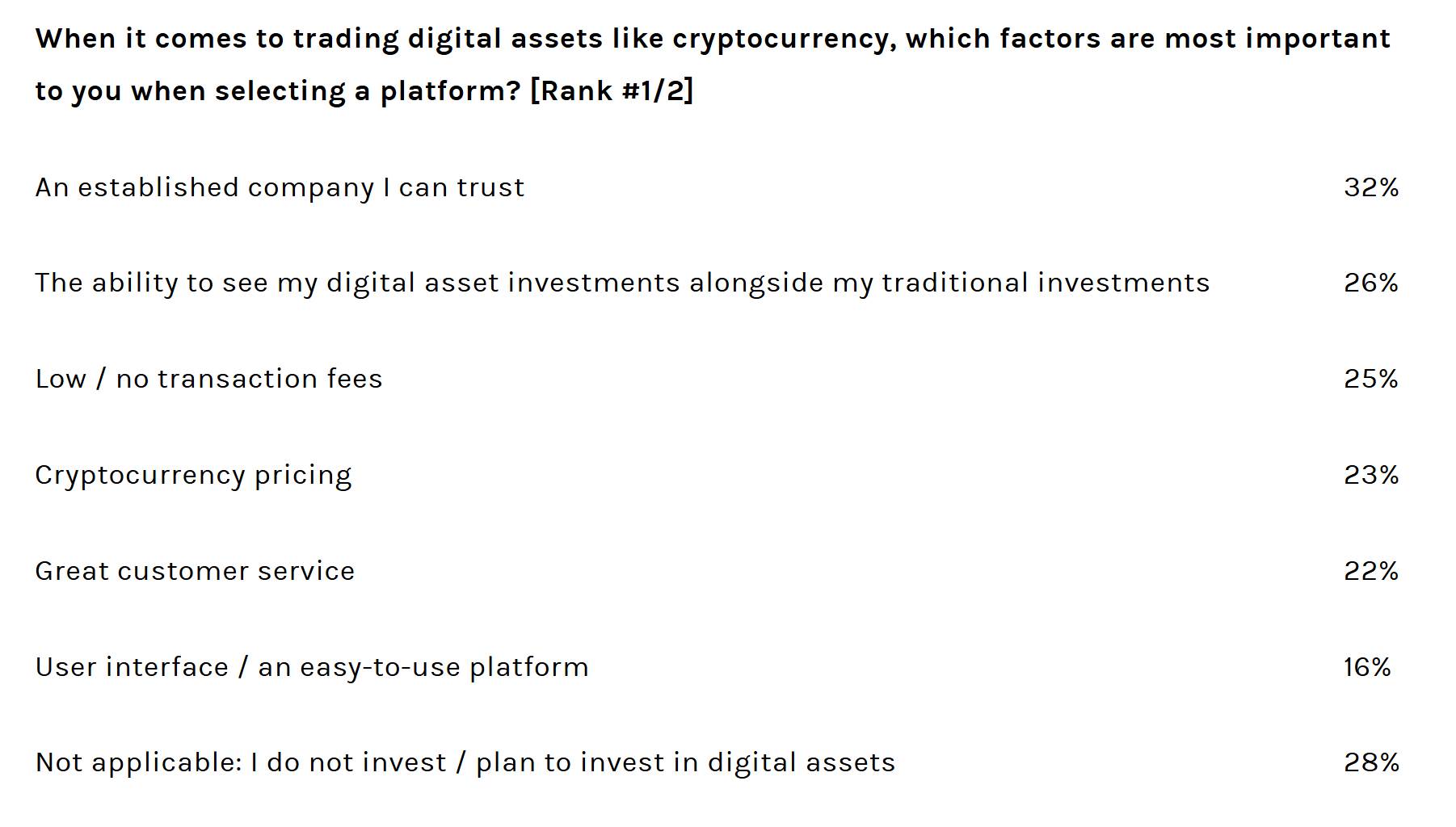
Investors tend to use trusted platforms to purchase cryptocurrencies. Source: Morgan Stanley
Customers can purchase selected altcoins without opening and investing a separate cryptocurrency exchange account. This simplifies the trading process while retaining more of client funds and activities within Schwab, E*TRADE and Interactive Brokers.
Milan Galik, CEO of Interactive Brokers, said in March this year: "Our clients want the flexibility to diversify into crypto assets while maintaining the tools, pricing and trust they rely on."
Increasingly mature encryption infrastructure and a clearer regulatory environment make expansion easier. Brokers can add cryptocurrencies without building an exchange from scratch. Infrastructure providers such as Zerohash and Paxos are responsible for transactions and custody. At the same time, a joint explanation issued by the U.S. Securities and Exchange Commission (SEC) and the Commodity Futures Trading Commission (CFTC) in March this year stated that "most crypto assets are not securities per se," reducing uncertainty about new product launches.
Solana and XRP have found buyers
Solana and XRP's exchange-traded funds (ETFs) have found buyers through regular brokerage accounts. However, demand for different altcoins is uneven, with LINK and AVAX performing far behind SOL and XRP.
The U.S. spot XRP ETF attracted more than US$1.4 billion in funding in the six weeks after its launch in November 2025, and reached US$1.68 billion through September 1. Bloomberg Intelligence said retail investors may constitute the majority of buyers.
Bloomberg intelligence analyst Eric Balchunas wrote on X: "Considering that these ETFs were launched during a brutal 45% retracement, this performance is indeed impressive."
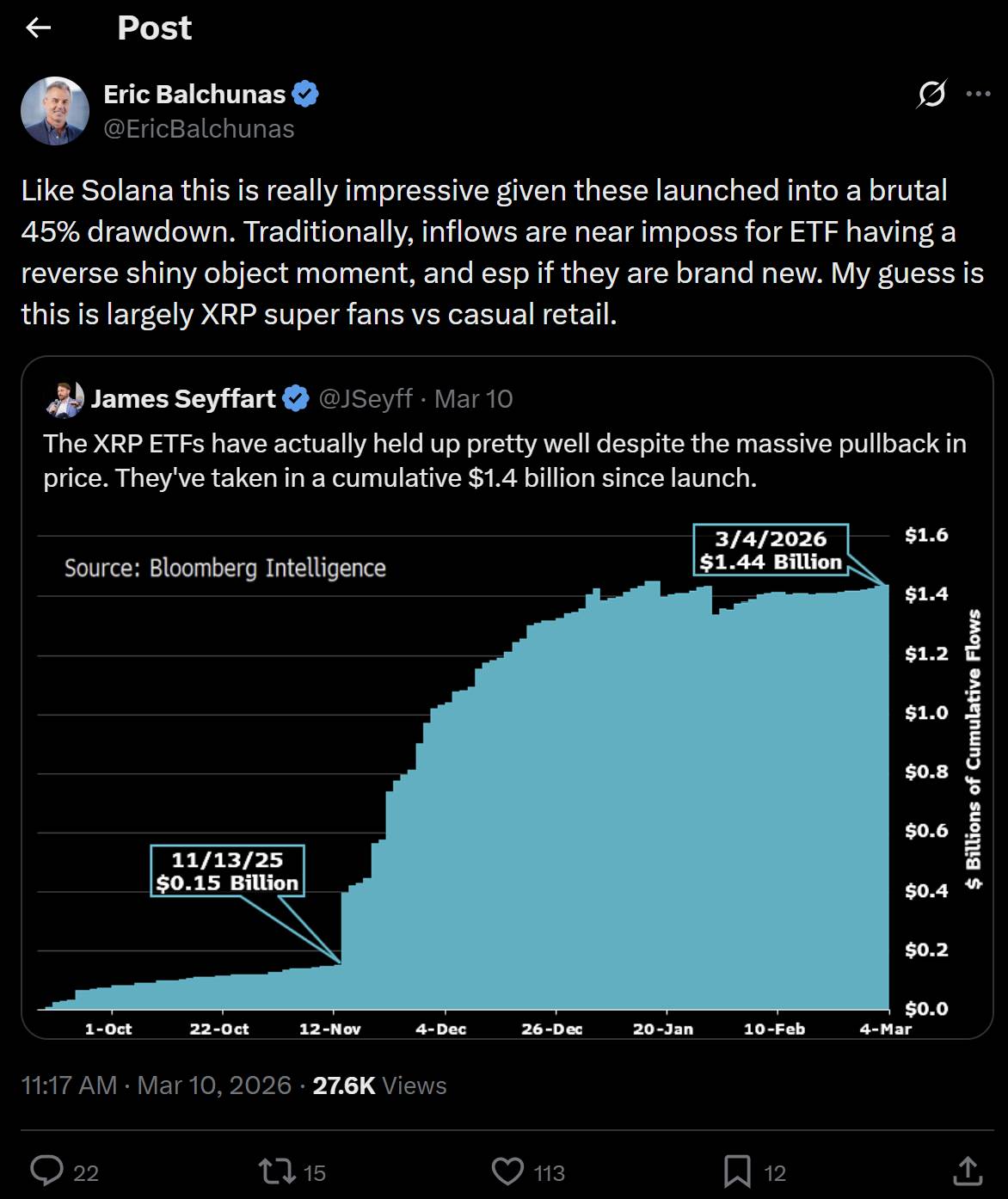
XRP ETF showed strong performance after its launch. Source: Eric Balchunas/X
The cumulative net inflow of the U.S. spot SOL ETF as of September 1 was US$1.31 billion. That includes $449.3 million in seed capital, which represents an additional approximately $862 million since the deal began.
Demand for LINK and AVAX is weak. The first U.S. ETF for both tokens was launched in January this year. As of August 31, the LINK ETF attracted net inflows of $146.4 million, while the three AVAX funds held total assets of only $36.7 million.
AMBCrypto analyst Benjamin Njiri wrote: "Whether this is a slow start for other altcoin ETFs or a reality test remains to be seen."
Demand for altcoins remains concentrated
The uneven capital flow reflects the broader market landscape dominated by Bitcoin. CoinMarketCap's altcoin seasonal index was 26 out of 100 points on September 1, clearly indicating that the market is in the "Bitcoin season."
Schwab's promotion will expand direct access to LINK and AVAX, although these tokens are not currently available on its platform.
For now, wider access has not led to broader demand for altcoins.
Nate Geraci, president of NovaDius Wealth Management, told CoinDesk: "Ultimately, investors will decide which products make sense and which are not."