Exchange Ranking
 Top Exchanges
 24h Volume Ranking
 Popularity Ranking
 Exchange BTC Balance
 Proof of Reserves
 Decentralized Exchanges
 Funding Rate
 Funding Heatmap
 Liquidation Data
 Max Pain
 Long/Short Ratio
 Whale L/S Ratio
 Binance/Okex/Huobi L/S
 Bitfinex Margin L/S
 ETF Tracker
 Solana ETF
 XRP ETF
 Hong Kong ETF
 Bitcoin Treasuries
 Crypto Reversal
 Ethereum Reserves
 HyperLiquid Wallet Analysis
 Hyperliquid Whale Watch
 Large Transactions
 On-chain Movement
 Bitcoin ROI
 Stablecoin Market Cap
 Options Analysis
 News
News Articles
 Economic Calendar
 Features
 Wallet
 Contract Calculator


 Security
 Collections
 Watchlist
 Following
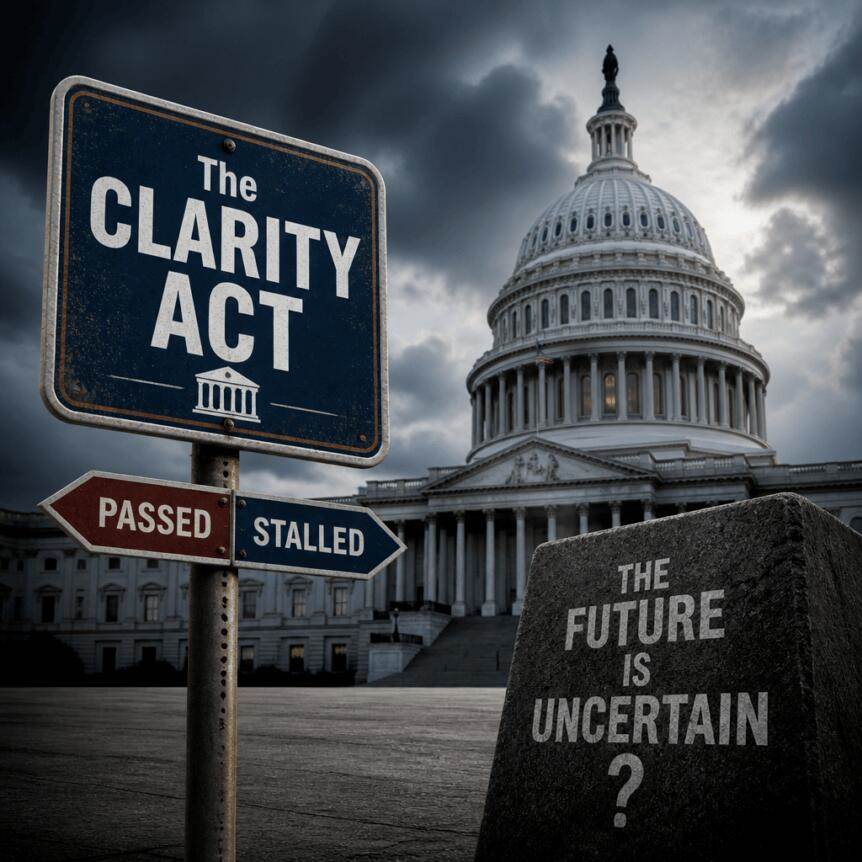
参议院未能通过CLARITY法案:加密行业面临监管不确定性
由于参议院以50比49的票数未能推进《CLARITY法案》,加密货币企业目前缺乏联邦市场结构框架。据三位行业专家称,这可能导致产品发布、融资决策和商业协议的延迟。
核心要点摘要
- 立法受阻:《CLARITY法案》未能获得开启辩论所需的60张参议院选票。
- WasabiCard观点:预计监管不确定性将推迟部分加密货币产品的发布、合作伙伴关系及融资决策。
- 去中心化研究中心呼吁:敦促美国证券交易委员会(SEC)和商品期货交易委员会(CFTC)在现有职权范围内提供明确指引。
- Paybis建议:在美国与欧盟的稳定币要求存在差异时,应分别进行合规审查。
管辖权争议悬而未决
去中心化研究中心执行董事Kyle Bligen在接受crypto.news采访时指出,参议院的投票结果令人失望,但这并未消除建立持久性数字资产规则的必要性。
“国会仍是制定全面市场结构框架的最佳途径,”Bligen表示。在联邦立法缺席的情况下,他呼吁SEC和CFTC利用其现有权力为行业提供更清晰的指导。然而,他也警告说,不应直接将为传统金融中间商制定的规则应用于去中心化系统。
根据Bligen的观点,政策任务是在不将对开发者或其他缺乏执行所需控制权的参与者施加义务的前提下,保护消费者并遏制非法活动。“即使立法进程陷入停滞,这项工作也不能停止,”他强调道。
此次50比49的参议院投票结果距离 invoking cloture(终结辩论)所需的60票还差10票,因此无法开始对H.R. 3633号的正式辩论。终结辩论程序本身并不能使法案成为法律,它仅允许参议院继续进行辩论讨论。
所有参与的民主党议员均反对该动议,而共和党参议员苏珊·柯林斯(Susan Collins)、乔什·霍利(Josh Hawley)、杰里·莫兰(Jerry Moran)和汤姆·蒂利斯(Thom Tillis)也投了反对票。蒂利斯出于程序原因改变了投票立场,从而为参议院重新考虑该动议保留了一条途径。
在投票前,关于政府道德、稳定币奖励以及银行条款的争议持续存在。民主党谈判者提出了迟来的反提案,但在参议院采取行动之前, lawmakers 并未公布其完整文本。
众议院已于2025年7月以294比134的票数通过了其版本的《CLARITY法案》,其中78名民主党人支持该措施。共和党在参议院拥有53个席位,这意味着法案支持者需要至少7名民主党人的支持才能跨越程序门槛。
今年7月,财政部长斯科特·贝森特(Scott Bessent)在经过数月的立法者谈判后,曾推动进行投票。当时,Polymarket交易员为该法案在2026年成为法律的可能性赋予了约30%的概率,低于2月份的82%。随着终结辩论动议的失败,这一概率从前一天日的31%降至7%。
监管不确定性可能推迟加密产品上市
稳定币平台WasabiCard的全球合作伙伴关系主管Matt Price表示,此次投票使得企业面临着与参议院行动前相同的分类和管辖权问题。
“《CLARITY法案》未能推进,使行业回到了投票前的基本困境,”Price说道。“公司仍然无法明确某些数字资产产品将被如何分类,或者适用哪些规则。”
在没有明确的职权划分情况下,Price预计公司在投入资本到产品之前,将花费更多时间寻求法律建议。他补充说,一些公司可能会推迟发布或签署商业协议,因为他们不希望监管机构在产品进入市场后采取不同的观点。
据Price称,关于SEC还是CFTC拥有管辖权的问题也可能影响加密公司的融资选择和谈判。他预计部分合作伙伴关系和产品发布将因此被推迟。
Price表示,银行和支付公司也可能表现出类似的谨慎态度,因为它们需要了解数字资产项目附带的合规责任,以及监管机构是否会在发布后改变适用的要求。“这可能会减缓市场上的创新和采用速度,”他说。
此次失败的投票也增加了对联邦监管机构的压力。根据9月16日的一份报告,前CFTC主席Chris Giancarlo表示,SEC和CFTC可以在其现有授权下继续制定规则。Coinbase首席执行官Brian Armstrong在投票后也发出了类似呼吁,表示行业不能再等待国会,并敦促这两个机构使用其已有的工具。Ripple首席执行官Brad Garlinghouse也要求监管机构填补立法空白。
然而,机构行动无法解决法案涵盖的所有问题。特别是,仅凭SEC的规则无法确立SEC与CFTC之间的法定职权划分,正如9月16日的报告所述。
H.R. 3633号法案仍留在参议院日程表上,且蒂利斯的程序性投票允许再次尝试终结辩论。参议员约翰·肯尼迪(John Kennedy)表示,该措施可能在11月大选后的“跛脚鸭”会议期间回归,而参议员泰德·克鲁兹(Ted Cruz)则将其描述为“基本已死”。
Any amendment approved by the Senate still requires further action by the House before legislation can be submitted to the president. A shortened House schedule reduces the number of voting days available to lawmakers before leaving Washington.
Foreign stablecoin rules bring a separate compliance test
Konstantins Vasilenko, co-founder and chief business development officer of Paybis, a MiCA licensed cryptocurrency exchange, said regulatory uncertainty also extends to stablecoin businesses operating between the United States and Europe.
According to Vasilenko, U.S. authorities are determining how domestic stablecoin requirements apply to foreign issuers, while European policymakers are considering how to handle surveillance outside the EU.
Vasilenko stated that under the European Union's Cryptographic Asset Markets Regulation (MiCA), issuers must prove that they hold authorization, manage reserves and are able to fulfill redemption requests. The U.S. Treasury Department's legal order test raises a different question: whether foreign issuers can implement U.S. orders to freeze assets.
"It remains unclear to what extent the platform must meet this inspection criterion," he said.
According to Vasilenko, the Ministry of Finance raised questions about smart contracts and their functions, including "freezing,""seizure" and "destruction." Compliance reviews can determine whether an issuer has the technical capabilities and internal processes to respond to legal orders, but cannot guarantee the specific way the company will respond in each future case.
Vasilenko called on the Ministry of Finance to clarify what evidence would meet its review requirements. He noted that clear criteria would help exchanges and wallet providers evaluate foreign stablecoins before providing services to customers under U.S. rules.
Europe is also considering separately how much its regulators can rely on oversight from other jurisdictions. Vasilenko said mutual recognition should be assessed on a case-by-case basis rather than being granted through a single all-powerful decision.
When U.S. and EU authorities raise the same compliance questions, one answer is enough. But when requirements differ, such as in terms of the ability to comply with legal U.S. orders, Vasilenko said the platform and publisher need to complete two checks.