Exchange Ranking
 Top Exchanges
 24h Volume Ranking
 Popularity Ranking
 Exchange BTC Balance
 Proof of Reserves
 Decentralized Exchanges
 Funding Rate
 Funding Heatmap
 Liquidation Data
 Max Pain
 Long/Short Ratio
 Whale L/S Ratio
 Binance/Okex/Huobi L/S
 Bitfinex Margin L/S
 ETF Tracker
 Solana ETF
 XRP ETF
 Hong Kong ETF
 Bitcoin Treasuries
 Crypto Reversal
 Ethereum Reserves
 HyperLiquid Wallet Analysis
 Hyperliquid Whale Watch
 Large Transactions
 On-chain Movement
 Bitcoin ROI
 Stablecoin Market Cap
 Options Analysis
 News
 Articles
 Economic Calendar
 Features
 Wallet
 Contract Calculator


 Security
 Collections
 Watchlist
 Following
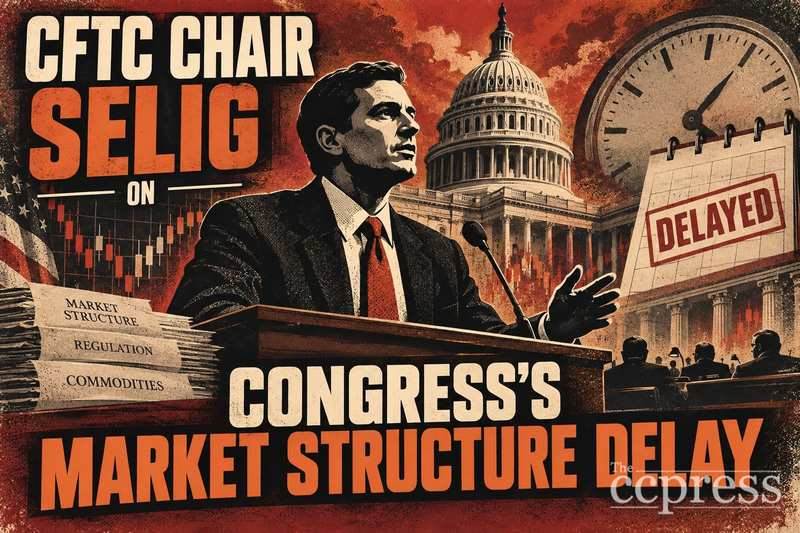
Commodity Futures Trading Commission Chairman expresses disappointment at Congress's stagnation
Commodity Futures Trading Commission Chairman Brian Selig has expressed dissatisfaction with Congress's failure to advance market structure legislation, a sign of growing frustration among regulators amid persistent key policy gaps. Selig's comments highlighted a recurring tension: The CFTC has been urging Congress to clarify legal jurisdiction for digital asset markets, but legislative action has repeatedly stalled. In the absence of a market structure bill, the regulatory framework governing cryptocurrency trading venues, intermediaries, and asset classification remains uncertain.
Inpatience with Congress
The CFTC chairman has never concealed his preference for congressional solutions. Previous reports pointed out that Selig had said that clarity in the structure of the crypto market could be achieved through institutional rules or legislation, and he regarded these two paths as options rather than fait accompli. His recent expressions of disappointment suggest that congressional inaction is forcing the agency closer to unilateral action.
The importance of the state of affairs is not an abstract concept. Market structure legislation will define which digital assets fall under the jurisdiction of the CFTC and which are supervised by the U.S. Securities and Exchange Commission (SEC); establish registration requirements for trading venues; and set customer protection standards for crypto intermediaries. Without such legislation, the battle for regulatory powers will continue and the outcome of enforcement will be difficult to predict.
Clarification Act deadlocked
The legislation most closely related to Selig's concerns is often considered to be the Digital Asset Market Structure Act, sometimes referred to as the Clarity Act. The CFTC has been closely monitoring its progress. Previous reports confirmed that if the bill is blocked in Congress, Selig is prepared to advance encryption rules through institutional action; in addition, the agency has also actively formulated contingency plans in case Congress fails to take action.
The bill's failure to move forward is not new, but Selig's public expression of disappointment raises questions about timing: How long will the CFTC wait to move forward without congressional support?
Subsequent developments
The CFTC can issue rules within its existing jurisdiction without congressional approval. If the legislative path remains blocked, the agency may seek a "notile-comment" rule-making process to address market structure issues that it believes fall within its current legal authority. However, this approach carries legal risks because rules based on controversial jurisdictional bases can lead to court challenges.
The broader regulatory landscape is complicated by the joint crypto initiative of the SEC and CFTC, which reflects the recognition that the two agencies must coordinate rather than go their separate ways. Selig's frustration with Congress actually put more pressure on the two agencies to fill the void on their own.
Will the CFTC ultimately act without congressional support? Or will Selig continue to wait for another legislative session cycle, hoping for the delayed law?