Exchange Ranking
 Top Exchanges
 24h Volume Ranking
 Popularity Ranking
 Exchange BTC Balance
 Proof of Reserves
 Decentralized Exchanges
 Funding Rate
 Funding Heatmap
 Liquidation Data
 Max Pain
 Long/Short Ratio
 Whale L/S Ratio
 Binance/Okex/Huobi L/S
 Bitfinex Margin L/S
 ETF Tracker
 Solana ETF
 XRP ETF
 Hong Kong ETF
 Bitcoin Treasuries
 Crypto Reversal
 Ethereum Reserves
 HyperLiquid Wallet Analysis
 Hyperliquid Whale Watch
 Large Transactions
 On-chain Movement
 Bitcoin ROI
 Stablecoin Market Cap
 Options Analysis
 News
 Articles
 Economic Calendar
 Features
 Wallet
 Contract Calculator


 Security
 Collections
 Watchlist
 Following
 BTC
 ETH
2026 Panorama Guide to Blockchain Analysis Tools
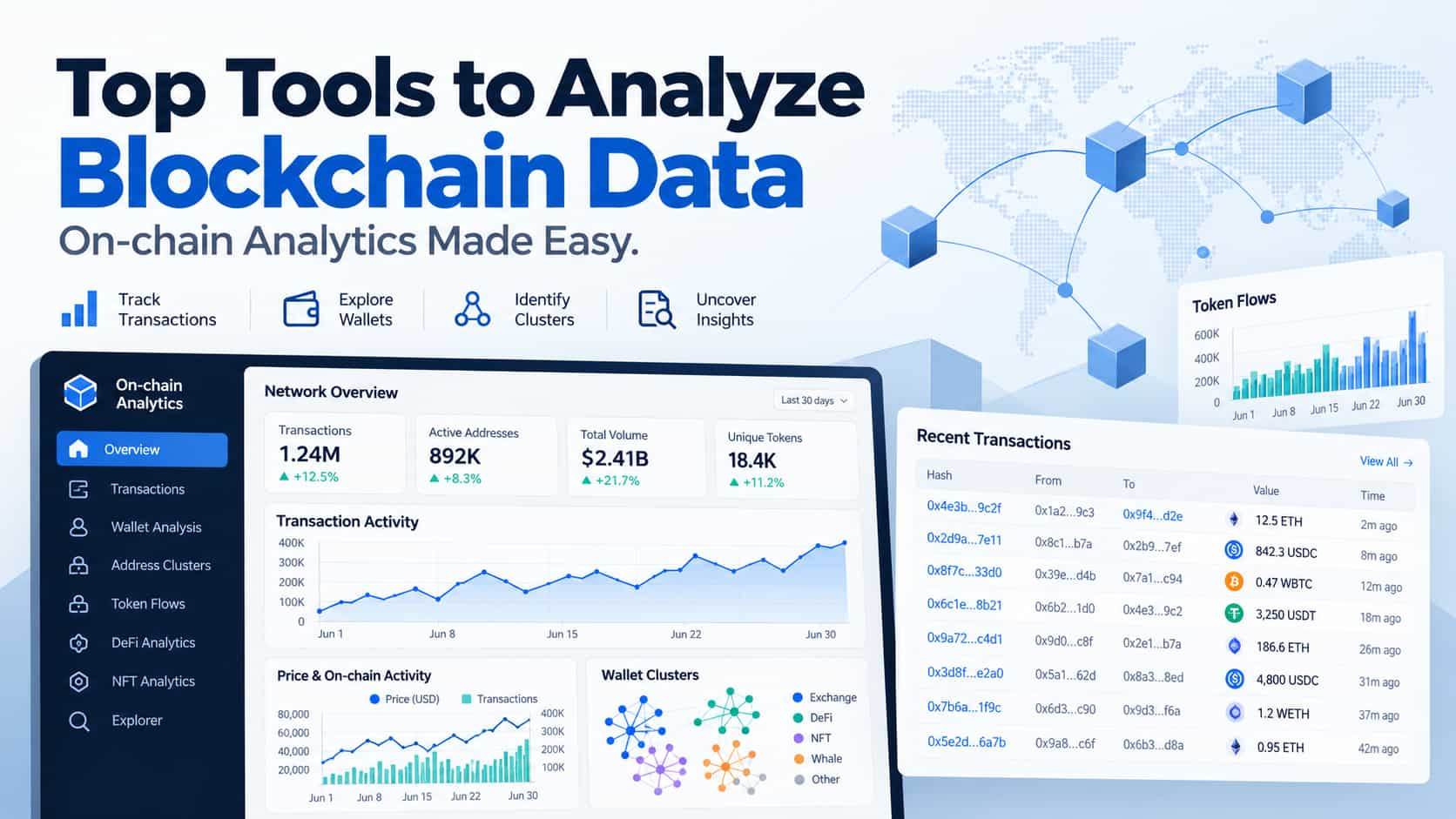
On the public blockchain, every transaction is visible to people who know how to find it. The challenge has never been acquisition of data, but understanding the millions of transfers made every day without spending hours reading the raw hashes. This is exactly what modern on-chain analytics platforms solve: They transform raw ledger data into charts, tags, and alerts, allowing anyone to take action.
In this guide, we compare the top blockchain analysis tools in 2026, including the advantages, costs and shortcomings of each tool.
Why on-chain analysis is important
Reading the blockchain browser will only tell you that a transaction has occurred. On-chain analysis tells you who the subject behind you is, what pattern it fits, and whether it is worth worrying about. Traders use it to cluster wallets to discover insider trading portfolios before token issuance; analysts use it to measure the health of agreements; and investigators use it to track stolen funds across chains. If you have ever wondered how to analyze blockchain data without a degree in data science, the following tools are the answer.
1. Bubblemaps: Visualize wallet connections
Function overview:
Bubblemaps transforms wallet activity and blockchain transactions into interactive bubble charts. Each bubble represents a wallet, the bubble size reflects the amount of open positions, and connected bubbles reveal clusters of wallets that behave as a whole. This makes it the fastest way to audit the distribution of tokens: you can see in seconds whether newly issued tokens are truly decentralized or whether a few associated wallets control most of the supply.
Core functions:
- Wallet visual clustering and on-chain analysis
- Cross-chain coverage
- "Time Travel" feature for historical supply snapshots
- Pre-sale and airdrop testing
- Intelligence Center (Intel Desk), where the community releases its full investigation report
Bubblemaps has become a standard step in token security checks on Solana and EVM links.
Free vs. Paid:
Basic bubble chart features are free, and advanced features such as historical data and deeper access to intelligence centers are charged.
Limitations:
It focuses on wallet relationships and token distribution and therefore does not attempt to become a comprehensive market data terminal. It is recommended to use it with charts or portfolio tools to improve the trading workflow.
Best applicable populations:
Traders and researchers who want visual answers rather than spreadsheets, especially security checks for meme coins and new issues.
2. Etherscan and various block browsers: a common starting point
Function overview:
Every chain has a block browser, and Etherscan is still the reference standard for Ethereum. If you want to learn how to analyze blockchain transactions at the most basic level, this is the starting point: Paste the transaction hash, wallet address or contract address to view the original input, token transfer, Gas fees and status.
Core functions:
- Complete transaction history
- Verified contract source code
- List of token holders
- Gas Tracking
- Free public APIs
Free vs. Paid:
Manual use is completely free, and API services provide developers with different levels.
Limitations:
The browser displays only one address at a time. There are no tags, no clusters, and no alerts, so serious investigations quickly become beyond their capabilities.
Best applicable population:
Users who need to verify a specific transaction and read contract details before in-depth analysis.
3. Glassnode: Network Level Indicator
Functional Overview:
Glassnode views blockchain as an economy rather than a collection of wallets. Its indicators of realized market value, exchange flow and holder queues are the cornerstone of understanding the market cycle.
Core functions:
- Hundreds of organization-level indicators
- Selected Weekly Insight Reports
- API access
- Deep Bitcoin and Ethereum coverage
Free vs. Paid:
Free layers are available, but with limited metrics; professional plans include a full range of features.
Limitations:
is not designed for token-level research or wallet surveys on emerging links.
Best applicable population:
Long-term investors who are concerned about online health.
4. Arkham Intelligence: Naming the entity behind the wallet
Functional overview:
Arkham specializes in large-scale de-anonymization, linking addresses to real-world entities such as companies, exchanges, and public figures. Its visualization tools complement the functionality of wallet clustering by appending identities to the clusters you discover.
Core functions:
- Entity affiliation identification
- Address Visualizer
- Alarm System
- Intel Exchange, where users can buy and sell research rewards
Free vs. Paid:
You can use the free layer if you have an account, and you need to pay for advanced functions.
Limitations:
For newly emerging or unknown wallets, attribution identification may be lagging and coverage beyond the main entity may be thin.
Best applicable population:
Investigative journalists and researchers who need to label their addresses with specific names.
5. Dune Analytics: Building a custom blockchain dashboard
Functional overview:
Dune is a SQL playground based on raw blockchain data. Anyone can write queries, publish dashboards, and fork out thousands of community-built dashboards covering everything from decentralized exchange (DEX) volume to governance voting.
Core functions:
- Multi-chain Data Warehouse
- Community Dashboard Library
- API access
- Full query transparency
Free vs. Paid:
Provides generous free layers; paid plans add faster query speeds and API restrictions.
Limitations:
You need SQL skills, and the quality of query results depends on the underlying tables and assumptions.
Best applicable population:
Technical analysts and teams that need customized metrics that are not available with off-the-shelf tools.
6. Nansen: Wallet tags and smart money tracking
Function overview:
Nansen has one of the largest tagged wallet databases in the industry, covering exchanges, funds, market makers and traders with known profits. It answers questions that most tools cannot answer: Who is this wallet? Should I follow it?
Core functions:
- More than 300 million annotated addresses
- Smart Money Dashboard
- Real-time alerts for tracked wallets
- Portfolio and Profit Rankings
Free vs. Paid:
Free tools are limited, and full access requires subscription to professional-oriented plans.
Limitations:
Prices are expensive for retail users, and the amount of data can overwhelm beginners.
Best applicable populations:
Funds and veteran traders who build strategies based on wallet behavior.
How to analyze blockchain data: A simple workflow
For any user who wants to know how to analyze blockchain transactions in practice, most experienced researchers follow the same sequence:
- Basic verification information: Paste the token or transaction into the blockchain browser to confirm that the contract has been verified and the transfer is true and valid.
- Check holders: Use Bublemaps to view the token distribution and determine whether wallet clustering suggests bundled insiders.
- Check contracts: Scan for casting functions, honeypot traps, or blacklist mechanisms.
- Check wallets: Find key holders in Nansen or Arkham to learn their identities.
- Expand your horizons: Use Dune or Glassnode to gain a broader market context.
Quick comparison
结语
不存在单一的“最佳”区块链分析工具,因为这项工作总是包含多个层次:原始交易、钱包关系、合约安全性和市场背景。最好的区块链分析工具是互补而非竞争的。
对于 2027 年的实用入门套件,建议包括:用于验证的区块浏览器、用于钱包连接和分布检查的 Bubblemaps,以及用于宏观视角的网络指标平台。无论你选择哪种组合,原则保持不变:链上的数据从不撒谎,而上述工具让它清晰易懂。