
 Exchange Ranking
 Top Exchanges
 24h Volume Ranking
 Popularity Ranking
 Exchange BTC Balance
 Proof of Reserves
 Decentralized Exchanges
 Funding Rate
 Funding Heatmap
 Liquidation Data
 Max Pain
 Long/Short Ratio
 Whale L/S Ratio
 Binance/Okex/Huobi L/S
 Bitfinex Margin L/S
 ETF Tracker
 Solana ETF
 XRP ETF
 Hong Kong ETF
 Bitcoin Treasuries
 Crypto Reversal
 Ethereum Reserves
 HyperLiquid Wallet Analysis
 Hyperliquid Whale Watch
 Large Transactions
 On-chain Movement
 Bitcoin ROI
 Stablecoin Market Cap
 Options Analysis
 News
News Articles
 Economic Calendar
 Features
 Wallet
 Contract Calculator


 Security
 Collections
 Watchlist
 Following
 BTC
BTC  ETH
ETH Key Insights
Cryptocurrency payments account for only 0.2% acceptance among online merchants in the euro zone.
The acceptance rate of mobile payments among brick-and-mortar merchants climbed to 68%.
Despite the widespread growth of digital payment methods, cash still dominates.
The European Central Bank found that cryptocurrency payments will be almost non-existent among eurozone companies in 2026. Its August 13 survey showed that only 0.2% of online sellers accepted crypto assets. This result contrasts sharply with the widespread growth in mobile payments and bankcard payment methods.
This survey is important because merchant acceptance remains the basic test for cryptocurrency payment use cases. Data shows that while policymakers are advancing the independent digital euro framework, companies prefer existing digital payment tracks. This gap suggests that cryptocurrencies are still largely outside of daily merchant payments in the euro zone.
Cryptocurrency payments remain insignificant among euro zone merchants
The European Central Bank conducted a survey of 8205 companies in 21 euro zone countries. Ipsos European Public Affairs conducted telephone interviews from February 23 to April 10. The sample covers industries such as retail, hotels, restaurants, cafes, art, entertainment and leisure.
Among online sellers, 82% accept bank card payments and 74% accept bank transfers. Only 0.2% reported accepting crypto assets. The European Central Bank's questionnaire classified Bitcoin, Ethereum and TEDA as crypto assets and stablecoins.
The situation of cryptocurrency payments in physical stores is similar. The European Central Bank reported that acceptance rates were below 1% in both 2024 and 2026. In contrast, the mobile payment acceptance rate will reach 68% in 2026, compared with 36% two years ago. 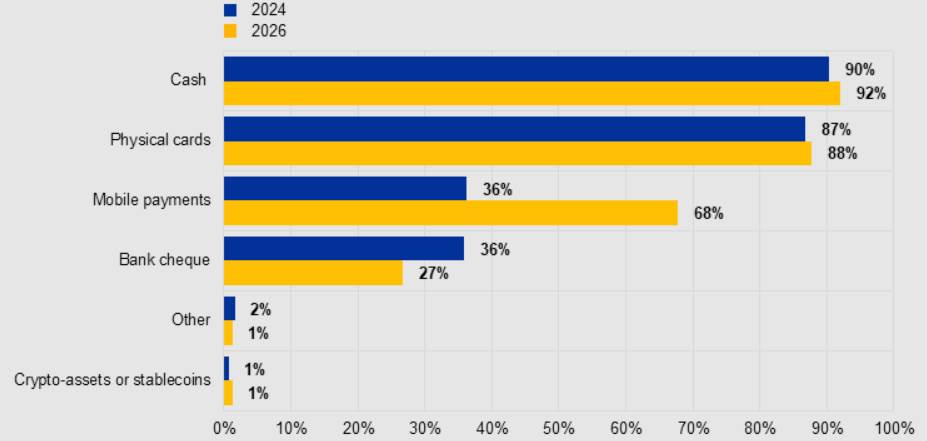 Source: European Central Bank
The European Central Bank said instant payments and digital wallets are the most common mobile payment options. Bank checks showed the opposite trend, with the acceptance rate falling to 27% from 36% in 2024. This divergence suggests that merchants are replacing some traditional payment instruments while retaining cash and bank cards.
Examples of wallets listed in the questionnaire include Apple Pay and Google Pay. The physical bank card acceptance rate reached 88%, and the cash acceptance rate was 92%.
Mobile payments grow, cryptocurrency payments stagnate
Data from the European Central Bank shows that merchants are transitioning to mobile payments much faster than crypto-related options. Consumer preference is the primary factor in the choice of payment methods, with 26% of companies surveyed ranking it first. Security followed closely, accounting for 22%, and processing convenience ranked third with 15%. 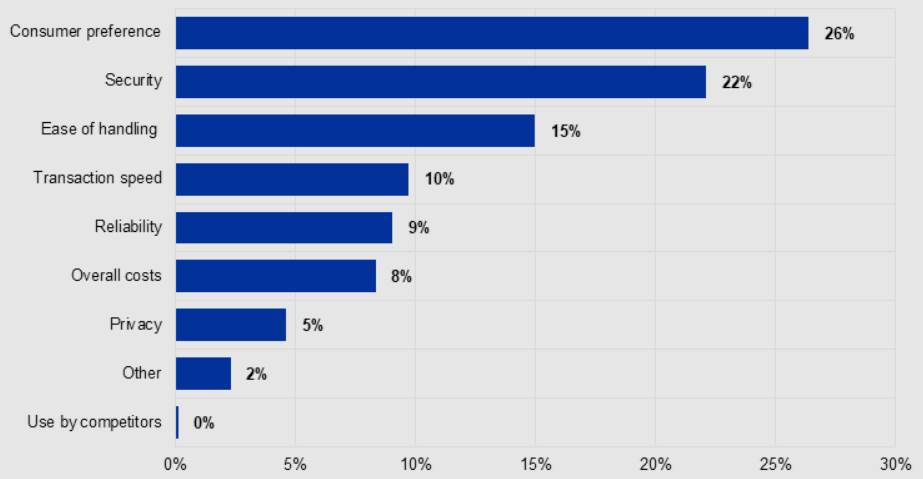 Source: European Central Bank
Despite the increasing popularity of digital payments, cash is still widely supported by merchants. The ECB found that 92% of companies that accept cash expect to continue to accept cash over the next five years. Only 6% expect it to stop and 2% are uncertain.
The results vary widely among countries. Among small and medium-sized enterprises, 51% of cash-receiving companies in Cyprus may stop accepting cash. Greece followed closely, accounting for 23%, and Bulgaria reached 18%.
The survey also revealed a measurement limitation of cryptocurrency acceptance. The questionnaire asked merchants whether they would accept crypto assets, and cited Bitcoin, Ethereum and TEDA as examples. However, payment services that convert cryptocurrency into fiat currency before merchants settle are not separately classified.
This distinction is critical for payment news, as some companies may never receive crypto assets directly. As a result, the ECB survey measures merchant acceptance in the report, rather than every transaction initiated through crypto-related services. The report did not estimate potential differences between the two measurements.
The report also did not list regulation as a reason for companies to refuse cryptocurrency payments. This limits conclusions as to why acceptance among companies surveyed is so low.
EU regulations define cryptocurrency payments differently from digital euros
The EU has passed the Crypto Asset Market Regulation Act to regulate cryptoassets. Regulation 2023/1114 establishes uniform rules for issuers and service providers of crypto assets. The framework covers regulated crypto asset and related service providers.
Its legal structure is different from the digital euro planned by the European Central Bank. The European Central Bank describes the digital euro as a central bank digital currency, not a crypto asset. It will replenish cash and support online, offline, in-store and person-to-person payments.
The European Commission's proposal also makes different provisions on merchant acceptance. Its 2023 single currency package proposes to grant the digital euro legal tender status. The committee said merchants should generally accept digital euros, but very small businesses would be exempted.
The European Central Bank will advance the project in July 2026. It selected 36 payment service providers to conduct small-scale pilots involving merchants and central bank employees. The pilot plan will be launched in the second half of 2027 and will last for 12 months.
The ECB said the pilot will test personal-to-business payments in physical storefronts and e-commerce. During the testing period, the Beta version of the digital euro did not have legal tender status.
The agency's goal is to have a possible first release in 2029. This timetable depends on whether EU lawmakers can pass the required legislation in 2026.
























