Exchange Ranking
 Top Exchanges
 24h Volume Ranking
 Popularity Ranking
 Exchange BTC Balance
 Proof of Reserves
 Decentralized Exchanges
 Funding Rate
 Funding Heatmap
 Liquidation Data
 Max Pain
 Long/Short Ratio
 Whale L/S Ratio
 Binance/Okex/Huobi L/S
 Bitfinex Margin L/S
 ETF Tracker
 Solana ETF
 XRP ETF
 Hong Kong ETF
 Bitcoin Treasuries
 Crypto Reversal
 Ethereum Reserves
 HyperLiquid Wallet Analysis
 Hyperliquid Whale Watch
 Large Transactions
 On-chain Movement
 Bitcoin ROI
 Stablecoin Market Cap
 Options Analysis
 News
News Articles
 Economic Calendar
 Features
 Wallet
 Contract Calculator


 Security
 Collections
 Watchlist
 Following
 BTC
BTC Sam Bankman-Fried (SBF): The last fight in the Supreme Court
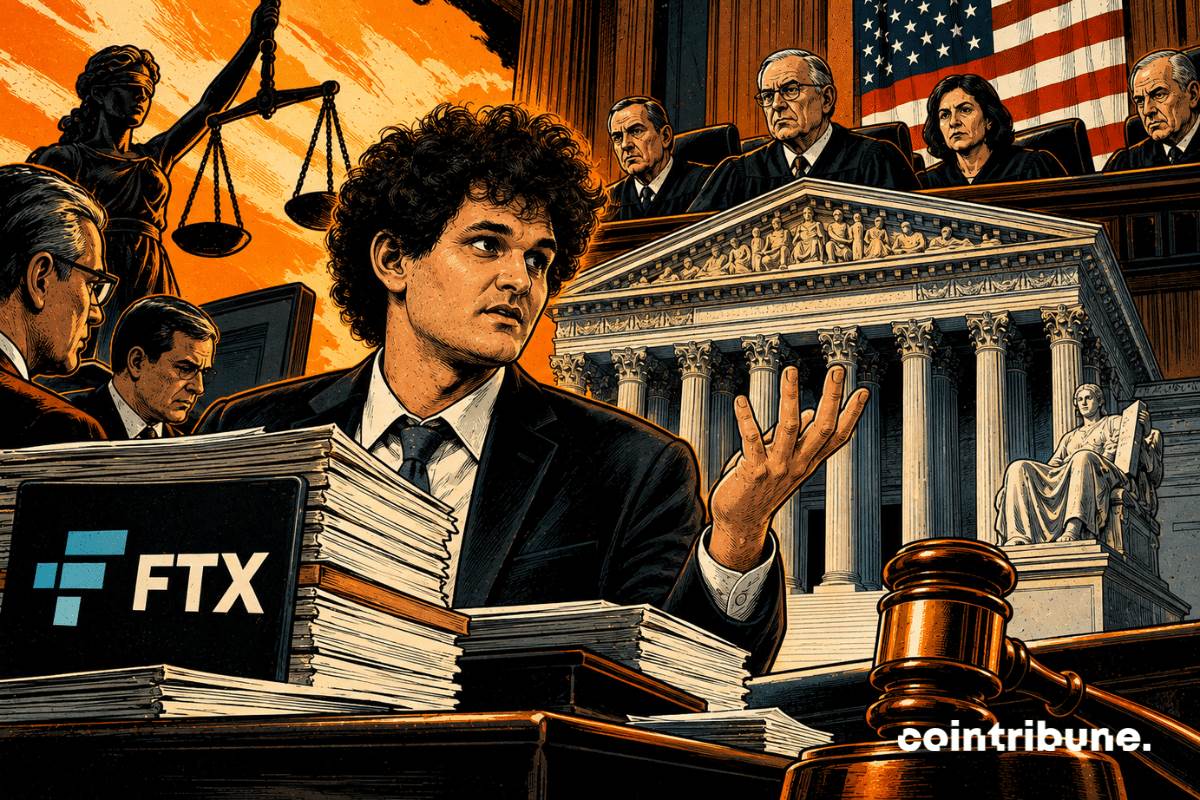
Sam Bankman-Fried, commonly known as "SBF", has little to go back on. The path he had just chosen led to the U.S. Supreme Court. The former head of cryptocurrency platform FTX was sentenced to 25 years in prison for bankruptcy and is now seeking a retrial and disputing the confiscated $11 billion. The core of his request revolved around an awkward question: What is the value of the concept of "loss" when the customer finally receives full compensation?
Summary of the case
- Goal of appeal: SBF appealed to the Supreme Court to overturn its 25-year sentence and seek a retrial, while also challenging a forfeiture order against its $11 billion assets.
- Defense: Its defense team claimed that FTX and Alameda had sufficient assets to refund clients 'funds and that clients had actually received full compensation with interest after the bankruptcy proceedings ended.
- Legal obstacles: Kousisis Precedents complicated his appeal. The Supreme Court ruled in 2025 that fraud was established even if the perpetrator had no intention of causing net financial loss.
- Evidence controversy: SBF also questioned the evidence presented to the jury. According to his defense, the prosecution mentioned losses in its statement, but evidence that contradicted it was excluded from the trial.
The customer has received a refund, why is SBF still fighting?
That's exactly what SBF's defense team now wants to make clear to the judge. In November 2022, FTX experienced a sensational bankruptcy, and subsequent liquidation procedures resulted in almost all creditors receiving full refunds with interest.
This detail is crucial, although it does not tell the full story. These repayments are based on the dollar value of the amount claimed at the time of bankruptcy. At the time, Bitcoin was priced at approximately $16,000. Investors who want to keep crypto assets during the market rebound cannot recover this value-added gain.
More importantly, the prosecution's views are completely different. In their view, subsequent repayments cannot change the misappropriation of public funds attributed to SBF. Prosecutors accused him of embezzling billions of funds belonging to FTX customers. The case also involves $1.7 billion related to FTX investors and $1.3 billion related to Alameda lenders.
This is why both parties can tell two very different stories when looking at the same repayment record. The defense emphasized the funds eventually recovered, while the prosecution focused on what happened before.
What exactly does the former cryptocurrency giant want from the Supreme Court?
His demands are unambiguous. SBF wants to overturn the conviction, get a retrial and revoke an $11 billion confiscation order.
His lawyers accused the court of shutting down some debate space. At its request, the defense failed to present evidence intended to prove that FTX and Alameda had sufficient assets to return client funds.
"There are always sufficient assets available to repay customers as ultimately done, with substantial interest," the complaint states.
In his view, this $11 billion constitutes the second problem. The SBF called it an "overwhelming fine" and cited the Eighth Amendment to the Constitution, which prohibits excessive fines.
However, the threshold remains high. The Supreme Court hears only about 1% of cases filed each year. It still needs to decide whether to entertain the former cryptocurrency billionaire's appeal.
Previously, the Court of Appeal had rejected his arguments in June. A ruling a year ago hindered his attempt even more seriously.
Kousisis: Supreme Court jurisprudence before SBF
The case is called Kousisis v. United States. This has nothing to do with cryptocurrency, but a project that obtains public contracts for subcontracting obligations through false certification. However, the work itself was done as required.
In 2025, the Supreme Court unanimously ruled that electronic fraud can still be established even if the perpetrator did not intend to cause net financial loss.
The Court of Appeal used this decision to confirm Sam Bankman-Fried's conviction. Now, his defense team is trying to use the same logic of reasoning in different ways.
If prosecutors do not have to prove financial loss to establish fraud, why can they show the jury elements that imply that a customer suffered a huge loss? SBF asked why his defense couldn't show evidence in the opposite direction?
Attorney Jeffrey Fisher argued that since the existence of fraud itself does not depend on financial loss, the presentation is "misleading and biased." While this isn't as sensational as FTX's billions of dollars lost, legally, appeals largely hinge on it.
The former head of the cryptocurrency empire is also trying his luck elsewhere. In June, SBF asked Donald Trump for a pardon. The request is still pending with the U.S. government. The Senate opposed the amnesty measure in July, and Trump closed the door as early as January. For those who once dominated much of the cryptocurrency space, options are rapidly running out.