Exchange Ranking
 Top Exchanges
 24h Volume Ranking
 Popularity Ranking
 Exchange BTC Balance
 Proof of Reserves
 Decentralized Exchanges
 Funding Rate
 Funding Heatmap
 Liquidation Data
 Max Pain
 Long/Short Ratio
 Whale L/S Ratio
 Binance/Okex/Huobi L/S
 Bitfinex Margin L/S
 ETF Tracker
 Solana ETF
 XRP ETF
 Hong Kong ETF
 Bitcoin Treasuries
 Crypto Reversal
 Ethereum Reserves
 HyperLiquid Wallet Analysis
 Hyperliquid Whale Watch
 Large Transactions
 On-chain Movement
 Bitcoin ROI
 Stablecoin Market Cap
 Options Analysis
 News
News Articles
 Economic Calendar
 Features
 Wallet
 Contract Calculator


 Security
 Collections
 Watchlist
 Following
 ETH
ETH The Ethereum ecosystem has hit a recent high: Blob usage has exceeded records, and expansion and funding bottlenecks coexist.
The Ethereum encryption ecosystem has recently hit a record high. Since September 3, 2026, demand for "blobs"(the cheap data storage space used by Rollup) has reached unprecedented levels. This performance not only proves that adoption of Layer 2 solutions is growing, but also confirms Ethereum's scalability strategy, while re-highlighting a lesser-focused issue: how to provide financial support to developers.
Summary of Core Points
- Ethereum has set a new record in using an average of 6.7 data blocks per block per day.
- Driven by Rollup, current demand has exceeded the peak observed at the end of 2025.
- The cryptocurrency network currently only operates at 40%-50% of its target value (14 data blocks per block).
- Four capacity improvements have been made since the Dencun upgrade, and the fifth improvement is under discussion.
- According to a report from Protocol Guild, funding for the client team remains a bottleneck for development.
Why does Ethereum have 6.7 data blocks per block?
On September 3, Trent Van Epps, a former Ethereum Foundation member and Protocol Guild organizer, reported that the moving average for the past three days was 5.9 data blocks per block. The daily average even reached 6.7, much higher than the peak before the end of 2025.
In Ethereum's technical terminology,"data block" refers to a cheap temporary storage space introduced by the 2024 Dencun upgrade (EIP-4844 standard). Rollup is a Layer 2 (L2) encrypted network such as Arbitration, Optimism, or Base. They store this data before submitting the transaction batch to the Ethereum main chain for verification.
The principle is simple: the higher the number of data blocks used per block, the more activity is transmitted through the Ethereum Data Availability Layer. Therefore, this record means that Layer 2 has released more transaction batches in Ethereum's data layer. Each data block contains 4,096 32-byte elements, which is approximately 128 KB. Calculated in 6.7 units, the theoretical volume per block is close to 858 KB.
How can Ethereum expand its capacity by 2.3 times?
After a brief decline in spring 2026, block usage on Ethereum has resumed rising. Even more remarkable is that it now exceeds its previous peak set at the end of 2025.
In fact, since the launch of Dencun, Ethereum's block capacity has steadily increased through continuous steps:
- When Dencun was launched in 2024:36 blocks (target/maximum);
- After Pectra update: 6/9 blocks;
- After BPO1 phase: 10/15 blocks;
- BPO2 (effective January 2026, which is the current level of Ethereum): 14/21 data blocks.
As a result, the targeted capacity of the Ethereum encrypted network has increased by 2.3 times compared to the Fusaka era. "Data blocks provide Rollup with a lower-cost way to publish data on Ethereum," the official document explains. EIP-4844 data disappeared from the node after 4,096 eras (approximately 18 days). This reduces the storage burden while maintaining verifiability during useful periods.
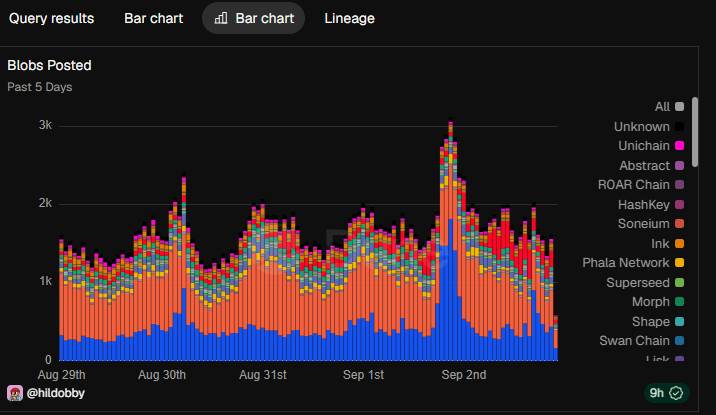
Ethereum data block usage hit a new high of 6.7 blocks per block. Source: hildobby, Dune Analytics
However, the Ethereum encrypted network is far from saturated. In fact, current activities only account for 40% to 50% of current goals. The goal is set at 14 data blocks per block. The upper limit of 21 constitutes the technical limit for each block. This margin still protects Rollup's transaction fees from a structural spiral.
Explanation: Ethereum is busy but not yet fully loaded
What is at stake in the next capacity increase in the blockchain network?
The issue currently troubling Ethereum encryption developers is the timetable for the fifth upgrade for 21/32 data blocks. For some, more data blocks mean lower transaction fees for Rollup and its users. What about the shortcomings? This will increase the bandwidth load on Ethereum node operators.
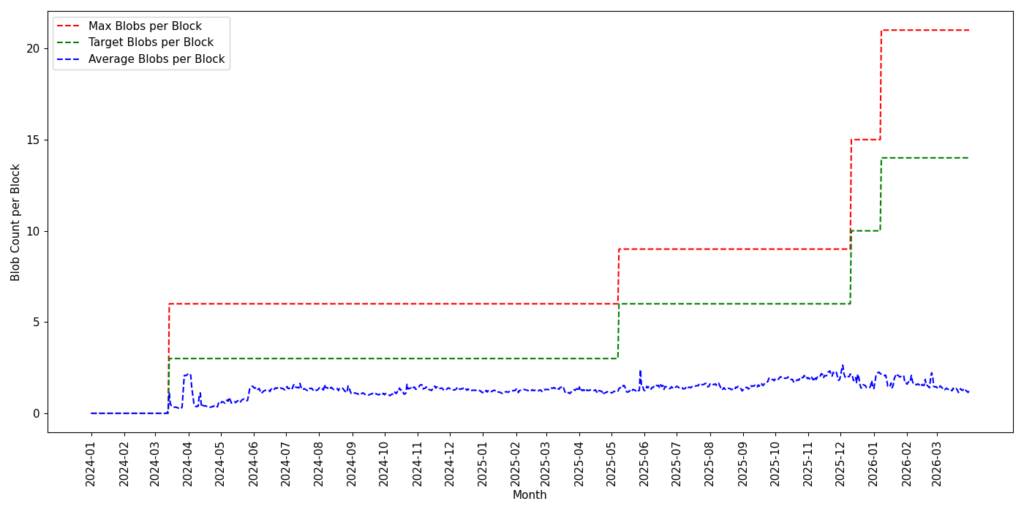
Evolution of Ethereum block usage, goals and caps. Source: Ambrosia and Mizrach, 2026, CC BY 4.0 license
For others, the bottleneck may be particularly human. For example, according to Trent Van Epps, the client team running Ethereum is still underfunded relative to the size of the network. According to reports, core development of Ethereum requires approximately US$30 million per year. Protocol Guild reportedly allocated nearly $40 million over four years, but that was not enough. Therefore, extended data availability depends on both human resources and code.
Not only that! The debate also fits Glamstam's perspective. This is the next major upgrade to the encrypted network and aims to increase Ethereum's global gas limits.
Regardless, this record of block usage on Ethereum confirms that Rollup's adoption is growing. The next catalyst to watch out for is the outcome of the debate surrounding the increase to 21/32 data blocks.