Exchange Ranking
 Top Exchanges
 24h Volume Ranking
 Popularity Ranking
 Exchange BTC Balance
 Proof of Reserves
 Decentralized Exchanges
 Funding Rate
 Funding Heatmap
 Liquidation Data
 Max Pain
 Long/Short Ratio
 Whale L/S Ratio
 Binance/Okex/Huobi L/S
 Bitfinex Margin L/S
 ETF Tracker
 Solana ETF
 XRP ETF
 Hong Kong ETF
 Bitcoin Treasuries
 Crypto Reversal
 Ethereum Reserves
 HyperLiquid Wallet Analysis
 Hyperliquid Whale Watch
 Large Transactions
 On-chain Movement
 Bitcoin ROI
 Stablecoin Market Cap
 Options Analysis
 News
 Articles
 Economic Calendar
 Features
 Wallet
 Contract Calculator


 Security
 Collections
 Watchlist
 Following
 BTC
 ETH
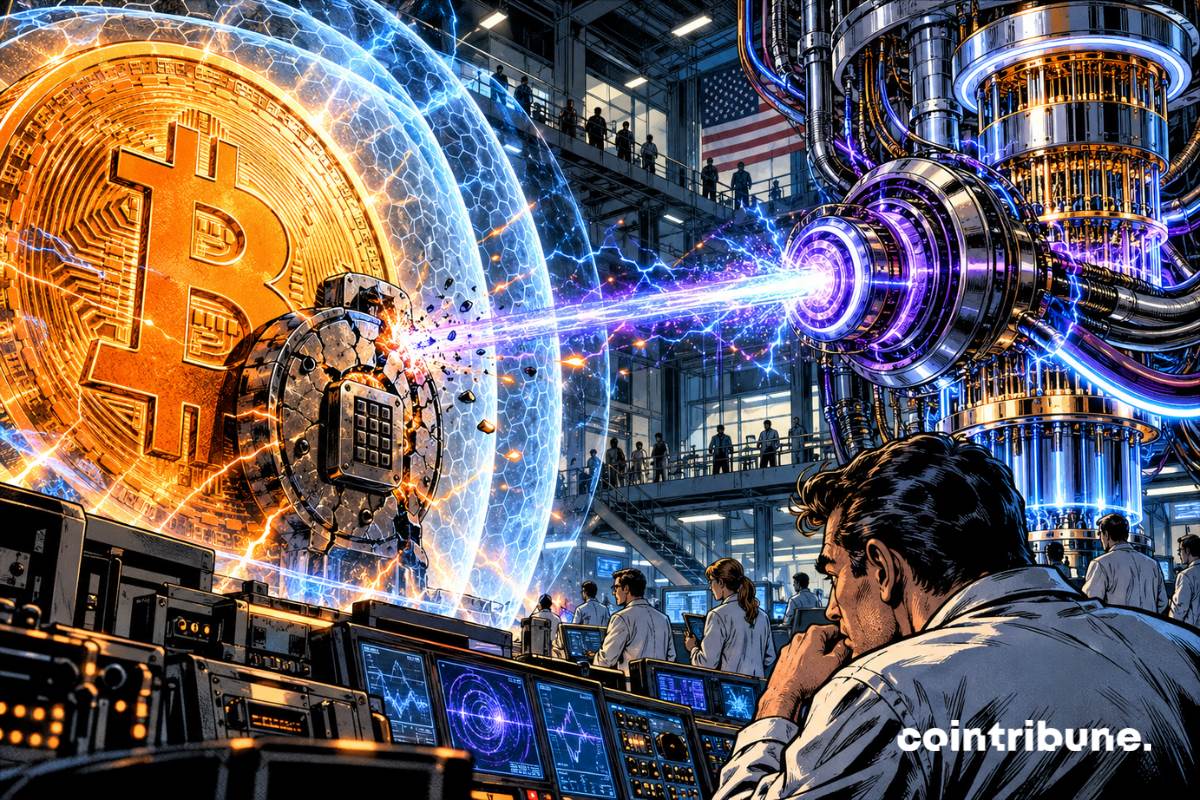
The United States invests US$215 million to accelerate the development of fault-tolerant quantum computers
The U.S. Department of Energy (DOE) aims to demonstrate machines with hundreds of logic qubits by 2028. For Bitcoin, this news deserves close attention. In theory, a sufficiently powerful quantum computer could in the future attack the signature mechanisms that protect certain bitcoins. In addition, this week an Ethereum researcher raised another concern: Before the famous "Q-Day"(Quantum Computing Threat Day) arrives, artificial intelligence (AI) may accelerate the threat.
Summary of Core Points
- The United States plans to invest up to $215 million to accelerate the development of quantum computing.
- No quantum computer currently can crack Bitcoin's cryptographic system.
- Justin Drake, a researcher at the Ethereum Foundation, warned that artificial intelligence could also speed up the process of discovering mathematical loopholes.
The American Quantum Competition from a Bitcoin Perspective
The American program is called the "Quantum Genesis Q Competition." The U.S. Department of Energy aims to fund companies that can build quantum computers that can truly be used for scientific research. At the same time, artificial intelligence has significantly reduced the cost of certain quantum protection technologies for Bitcoin, which is driving the acceleration process.
The competition plans a prize pool of up to $215 million. The first phase will pay for several intermediate phases. Subsequently,$100 million will be allocated to teams capable of demonstrating scientific machines with at least 100 logic qubits. Two other $50 million packages each target thresholds of 150 and 200 logic qubits, respectively.
The U.S. Department of Energy hopes to implement a system with "hundreds" of logic qubits by 2028. This figure requires further explanation. Current quantum computers often claim to have hundreds or thousands of physical qubits, but they are still prone to error. A logical qubit consists of multiple physical qubits to achieve sufficiently reliable calculations.
When discussing attacks on modern cryptography, what really matters is the number of these logical qubits. The U.S. government has not hidden its ambitions. The "Quantum Genesis" project aims to combine quantum computing, supercomputers and artificial intelligence. Priority application areas include chemistry, materials physics, applied mathematics and nuclear science.
Bitcoin is not a direct target of the project. But advances in scientific research could ultimately lead to the creation of machines capable of solving today's mathematical problems with cryptocurrency security. This is where the topic becomes fascinating.
Why quantum computers may threaten some BTC
Bitcoin uses multiple cryptographic mechanisms. SHA-256 is mainly used to protect mining and network hash systems. Transactions also rely on secp 256k1 elliptic curve cryptography.
主要令人担忧的是第二部分。私钥用于签署交易,关联的公钥允许网络验证签名是否有效。使用经典计算机时,从公钥中检索私钥被认为在实践上是不可能的。
一台足够强大并使用Shor算法的量子计算机可能会改变这一局面。理论上,它可以解决底层保护机制的数学问题,并从暴露的公钥中重建私钥。
但目前尚不可能。
专门致力于以太坊量子抗性的官方页面(以太坊账户也使用椭圆曲线密码学)引用了谷歌量子AI于3月发表的一项研究。该研究估计,攻击256位椭圆曲线密码学大约需要1,200个逻辑量子比特,这远低于一些早期的估计。
比特币面临量子挑战:威胁遥远但真实存在
美国能源部在其竞赛中目标是达到100至200个逻辑量子比特。差距依然巨大。而且,仅比较这一点是不够的:量子比特数量并非唯一因素。还必须考虑可能的操作次数、错误校正、机器稳定性以及攻击所需的时间。
目前,没有任何现有的量子计算机能够通过计算所有者的私钥来窃取比特币。
开发者们已不再忽视这一威胁。BIP-361项目估计,截至2026年3月1日,超过34%的比特币已经公开了链上公钥。这并不意味着现在可以窃取34%的BTC。它仅仅指出一部分供应量如果出现在具有密码学意义的量子机器面前,将成为更直接的打击目标。
Ethereum研究员引入AI变量
本周,辩论进入了新的维度。以太坊基金会研究员Justin Drake呼吁区块链行业冷静地开始准备他所谓的“掩体模式”(bunker mode)。他的担忧不仅限于量子计算。Drake认为,人工智能在数学领域的快速进步最终可能会发现针对ECDSA(椭圆曲线数字签名算法)的未知捷径。在最悲观的情景下,问题可能在“几个月内而非几年内”变得严重。
他并没有说ECDSA已被破解。目前没有任何允许从比特币钱包公钥中检索私钥的实际攻击被公开演示。这种警告更多源于辅助数学的人工智能进步速度。OpenAI最近发布了几百篇由其内部模型生成的数学著作。Drake认为这表明AI系统正变得能够快速探索长期仅限人类研究者涉足的问题。
比特币正是基于这样一个假设:某些数学问题极其难以解决。如果AI发现了效率更高的新算法,所需的暴力破解力量可能会减少。Vitalik Buterin对此假设非常重视,并公开回应了Drake。
He goes even further: Some solutions that are believed to be quantum-resistant, especially cryptography based on Euclidean lattices, may also be attacked and advanced by the mathematical results generated by AI.
But Buterin refused to panic. He does not advise users to move assets quickly. An ill-prepared migration itself can lead to losses. This nuance is important: researchers 'alerts are not the same as a cryptographic collapse.
Not all Bitcoin addresses are exposed in the same way
Still, Drake proposes a simple measure for large holders: Where feasible, give priority to new addresses that do not yet have a public key displayed on the chain. Why? Some Bitcoin address forms hide the public key behind the hash value until money is spent. This deprives potential attackers of the starting point they need to find the private key.
But this mechanism does not protect all coins. The old Pay-to-Public-Key output directly exposes the public key. Taproot also has such particularities. When a modern address is reused after spending, its public key may have been compromised.
This debate has been raging in ecosystems for months. Adam Back has called on Bitcoin to gradually prepare for the quantum transition. However, opinions on urgency are strongly divided. Some researchers believe the window period is only a few years. Others believe that the necessary hardware will still be decades away. Current experiments seem insignificant compared to real cryptographic problems. Just to avoid being forced to make last-minute decisions, developers are already studying different solutions. Bitcoin has never been fully built using post-quantum cryptography. Before the threat becomes a reality, it will likely need to evolve.
Bitcoin is preparing multiple retreat paths
One of the most watched proposals is BIP-360. The project introduced a new output type called Pay-to-Merkle-Root (P2MR). The idea obviously is to remove the key disbursement path used in Taproot, which exposes the public key.
BIP-360 does not make Bitcoin fully quantum resistant. It reduces some of the attack surface and prepares for an architecture that makes it easier to integrate with new signatures. The project is currently in the proposal stage and has not yet been activated on Bitcoin.
Another project, BIP-361, goes further. It envisions that after introducing a true post-quantum approach, Bitcoin could phase out accepting some old suspicious signature types. The goal will be to encourage holders to migrate before Q-Day.
该提案仍处于草案形式。机构开始密切关注这一主题。BlackRock、Coinbase、Strategy以及其他几家参与者加入了一个拥有1500万美元资金的联盟,致力于比特币的量子安全工作。因此,准备工作现已超越少数开发者的讨论,成为一个金融议题。政府也没有减缓自身的研发步伐。