Exchange Ranking
 Top Exchanges
 24h Volume Ranking
 Popularity Ranking
 Exchange BTC Balance
 Proof of Reserves
 Decentralized Exchanges
 Funding Rate
 Funding Heatmap
 Liquidation Data
 Max Pain
 Long/Short Ratio
 Whale L/S Ratio
 Binance/Okex/Huobi L/S
 Bitfinex Margin L/S
 ETF Tracker
 Solana ETF
 XRP ETF
 Hong Kong ETF
 Bitcoin Treasuries
 Crypto Reversal
 Ethereum Reserves
 HyperLiquid Wallet Analysis
 Hyperliquid Whale Watch
 Large Transactions
 On-chain Movement
 Bitcoin ROI
 Stablecoin Market Cap
 Options Analysis
 News
 Articles
 Economic Calendar
 Features
 Wallet
 Contract Calculator


 Security
 Collections
 Watchlist
 Following
 BTC
 ETH
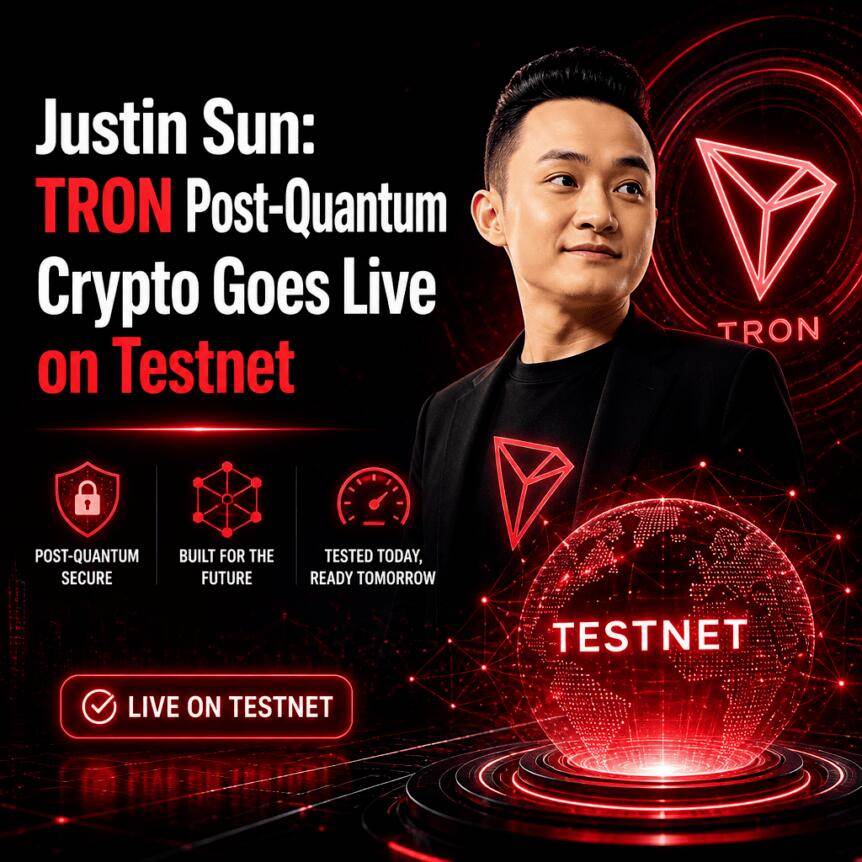
Sun Yuchen, founder of wavefield (TRON), said that the network's post-quantum cryptography work has been running on the test network, allowing wavefields to take the lead in achieving "quantum-resistant" capabilities ahead of the industry milestone known as "Q-Day". Sun Yuchen pointed out in an X post posted on Saturday that the team is paying close attention to the progress of quantum computing and artificial intelligence and is preparing to deploy relevant functions to the main network when the technology matures.
The announcement comes as other parts of the cryptocurrency ecosystem explore ways to protect wallets and keying material against possible future threats. With the improvement of quantum computer computing power, the elliptic curve encryption algorithm currently widely used in major blockchain chains may be weakened. At the same time, security-focused American Fortress has introduced a proposal to strengthen wallet security to protect against quantum threats without requiring users to transfer funds or change wallet addresses.
Core Points
- Progress in post-wave field quantum cryptography: Sun Yuchen said that the post-quantum cryptography function of the wave field has been launched on the test network, and the main network deployment is described as "possible at any time", depending on preparation.
- Aiming to complete the upgrade before "Q-Day": Sun Yuchen linked the wavefield plan to achieving quantum-resistant capabilities before "Q-Day". "Q-Day" refers to the day when quantum computing capabilities may challenge current security standards.
- American Fortress's plan: 据7月28日报道,该组织的方法侧重于在不改变现有钱包地址的情况下提供量子安全的钱包保护。
- 技术文档状态:AmericanFortress的提案已作为技术论文发布在Cryptography ePrint Archive上,但尚未经过同行评审。
- 行业共识:从比特币-focused的研究资助到以太坊和Algorand的路径规划,多个生态系统的努力正汇聚于升级密码学基础的需求。
波场后量子密码学进入测试网阶段
孙宇晨的更新表明,波场的后量子密码学工作不仅仅是理论研究,他称其“现已在测试网上运行”。在同一条X帖子中,他强调公司“密切跟踪量子计算和人工智能的进展”,并表示一旦满足安全和工程就绪的条件,就准备好将抗量子功能部署到主网。
对于用户而言,主要意义在于对资产保护的务实关注。孙宇晨表示,波场致力于确保用户资产的安全,并暗示该链可能成为少数几个在“Q日”之前实现抗量化的主要网络之一。虽然孙宇晨的消息中“Q日”并非一个精确的事件日期,但该概念在加密货币领域被广泛使用,用来描述量子系统可能具备破解当前公钥方案底层密码假设能力的时刻。
Entering the testnet is significant because it means that implementation has moved beyond the theoretical design stage. However, readers should still focus on details, such as what is being tested during the transition from testnet to mainnet (such as how key operations are handled, how migration plans are made, and what wallet and exchange compatibility guarantees look like).
AmericanFortress proposes quantum secure wallet protection without transferring funds
In the context of wavefield schedules, AmericanFortress, an organization focusing on blockchain security, has outlined a cryptographic plan to defend against future quantum attacks, while requiring users not to transfer funds, rotate keys, or change wallet addresses.
According to Cointelegraph on July 28, American Fortress's approach differs from many proposed post-quantum strategies in that it adds quantum security protection while keeping existing wallet addresses in use. The practical benefits of this approach are obvious, especially for daily wallet holders and infrastructure providers: Address stability reduces operating overhead and avoids forced migration cycles caused by complex hosting, accounting, and user support issues.
Still, the realistic feasibility of any "no address change" design depends on technical constraints-that is, how protection is applied, on what assumptions it is based on, and how it interacts with existing signature and verification processes. The release of the proposal provides a way for developers to review these assumptions.
Technical paper on ePrint, not yet peer-reviewed
AmericanFortress published the proposal in a technical paper on its proposal, which is included in the Cryptography ePrint Archive. The ePrint list can be found in the IACR archives, but the article states that the paper had not been peer-reviewed at the time of publication.
For the cryptocurrency community, peer review is often seen as a quality checkpoint, especially for cryptographic proposals that may affect wallet security design. Even without peer review, releasing detailed drafts provides researchers and engineers with specific objects to test, analyze, and potentially build. As wavefields and other networks advance, such proposals could help shape a "quantum-resistant" form at the wallet level, rather than just the chain level.
Why post-quantum efforts in the cryptocurrency field are accelerating
The impetus for post-quantum cryptography is because a sufficiently powerful quantum computer may eventually threaten elliptic curve encryption. Many blockchain systems-including Bitcoin, Ethereum, etc. -rely on elliptic curve schemes to secure transactions and public key identities. If the quantum power reaches a threshold to enable effective decryption or key recovery attacks on such schemes, the security assumptions need to be updated.
The sense of urgency is reflected in the multiple parallel initiatives mentioned in early reports. Earlier this year, a coalition led by Strategy committed $15 million to fund Bitcoin quantum security research. In addition, the Ethereum Foundation has released a proposal outlining how to migrate accounts to anti-quantum cryptography. Algorand has also outlined plans to introduce anti-quantum accounts by 2027.
Overall, these efforts suggest that the industry is not just studying quantum risk in the abstract, but is trying to craft upgrade paths that can be deployed in production systems. The challenge is that migration in a blockchain ecosystem is rarely straightforward: cryptographic changes must remain available, prevent financial losses, and remain compatible with existing wallets, exchanges, and contract ecosystems.
Wave Field announced the test network implementation and American Fortress's wallet focused proposal, highlighting different perspectives on the same issue. Network-level resilience and user-level wallet protection may ultimately need to be coordinated. Investors and developers should focus on whether solutions emphasize a migration-free user experience, compatibility with existing address formats, or strong alternatives to cryptographic primitives.
Looking to the future, the most important signals that need to be monitored are the progress of post-quantum functionality moving from a draft testnet to a mainnet-compatible version, as well as the practical guarantees provided for wallet behavior, custody operations, and signature verification-especially those that promise to keep addresses unchanged. With the quantum timetable still uncertain, the pace and clarity of details of implementation may be as important as the headline goal of getting ready before Q-Day.