Exchange Ranking
 Top Exchanges
 24h Volume Ranking
 Popularity Ranking
 Exchange BTC Balance
 Proof of Reserves
 Decentralized Exchanges
 Funding Rate
 Funding Heatmap
 Liquidation Data
 Max Pain
 Long/Short Ratio
 Whale L/S Ratio
 Binance/Okex/Huobi L/S
 Bitfinex Margin L/S
 ETF Tracker
 Solana ETF
 XRP ETF
 Hong Kong ETF
 Bitcoin Treasuries
 Crypto Reversal
 Ethereum Reserves
 HyperLiquid Wallet Analysis
 Hyperliquid Whale Watch
 Large Transactions
 On-chain Movement
 Bitcoin ROI
 Stablecoin Market Cap
 Options Analysis
 News
 Articles
 Economic Calendar
 Features
 Wallet
 Contract Calculator


 Security
 Collections
 Watchlist
 Following
By the end of 2025, global funds began to react together in the commodities market. Gold and silver prices increased by more than 70% and 170%, respectively, hitting new historical highs. These metals became popular choices for both risk aversion and inflation hedging purposes. However, at the moment when emotions are at their peak, funds are already starting to look for “the next destination.” Recent increases in trading volumes of industrial metals like copper and aluminum, along with the rise in expectations for new energy and AI-related infrastructure projects, indicate that the main phase of precious metal prices may have been completed. A cycle of commodity movements driven by macroeconomic trends, industry demand, and supply constraints is taking center stage, shifting focus from “value-preserving assets” to “true productive resources.”

I. The End of 2025’s “Rapid Rise”: Analyzing the underlying logic behind the gold and silver bull market
The precious metals market in 2025 cannot be simply described as a “bull market.” Instead, it was a situation where multiple historical factors combined to trigger a realignment of values.
● Market data: As of late December, the price of physical gold in London reached $4549.96 per ounce, a year-over-year increase of 72.72%. Silver prices also saw a remarkable increase, reaching over $79 per ounce, with a year-over-year increase of over 170%. Other precious metals like platinum and palladium also hit new historical highs, showing a general upward trend.
● Changes in driving forces: The core driving force behind this rise goes beyond the traditional framework of “weakening US dollars and declining interest rates.” There has been a fundamental shift in the factors that drive these prices.
○ Re-evaluation of monetary credit: Market concerns about the credibility of the US dollar, along with the global trend towards de-dollarization, are the fundamentals driving this bull market. Central banks around the world are continuously purchasing gold on a large scale to diversify their foreign exchange reserves, thereby creating a solid strategic foundation for gold prices. This gold purchase behavior is not a short-term transaction, but rather a long-term strategic allocation.
○ Rising demand for safe-haven assets: The intensification of global geopolitical tensions and growing trade conflicts have elevated the避险属性 of precious metals. Their role in mitigating economic cycle fluctuations has shifted to managing uncertainties related to international order.
○ Supply-demand imbalance: Take silver as an example. Its strong rise is driven by both financial and industrial factors. Demand from industries such as photovoltaics and artificial intelligence is surging, while mining supply is limited due to long investment cycles, leading to ongoing structural shortages in the market.
Latest market developments and institutional perspectives:
● Institutional consensus: Mainstream views suggest that the logic behind this market movement is strategic and sustainable. The market may be at the beginning of a new long-term bull market, rather than the end of an “eventful period.” CITIC Securities believes that factors such as Fed easing policies, downward pressure on the U.S. economy, and inflation persistence will continue to support precious metals prices.
● Risk warnings: At the same time, there are voices of caution. Current prices are already at historically high levels, and market sentiment is overheated. Institutions warn that investors should be cautious of potential sharp fluctuations caused by changes in Fed policy expectations and easing geopolitical tensions. The Shanghai Gold Exchange has also issued warnings regarding market risks.
II. Rotational signals are emerging: Historical patterns suggest that commodities are poised to take over the role of key players in the market.
Historical experience shows that there is a significant rotational effect within the commodities market. After precious metals experience a significant valuation recovery, funds often begin to look for segments within the industry that have greater growth potential.
A key indicator—the “commodity/gold ratio”—has sent important signals. When this ratio drops to extremely low levels and then begins to rise, it often indicates the start of a major bull market for commodities. Currently, gold prices are much higher than those of other basic commodities. This significant valuation gap creates room for further increases in industrial metals and other related products.
The underlying macro logic is as follows:
1. Spreading of driving forces: The monetary easing, weakening of the dollar, and global inflation expectations that drove up gold prices earlier will ultimately benefit all commodities priced in dollars.
2. Shift in demand expectations: Market attention is shifting from purely “hedging” and “credit protection” to focusing on real industrial demand related to energy transformation, artificial intelligence, and grid infrastructure development.
III. After precious metals, focus turns to industrial metals as key players
After the rotation among precious metals (recovery in the gold-to-silver ratio), the market’s focus has naturally shifted to industrial metals, which are more closely linked to global economic trends. Among these, copper and aluminum are considered the most promising candidates to take over the role of key players.
1. Copper: The core element of “green inflation”
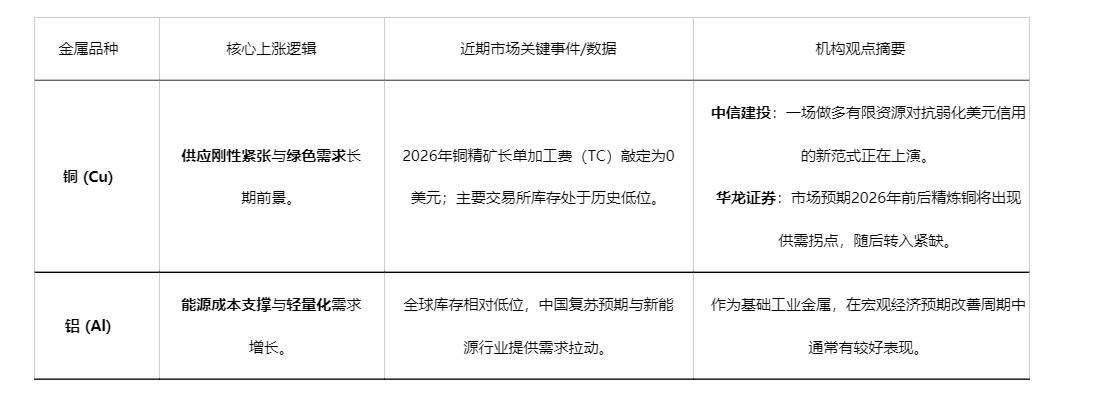
铜价在近期已空中加速,创下历史新高,成为“有色盛宴”中的领舞者之一。其逻辑坚实:
● 供应刚性凸显: 全球铜矿面临品位下降、投资不足、生产事故频发等制约。一个标志性事件是,2026年铜精矿长单加工费被敲定为零美元/吨,这反映出矿山端供应已紧张到极致,冶炼厂利润被挤压殆尽。
● 需求前景广阔: 全球能源转型(电动车、充电网络、可再生能源发电)和人工智能数据中心建设,均离不开铜这一“电气化金属”。中信建投指出,资本开支不足、AI需求强劲与资源民族主义等因素叠加,正在重塑资源的定价范式。
2、铝:“轻盈的基石金属”
铝价同样处于上行通道。其逻辑在于:
● 能源属性与成本支撑: 铝是“固态的电”,其生产成本高度依赖电力。全球能源价格波动和“双碳”目标下的电力结构调整,为铝价提供了长期支撑。
● 需求结构升级: 在汽车轻量化、光伏边框、消费电子等领域的需求持续增长,使其受益于制造业升级。
工业金属板块最新动态(截至2025年12月末):
四、加密市场与商品市场的“分道扬镳”
在传统大宗商品如火如荼之际,一个值得玩味的现象是加密资产(以比特币为代表)的近期表现并不同步。两者出现了显著的“分道扬镳”。
● 市场表现背离: 2025年下半年以来,尽管有美国《GENIUS法案》签署等监管利好刺激,加密市场在创下高点后整体进入震荡。这与同期贵金属和部分工业金属的单边强势上涨形成鲜明对比。
● 属性认知分化: 这种背离反映出两者在极端市场环境下被赋予了不同的属性标签。
○ 黄金/白银:当前更多地被视作 “终极避险资产” 和 “主权信用对冲工具” ,其上涨源于对现行货币体系深层次的信任危机。
○ 加密资产:尽管有“数字黄金”之称,但其价格波动性大、监管前景复杂,在当前阶段仍被许多主流资金视为高风险的另类投机资产或科技增长股。在市场追求“确定性”避险时,其吸引力相对减弱。
五、2026年前瞻:结构性行情与风险应对
展望2026年,市场共识是普涨行情难续,结构性分化将成为主线。
1、贵金属内部分化:Gold is expected to remain volatile under the support of central banks’ purchases, though its price increases may slow down. Silver, which is influenced by gold's trends, faces challenges in terms of industrial demand (such as in the photovoltaic industry). Platinum and palladium, on the other hand, rely more on their own industrial demand recovery to survive.
2. Industrial metals present clear opportunities: Metals like copper, which have a well-defined supply-demand gap, are likely to continue to be a focus of market attention. The market trend will shift from being driven by expectations to being influenced by actual supply-demand tensions.
3. Risks and strategies:
a. Policy risks: The Federal Reserve’s monetary policy decisions and trade policies after the U.S. elections (such as tariffs on critical minerals) remain major uncertainties.
b. Trading risks: With prices of all metals having risen significantly, market sentiment is highly volatile. It is important to be cautious of any unexpected events that could lead to sharp price fluctuations or technical corrections in the “long-selling-long” strategy.
c. Investment strategies: For ordinary investors, it is advisable to avoid chasing high prices in such a volatile market. Instead, they can invest in related ETFs or focus on equity investments in upstream mining companies with relatively stable valuations. This approach may offer greater stability and safety.
The surge in gold and silver prices by the end of 2025 isn’t just a lucrative opportunity for assets; it also marks the beginning of a new commodity cycle, driven by re-evaluation of currency credit, energy transformation, and global industrial restructuring.
Historical patterns and market signals clearly indicate that the spotlight on the stage is shifting from shiny precious metals to basic metals such as copper and aluminum, which are essential components of modern industry. However, it is crucial to remain vigilant during the climax of the market movement: at this critical moment, structural differentiation is inevitable. Only those who understand the underlying logic and are aware of market risks can navigate the changing dynamics and move forward safely.