Exchange Ranking
 Top Exchanges
 24h Volume Ranking
 Popularity Ranking
 Exchange BTC Balance
 Proof of Reserves
 Decentralized Exchanges
 Funding Rate
 Funding Heatmap
 Liquidation Data
 Max Pain
 Long/Short Ratio
 Whale L/S Ratio
 Binance/Okex/Huobi L/S
 Bitfinex Margin L/S
 ETF Tracker
 Solana ETF
 XRP ETF
 Hong Kong ETF
 Bitcoin Treasuries
 Crypto Reversal
 Ethereum Reserves
 HyperLiquid Wallet Analysis
 Hyperliquid Whale Watch
 Large Transactions
 On-chain Movement
 Bitcoin ROI
 Stablecoin Market Cap
 Options Analysis
 News
 Articles
 Economic Calendar
 Features
 Wallet
 Contract Calculator


 Security
 Collections
 Watchlist
 Following
 ATH
 BTC
If we only consider the price, Bitcoin in 2025 seems to have had a “high start but then a decline”: At the beginning of the year, high spirits drove BTC prices up to a new high of $126,000 in October. However, subsequent weakening macro data, concentrated margin calls, and reduced positions by major investors led to a drop in prices, ending the year around $90,000. But the real changes in the market lie beyond the charts—this year, ETFs continued to attract funds, regulatory frameworks became clearer, and institutions and companies began to get involved actively. As this somewhat平淡的 year comes to an end, capital and trends are shifting quietly: Stablecoins are challenging traditional payment systems; asset tokenization is becoming part of mainstream collateral systems; enterprise-level public chains are being used for actual transactions; DeFi, prediction markets, and AI payments continue to expand. Price adjustments are just a transition phase; 2025 is more like a preparation for the next round of implementation and revaluation in 2026.

Predictions for 2026
Bitcoin price
● By the end of 2027, the price of Bitcoin is expected to reach $250,000.
The market in 2026 is highly unpredictable and chaotic. However, there is still a possibility that Bitcoin could reach new historical highs in 2026. Current options market data indicates that the probability of Bitcoin reaching $70,000 or $130,000 by the end of June 2026 is quite high. Similarly, the probability of it reaching $50,000 or $250,000 by the end of 2026 is also significant. These broad price ranges reflect the uncertainty surrounding the market in the short term. As of this writing, the entire crypto market is in a bear market, and Bitcoin has not yet regained its upward momentum. We believe that there is still a risk of further declines in the short term, until Bitcoin’s price stabilizes again around $100,000 to $105,000. Other factors in the broader financial markets also contribute to this uncertainty, such as the pace of deployment of artificial intelligence-related capital expenditures, monetary policy conditions, and the U.S. midterm elections in November.
Over the past year, we have observed a structural decrease in Bitcoin’s long-term volatility levels. This could be due, in part, to the introduction of larger-scale covered options/ Bitcoin profit generation programs. It’s worth noting that Bitcoin’s volatility curve now assigns higher implied volatilities to put options compared to call options—something that wasn’t the case six months ago. In other words, we are moving away from the characteristics typically found in developing and growth-oriented markets, towards those of traditional macro assets.
This trend of maturation is likely to continue. Whether Bitcoin experiences further declines towards the 200-week moving average or not, the maturity of this asset class and its adoption by institutions are both increasing. 2026 could be a relatively quiet year for Bitcoin. Regardless of whether its final price reaches $70,000 or $150,000, our optimism regarding Bitcoin’s long-term prospects will only grow stronger. With increased institutional participation, relaxed monetary policies, and the market’s urgent need for non-US dollar hedging assets, Bitcoin is likely to become widely accepted as a tool for hedging against currency depreciation, just like gold in the next two years.
— Alex Thorn
Layer-1 and Layer-2
● The total market value of the Solana internet capital market is expected to surge to $2 billion (currently around $750 million).
Solana’s on-chain economy is gradually maturing, shifting from a culture-driven model to a business-oriented platform that generates real income. This transition is due to improvements in Solana’s market structure and increased demand for tokens with intrinsic value. As investors prefer to support sustainable on-chain businesses rather than short-lived trends, the internet capital market will become a key pillar of Solana’s economic activities.
— Lucas Tcheyan
● At least one universal Layer-1 blockchain will incorporate revenue-generating applications that can directly create value for its native tokens.
As more and more projects begin to rethink how L1 can capture and maintain value, blockchain technology will continue to develop in directions that focus on more explicit functionality design. The success of Hyperliquid in integrating revenue models into its permanent contract exchange, along with the trend of shifting economic value generation from the protocol layer to the application layer (known as the “fat application theory”), is reshaping people’s expectations of neutral underlying chains. An increasing number of chains are exploring the possibility of integrating certain infrastructure for revenue generation directly into their protocols, thereby strengthening their token economy models. Vitalik Buterin, the founder of Ethereum, recently called for low-risk and economically viable DeFi solutions to demonstrate the value of ETH. This further highlights the pressures facing L1s. MegaEth plans to introduce a native stablecoin that rewards validators with revenue, while Ambient’s AI-focused L1 aims to internalize inference costs. These examples show that blockchain technology is becoming more willing to control and monetize key applications. By 2026, it’s possible that one major L1 will officially integrate revenue-generating applications at the protocol level, with economic benefits directly linked to native tokens.
——Lucas Tcheyan
● The Solana’s inflation reduction proposal in 2026 will not be approved; instead, the existing proposal SIMD-0411 will be withdrawn.
The inflation rate of Solana has been a topic of debate within the community over the past year. Although a new inflation reduction proposal (SIMD-0411) was introduced in November 2025, no consensus has been reached regarding the best solution. Instead, there seems to be a tendency to focus on less important priorities, such as the implementation of structural reforms in the Solana market. Additionally, changes to SOL’s inflation policy could affect its reputation as a neutral value storage and currency asset in the future.
——Lucas Tcheyan
● Enterprise-level L1 will move from a pilot phase to becoming a fully operational settlement infrastructure. At least one of the Fortune 500 banks, cloud service providers, or e-commerce platforms will launch a branded enterprise-level L1 blockchain in 2026. This blockchain will handle transactions worth over $1 billion and will also serve as a bridge between public DeFi networks. Previous enterprise chains were mostly experimental or used for marketing purposes. The next generation of enterprise chains will be designed specifically for applications in certain industries. The verification layer will be operated by regulated issuers and banks, while the public chain will be used for liquidity, collateral, and price discovery. This will further highlight the differences between neutral public L1 and enterprise-level L1, which integrate issuance, settlement, and distribution functions.
——Christopher Rosa
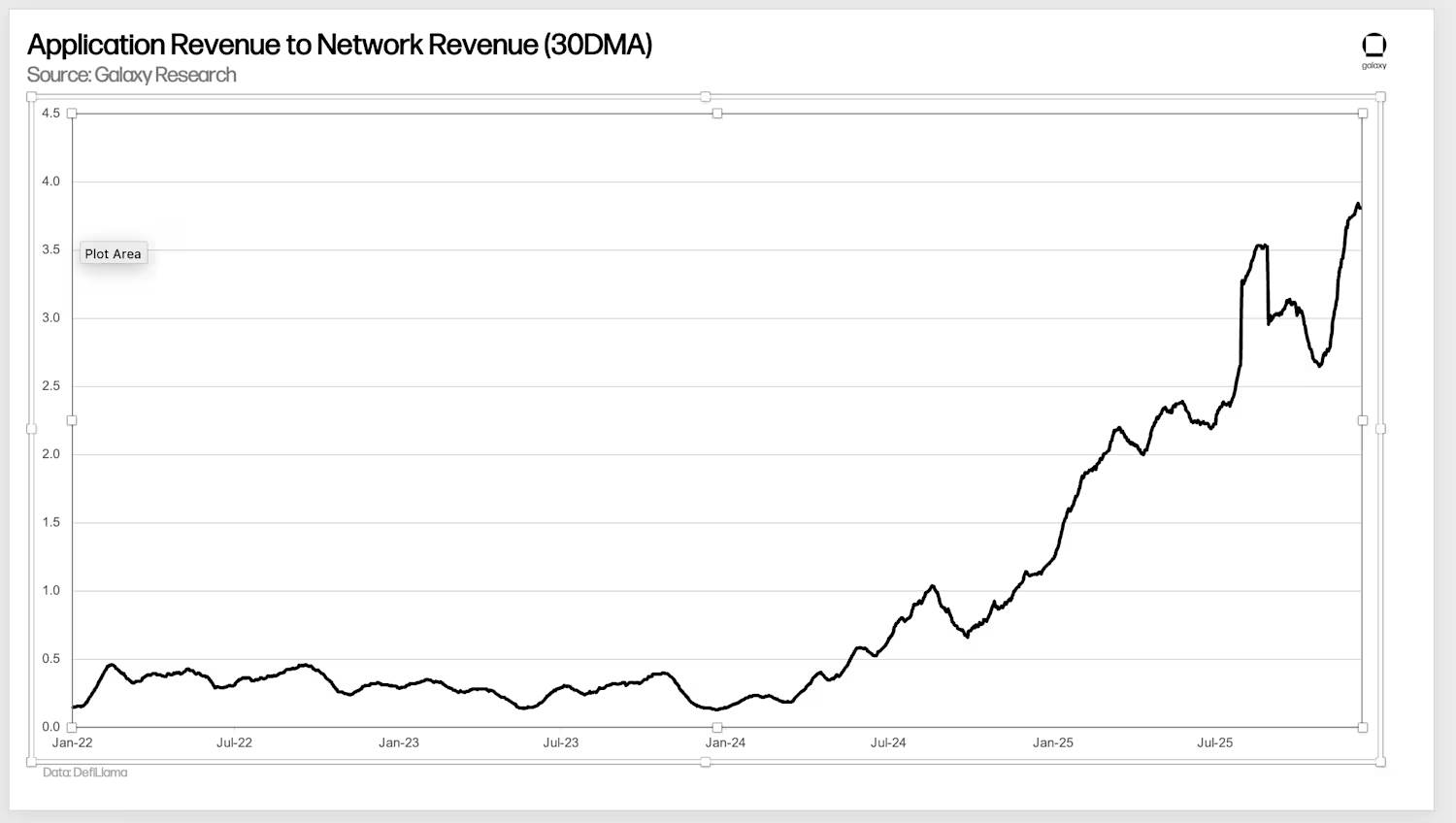
● The ratio of revenue from the application layer to that from the network layer will double by 2026.
As transactions, DeFi services, wallets, and emerging consumer applications continue to dominate the generation of fees on the blockchain, value capture is shifting from the underlying layer to the application layer. At the same time, the network is working to reduce MEV leaks in terms of structure, while also striving for fee compression at both L1 and L2 levels. This results in a reduction in the revenue base of the infrastructure layer. This will accelerate value capture at the application layer, allowing the “fat application theory” to continue to supersede the “fat protocol theory”.
——Lucas Tcheyan
Stablecoins and asset tokenization
● The U.S. Securities and Exchange Commission (SEC) may provide some exemptions for the use of tokenized securities in DeFi applications.
The SEC may offer certain exemptions to allow the development of a market for tokenized securities on the blockchain. This could take the form of what’s known as an “inaction letter” or a new type of “innovation exemption”. This concept has been mentioned by SEC Chairman Paul Grosky several times. It would allow legal, non-packaged forms of securities to enter the DeFi market, rather than just using blockchain technology for back-office capital market activities, as was done recently with the DTCC’s “inaction letter”. Formal rule-making is expected to begin in the second half of 2026, aiming to establish regulations for brokers, traders, exchanges, and other traditional market participants who use cryptocurrencies or tokenized securities.
——Alex Thorn
● The U.S. Securities and Exchange Commission may face lawsuits from traditional market participants or industry organizations due to its “innovation exemption” program.
无论是交易公司、市场基础设施还是游说公司,传统金融或银行业的某些部分将挑战监管机构对DeFi应用或加密公司提供豁免的行为,认为其未能制定全面的规则来管理代币化证券的扩张。
——亚历克斯·索恩(Alex Thorn)
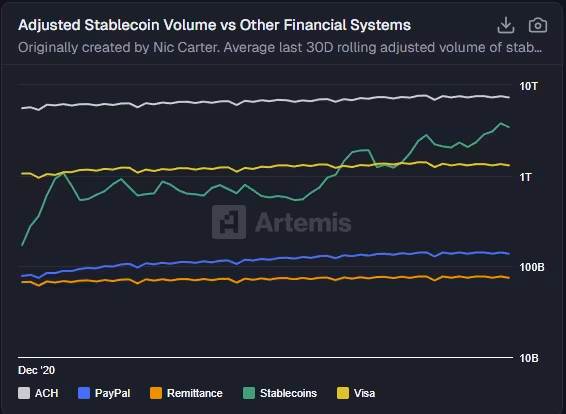
● 稳定币的交易量将超越ACH系统。
与传统支付系统相比,稳定币的流通速度显著更高。我们已经看到稳定币供应持续以30%-40%的年均复合增长率(CAGR)增长,交易量也随之增加。稳定币交易量已经超过了Visa等主要信用卡网络,目前处理的大约是自动清算所(ACH)系统交易量的一半。随着GENIUS法案的定义在2026年初敲定,我们可能会看到稳定币增长速度超越其历史平均增长率,因为现有的稳定币将继续增长,新进入者也将竞争这一不断扩大的市场份额。
——萨德·皮纳基维奇(Thad Pinakiewicz)
● 与传统金融(TradFi)合作的稳定币将加速整合。
Although the United States introduced several stablecoins in 2025, it remains difficult for the market to support a large number of widely used options. Consumers and businesses will not use multiple digital currencies simultaneously; they will prefer to use one or two stablecoins that are more widely accepted. We can see this trend of integration through collaborations between major institutions: nine major banks—including Goldman Sachs, Deutsche Bank, Bank of America, Santander, BNP Paribas, Citibank, Mitsubishi UFJ Bank, TD Bank Group, and UBS—are exploring plans to launch stablecoins based on G7 currencies. PayPal and Paxos have jointly launched PYUSD, integrating global payment networks with regulated issuers.
These examples show that success depends on the scale of distribution, namely the ability to connect with banks, payment processors, and enterprise platforms. It is expected that more stablecoin issuers will cooperate or integrate their systems in order to gain a significant market share.
——Jianing Wu
● A major bank or brokerage could begin accepting tokenized stocks as collateral.
So far, tokenized stocks have remained in a marginal position, limited to DeFi experiments and private blockchains piloted by major banks. However, traditional financial infrastructure providers are rapidly transitioning to blockchain-based systems, and regulatory support is increasing. In the coming year, we may see major banks or brokers开始 accepting tokenized stocks as online deposits, treating them as assets that are equivalent to traditional securities.
——Thad Pinakiewicz
● Card payment networks will be integrated into the public blockchain.
By 2026, at least one of the top three global card payment networks will use stablecoins to settle more than 10% of its cross-border transactions through the public chain. Although most end users may not have access to cryptocurrency interfaces, issuing entities and acquiring institutions will continue to display balances and liabilities in traditional formats. However, behind the scenes, some net settlements between regional entities will be conducted using tokenized dollars, thereby reducing settlement deadlines, upfront financing requirements, and risks associated with intermediary banks. This development will make stablecoins a core financial infrastructure for existing payment networks.
——Christopher Rosa
DEFI
● Decentralized exchanges (DEXs) will account for over 25% of spot transaction volume by the end of 2026.
While centralized exchanges still dominate liquidity and attract new users, several structural changes are driving more and more spot transactions to move online. The two main advantages of DEXs are the lack of KYC requirements and more efficient fee structures, which make them increasingly attractive to users and market makers seeking lower friction and greater flexibility. Currently, DEXs account for approximately 15%-17% of spot transaction volume, depending on the source of data.
——Will Owens
● The DAO treasury assets under Futarchy model governance will exceed $500 million.
Based on our prediction from a year ago, that futarchy as a governance mechanism would become more widely adopted, we believe that it has already shown sufficient effectiveness in real-world applications. This has led decentralized autonomous organizations (DAOs) to begin using futarchy as the sole decision-making system for capital allocation and strategic direction. Therefore, we estimate that by the end of 2026, the total assets of DAO funds managed through the futarchy model will exceed $500 million. Currently, approximately $47 million in DAO assets are managed using the futarchy model. We believe this growth will mainly come from newly established DAO instances, while existing DAO instances will also see an increase in their asset holdings.
——Zack Pokorny
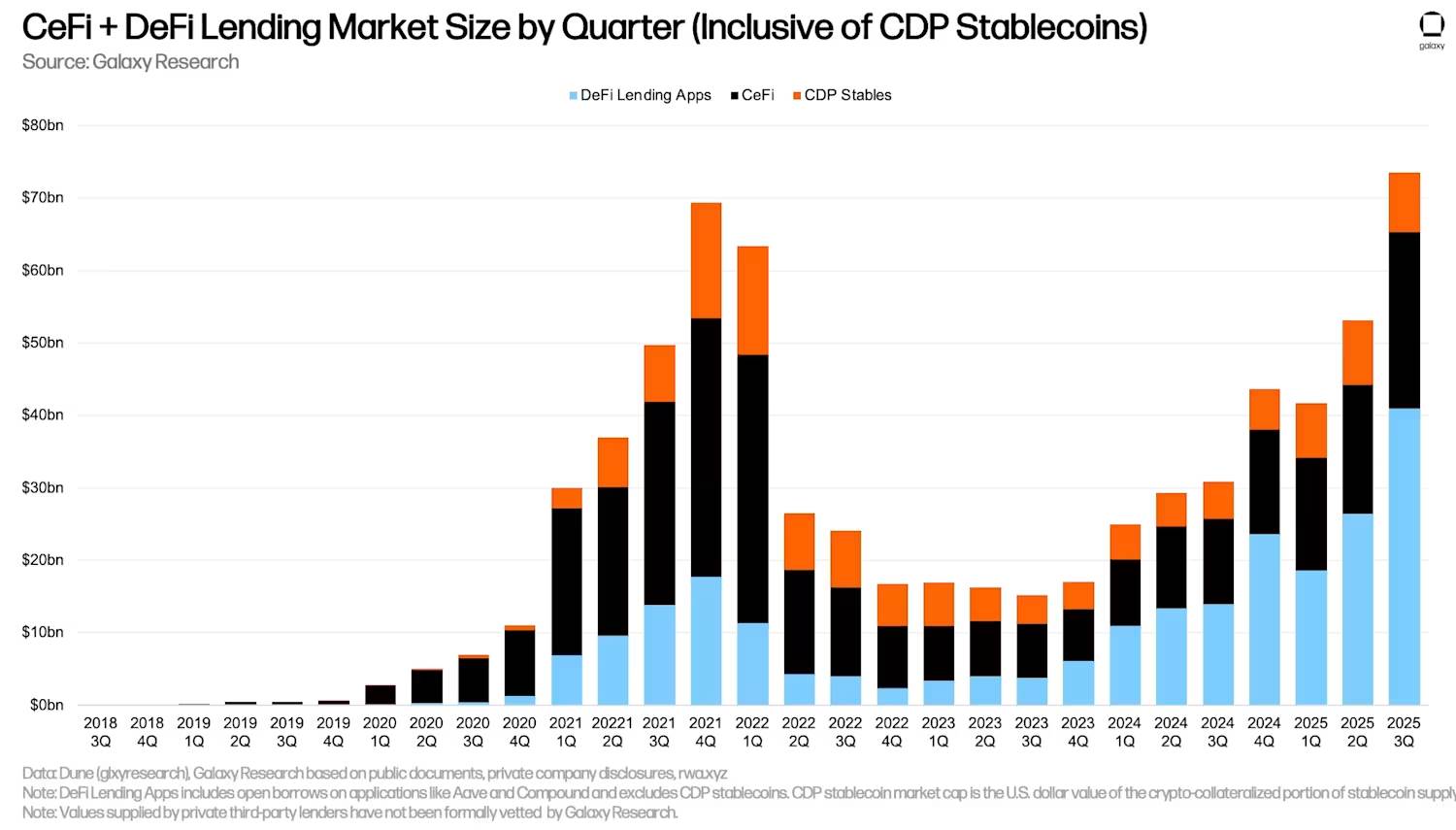
● The total balance of crypto mortgages is expected to exceed $90 billion at the end of the quarter.
Following the growth trend seen in 2025, the total amount of crypto mortgages in both DeFi and CeFi sectors is expected to continue expanding in 2026. The dominance of blockchain-based lending platforms will continue to rise, as institutional participants rely increasingly on DeFi protocols for borrowing activities.
——Zack Pokorny
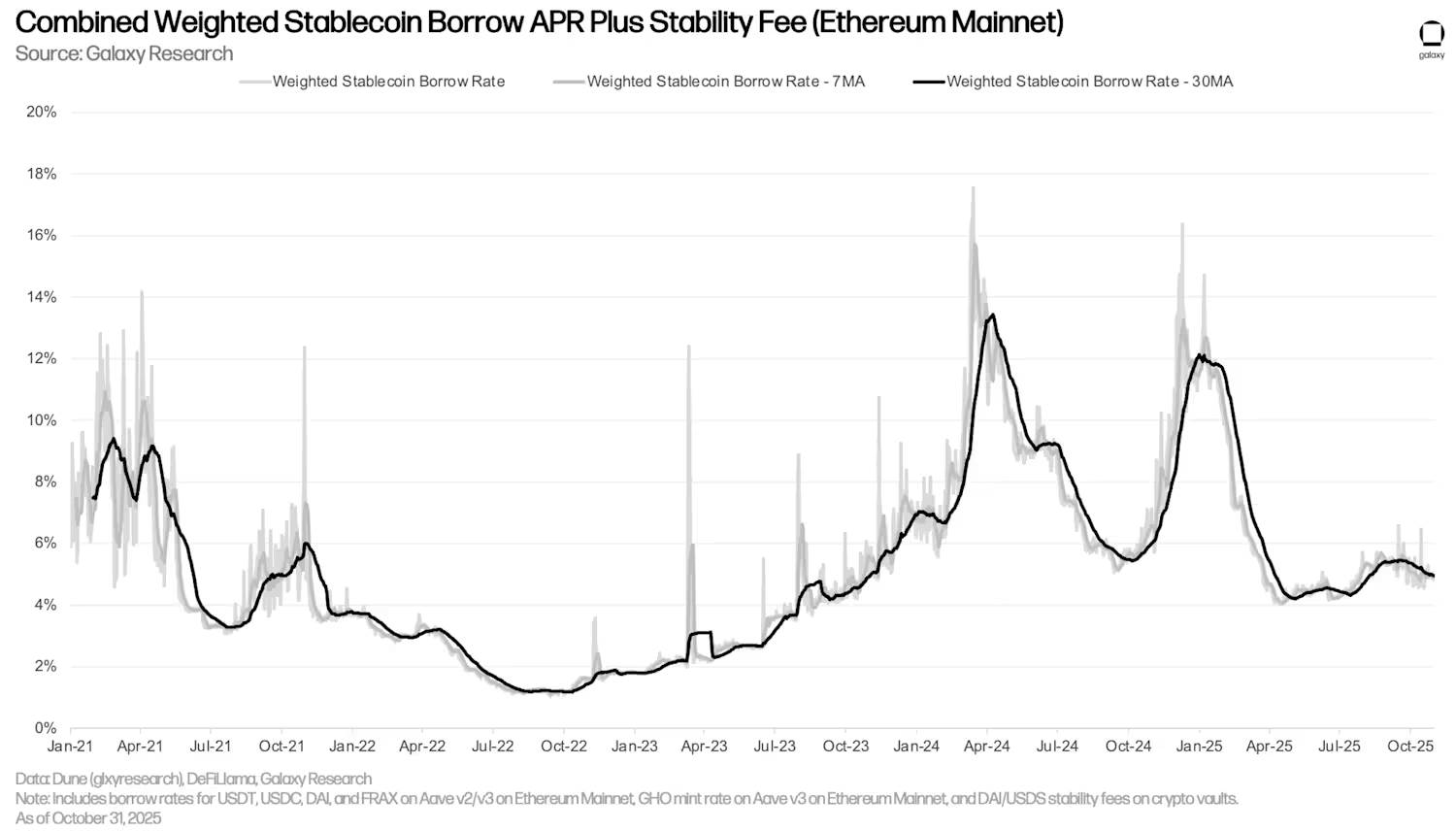
● The interest rates on stablecoins will remain moderate, with DeFi borrowing costs not exceeding 10%.
As more institutions participate in lending on the blockchain, we expect that increased liquidity and more stable, lower-interest rates will significantly reduce interest rate fluctuations. At the same time, arbitrage opportunities between on-chain and off-chain interest rates become easier to exploit, while the barriers to accessing DeFi services continue to rise. It is expected that off-chain interest rates will further decline by 2026, thereby keeping on-chain borrowing rates at a low level—even during bull markets, off-chain interest rates will remain an important reference point.
The key points are:
(1) Institutional capital brings stability and sustainability to the DeFi market;
(2) The declining off-chain interest rate environment will keep on-chain interest rates below their typical levels during the expansion phase.
– Zack Pokorny
● The total market value of privacy tokens is expected to exceed $100 billion by the end of 2026.
In the fourth quarter of 2025, privacy tokens received significant attention from investors. As more funds were deposited on-chain, on-chain privacy became a focus. Among the top three privacy tokens, Zcash increased in value by approximately 800%, Railgun by about 204%, while Monero saw a relatively moderate increase of 53%. Early Bitcoin developers, including the pseudonymous creator Satoshi Nakamoto, have discussed ways to make transactions more private or even completely anonymized. However, practical zero-knowledge technologies were not yet widely available or ready for deployment at that time.
As more and more funds are stored on the chain, users—especially institutions—are beginning to question whether they truly want their crypto assets to be fully disclosed. Whether it’s a design that completely hides assets or a hybrid approach, we expect the total market value of privacy tokens to exceed $100 billion by the end of 2026. Currently, CoinMarketCap estimates the value of such tokens at around $63 billion.
——Christopher Rosa
● Polymarket’s weekly trading volume is expected to stabilize at over $1.5 billion in 2026.
Prediction markets have become one of the fastest-growing sectors in the crypto world, with Polymarket’s weekly nominal trading volume already approaching $1 billion. We expect this figure to exceed $1.5 billion in 2026, thanks to improved liquidity brought about by new capital-efficient mechanisms, as well as increased transaction frequencies driven by AI-powered order processing systems. Polymarket’s ability to distribute funds is also improving, accelerating the inflow of capital.
——Will Owens
TradFi
● More than 50 spot cryptocurrency ETFs, along with another 50 crypto ETFs (excluding those focused on individual spot tokens), will be launched in the United States.
随着美国证券交易委员会(SEC)批准通用上市标准,我们预计2026年现货山寨币ETF的推出速度将加快。2025年,已有超过15只Solana、XRP、Hedera、Dogecoin、Litecoin和Chainlink的现货ETF上市。我们预计其余主要资产也将紧随其后提交现货ETF申请。除了单一资产产品外,我们还预计多资产加密ETF和杠杆加密ETF将会推出。随着超过100个申请在进行中,预计2026年将迎来新产品的持续涌入。
——吴佳宁(Jianing Wu)
● 美国现货加密ETF的净资金流入将超过500亿美元。
2025年,美国现货加密ETF已吸引230亿美元的净资金流入。随着机构采用的深化,我们预计这一数字将在2026年加速增长。随着金融服务公司取消对顾问推荐加密产品的限制,以及曾经对加密持观望态度的主要平台(如先锋集团)加入加密基金,比特币和以太坊的资金流入将超越2025年的水平,并进入更多投资者的投资组合。此外,大量新加密ETF的推出,尤其是现货山寨币产品,将释放被压抑的需求,并在分销初期推动额外的资金流入。
——吴佳宁(Jianing Wu)
● 一家主要资产配置平台将把比特币纳入其标准模型投资组合。
Among the four major financial services companies, three of them—WU Bank, Morgan Stanley, and Bank of America—have eliminated restrictions on recommending Bitcoin. They now allow investors to allocate up to 1% to 4% of their portfolios to Bitcoin. The next step is to include Bitcoin products in their recommended lists and incorporate them into their official research frameworks. This will significantly increase their visibility among clients. The ultimate goal is to incorporate Bitcoin into model investment portfolios. This typically requires higher asset management volume (AUM) and sustained liquidity. However, we expect that Bitcoin funds will be able to meet these requirements and incorporate Bitcoin into model portfolios with a strategic weight of 1% to 2%.
– Jianing Wu
● More than 15 cryptocurrency companies will go public in the United States or upgrade their listing status.
By 2025, ten cryptocurrency-related companies, including Galaxy, will successfully go public or upgrade their listing status in the United States. Since 2018, more than 290 cryptocurrency and blockchain companies have completed private placements worth over $50 million. With regulatory conditions becoming more relaxed, we believe that many companies are now ready to seek listing in the United States in order to access the US capital market. Among the most likely candidates, we expect CoinShares (if it does not go public by 2025), BitGo (has filed applications), Chainalysis, and FalconX to go public or upgrade their listing status in 2026.
– Jianing Wu
● More than five digital asset management companies will be forced to sell their assets, be acquired, or close down completely.
In the second quarter of 2025, there was a surge in the establishment of digital asset funds. Starting from October, the mNAV ratios of these funds began to decline. As of the time of writing this article, DATs involving Bitcoin, Ethereum, and Solana are trading at mNAV ratios below 1. During the initial boom, many companies operating in various industries quickly transformed into DATs in order to take advantage of favorable financing conditions. In the next phase, it will be important to distinguish between DATs that have sustainable prospects and those that lack coherent strategies or capabilities for asset management. To succeed in 2026, DATs need to have a stable capital structure, innovative methods for liquidity management and revenue generation, as well as strong partnerships with relevant protocols (if not already established). Advantages in scale, such as large-scale holdings of Bitcoin, or geographical advantages, such as Metaplanet in Japan, could provide additional competitiveness. However, many DATs that entered the market during the early stages did not engage in adequate strategic planning. Such funds will struggle to maintain their mNAV ratios and may be forced to sell assets, be acquired by larger players, or even close down completely in the worst-case scenario.
——Jianing Wu
Policies
● Some Democrats will focus on the issue of “debanking,” and gradually accept cryptocurrencies as a solution.
Although the likelihood of such situations is low, it’s still worth paying attention to. By the end of November 2025, the Financial Crimes Enforcement Network (FinCEN), a department within the U.S. Treasury Department, urged financial institutions to be vigilant against suspicious activities related to cross-border transfers involving illegal immigrants. While the warning primarily focused on risks related to human trafficking and drug trafficking, it also mentioned that money service businesses (MSBs) are responsible for reporting suspicious activities, including cross-border transfers related to illegal employment income. This could include remittances sent by undocumented immigrants, such as plumbers, farm workers, or restaurant servers. These individuals may work in violation of federal laws, yet they remain popular among left-wing voters. The warning follows FinCEN’s earlier Geographical Target Order, which requires MSBs to automatically report cash transactions in designated border counties, with a threshold as low as $1,000—far lower than the legal requirement of $10,000 for currency transaction reports. These measures expand the range of everyday financial activities that could trigger federal reporting, thereby increasing the likelihood of immigrants and low-income workers facing financial restrictions, denial of services, or other forms of financial exclusion. These circumstances might make some Democratic supporters of immigration more sympathetic to the issue of “debanking” (a topic that has been largely discussed by the right in recent years), and they might be more willing to accept financial networks that require no permits and are resistant to censorship.
相反,支持民粹主义、亲银行以及主张法治的共和党人可能会因为同样的原因开始对加密货币产生不满,尽管特朗普政府及共和党内的创新派一直大力支持这一行业。联邦银行监管机构为现代化《银行保密法》和反洗钱合规要求而进行的持续工作,只会进一步引起人们对金融包容性政策目标与犯罪减少之间内在权衡的关注——而不同的政治派别会对这些权衡赋予不同的优先级。如果这种政治重组成为现实,这将证明区块链并没有固定的政治阵营。其无需许可的设计意味着人们对它的接受或反对并非基于意识形态,而是取决于它如何影响不同时代中不同群体的政治优先事项。
——马克·霍赫施泰因(Marc Hochstein)
● 美国将对预测市场相关的内幕交易或比赛操控展开联邦调查。
With US regulatory authorities approving the use of on-chain prediction markets, their trading volume and number of outstanding contracts have increased significantly. At the same time, several scandals have emerged, including allegations of insiders using private information to gain an advantage in the market, as well as raids by federal agencies targeting groups involved in manipulating competitions within major sports leagues. Since traders can participate using fake identities, without going through the process of KYC verification, insiders are more likely to be tempted to use their privileged information or manipulate the market. Therefore, we may see investigations conducted due to abnormal price fluctuations in on-chain prediction markets, rather than regular monitoring by traditional regulated sports betting platforms.
——Thad Pinakiewicz
AI
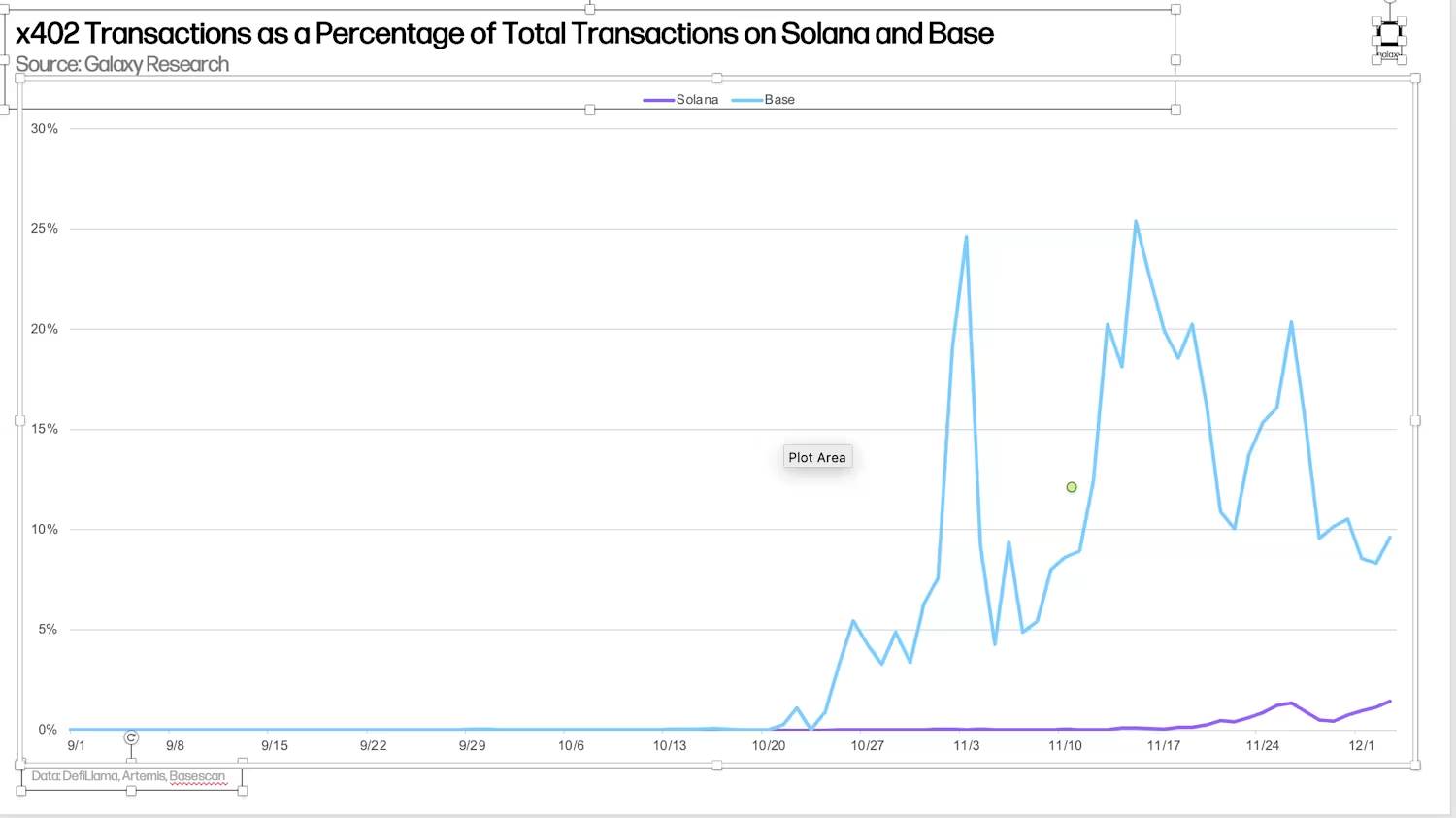
● Payments based on the x402 standard will account for 30% of the daily transactions on the Base chain, and 5% of the non-voting transactions on Solana. This indicates the widespread use of on-chain agent interactions.
With the advancement of AI-powered agents, the continuous adoption of stablecoins, and improvements in developer tools, x402 and other agent-based payment standards will enable on-chain activities to占更大的比例。As AI agents become more autonomous in executing transactions across various services, standardized payment primitives will become a core component of the execution layer.
Base and Solana have become leading blockchain platforms in this field. Base stands out due to the significant role played by Coinbase in creating and promoting the x402 standard. Solana, on the other hand, has gained prominence thanks to its large developer community and robust user base. We expect that as proxy-driven business models continue to develop, new payment-specific blockchains like Tempo and Arc will also experience rapid growth.
– Lucas Tcheyan
Looking back at predictions for 2025: The gains and losses of Bitcoin and the crypto market
By the end of 2024, people were extremely optimistic about the future of Bitcoin and cryptocurrencies. The new administration promised to end the “enforceable regulation” practices of the Biden administration. President Trump, who will take office soon, pledged to make the United States a “world capital of crypto”. Just one month before the second inauguration, buying Bitcoin became one of the hottest trading topics worldwide.
On December 31, 2024, we released 23 predictions for 2025. We expect that the market will expand in terms of scope and narrative. Some of these predictions were exactly correct, while others were less accurate. For many of our predictions, our team was on the right track, but not entirely accurate. From the recovery of revenue sharing on the blockchain to the increasing role of stablecoins, to the steady adoption by institutions, the major trends we identified continue to evolve.
In the following text, we will examine our predictions for the year 2025, and assess their accuracy. If there is any theme that we have underestimated in 2025, it would be the surge in digital asset markets. Although this trend only emerged briefly during the summer of 2025, its impact cannot be ignored. We evaluate our successes and failures using rigorous standards, and provide comments when necessary.
Bitcoin
❌ Bitcoin is expected to exceed $150,000 per unit in the first half of 2025, and possibly reach $185,000 per unit in the fourth quarter.
Result: Bitcoin did not break through $150,000 per unit, but reached a new high of $126,000 per unit. In November, we lowered our target price for the end of the year to $125,000 per unit. As of the time of writing, the trading price of Bitcoin is between $80,000 and $90,000 per unit, which seems unlikely to meet our updated target price for the end of 2025.
——Alex Thorn[Alex Thorn]
❌ In 2025, the total asset management volume of US-based ETPs dedicated to Bitcoin will exceed $250 billion.
Result: As of November 12, the total asset management volume reached $141 billion, an increase from $105 billion on January 1st. However, it still fell short of our forecasted target.
——Alex Thorn[Alex Thorn]
❌ In 2025, Bitcoin will once again become one of the assets with the best performance after adjusting for risk factors among global assets.
Result: In the first half of 2025, this prediction proved to be accurate. As of July 14, Bitcoin’s Sharpe ratio for the year so far is 0.87, which is higher than that of the S&P 500 index, Nvidia, and Microsoft, among others. However, it is expected that Bitcoin will end the year with a negative Sharpe ratio, failing to become one of the best-performing assets of the year.
——Alex Thorn
✅ At least one of the leading wealth management platforms will recommend allocating 2% or more of assets to Bitcoin.
Result: One of the four major financial services companies, Morgan Stanley, has removed any restrictions on allocating Bitcoin to accounts. In the same week, Morgan Stanley released a report recommending that portfolios can allocate up to 4% of assets to Bitcoin. Additionally, the Digital Assets Council of Financial Professionals, led by Ric Edelman, recommended allocating 10%-40% of assets to Bitcoin. Ray Dalio, founder of Bridgewater Associates, also suggested allocating 15% of assets to Bitcoin and gold.—Alex Thorn
❌ Five NASDAQ companies and five sovereign wealth funds will announce the inclusion of Bitcoin in their balance sheets.
结果:目前仅有三家纳斯达克100指数公司持有比特币。然而,全球约有180家公司持有或宣布计划在其资产负债表中购买加密货币,涉及超过10种不同的代币。超过五个国家通过建立官方储备或主权基金投资于比特币,这些国家包括不丹、萨尔瓦多、哈萨克斯坦、捷克共和国和卢森堡。数字资产财库公司(DAT)趋势是2025年购买加密货币的主要机构力量之一,尤其是在第二季度。
——吴佳宁(Jianing Wu)
❌ 比特币开发者将在2025年就下一次协议升级达成共识。
结果:不仅未能就下一次协议升级达成共识,比特币开发者生态系统内部还出现了关于如何对待非货币交易的争议。2025年10月,最广泛使用的比特币核心(Bitcoin Core)软件发布了第30版,争议性地扩大了OP_RETURN字段的限制。
The purpose of this data field is to channel the most destructive transactions into areas that cause minimal damage to the blockchain. However, this approach has sparked significant opposition within the Bitcoin community. At the end of October, an anonymous developer proposed a new Bitcoin improvement proposal (BIP) aimed at “counteracting spam transactions” through a temporary soft fork. Although this proposal gradually lost momentum over the following months, the debates surrounding this issue essentially weakened the developers’ efforts to reach a consensus on more forward-looking upgrades. Although proposals like OP_CAT and OP_CTV still received some attention in 2025, unresolved governance issues prevented developers from reaching an agreement on the next major protocol upgrade by December.
– Will Owens
✅ Among the top 20 listed Bitcoin mining companies by market value, more than half have announced plans to transition or collaborate with companies specializing in supercomputing, artificial intelligence (AI), or high-performance computing (HPC).
Result: Most mining companies are turning to hybrid AI/HPC mining models to more effectively monetize their infrastructure investments. Of the top 20 listed Bitcoin mining companies, 18 have announced plans to transition to AI/HPC as part of their business diversification efforts. The two companies that have not announced such plans are American Bitcoin ABTC and Neptune Digital Assets Corp (NDA.V).
– Thad Pinakiewicz
❌ The total amount of BTC locked up in DeFi smart contracts and staking protocols will almost double in 2025.
Results: The number of Bitcoins locked in DeFi initiatives by the year 2025 increased by only about 30% (from 134,987 Bitcoins on December 31, 2024 to 174,224 Bitcoins on December 3, 2025). This increase was mainly due to lending activities. Specifically, Aave V3 Core added 21,977 wrapped Bitcoins during the year, while Morpho added 29,917 wrapped Bitcoins. However, there was a net outflow of funds from Bitcoin staking protocols, with over 13,000 wrapped Bitcoins being lost.
– Zack Pokorny
ETH
❌ The native Ethereum token ETH is expected to reach a record high of $5500 in 2025.
Results: Ethereum’s native token ETH reached a temporary high in September 2025, but failed to break through $5000. Analysts believe that the price increases from April to the autumn of 2025 were mainly driven by purchases made by Treasury companies like Bitminer. However, as these Treasury companies’ activities weakened, ETH prices declined, and it has been difficult to maintain a price above $3000 since October.
– Alex Thorn
❌ The Ethereum staking rate is expected to exceed 50% in 2025.
Results: In 2025, the staking ratio of Ethereum reached approximately 29.7%, compared to 28.3% at the beginning of the year. Over the past few months, due to the termination of circular transactions and significant restructuring of large validators, the amount of ETH staked was limited, with both withdrawals and new staking being disrupted.
– Zack Pokorny
❌ The ETH/BTC ratio is expected to fall below 0.03 by 2025, and it will also exceed 0.045
. Result: This prediction seems accurate. The ETH/BTC ratio dropped to a minimum of 0.01765 on April 22, reaching our lower limit prediction. On August 24, it reached a peak of 0.04324, but did not reach the upper limit of 0.045. Although the ETH/BTC ratio has rebounded, it is still expected to remain lower than last year.
– Alex Thorn
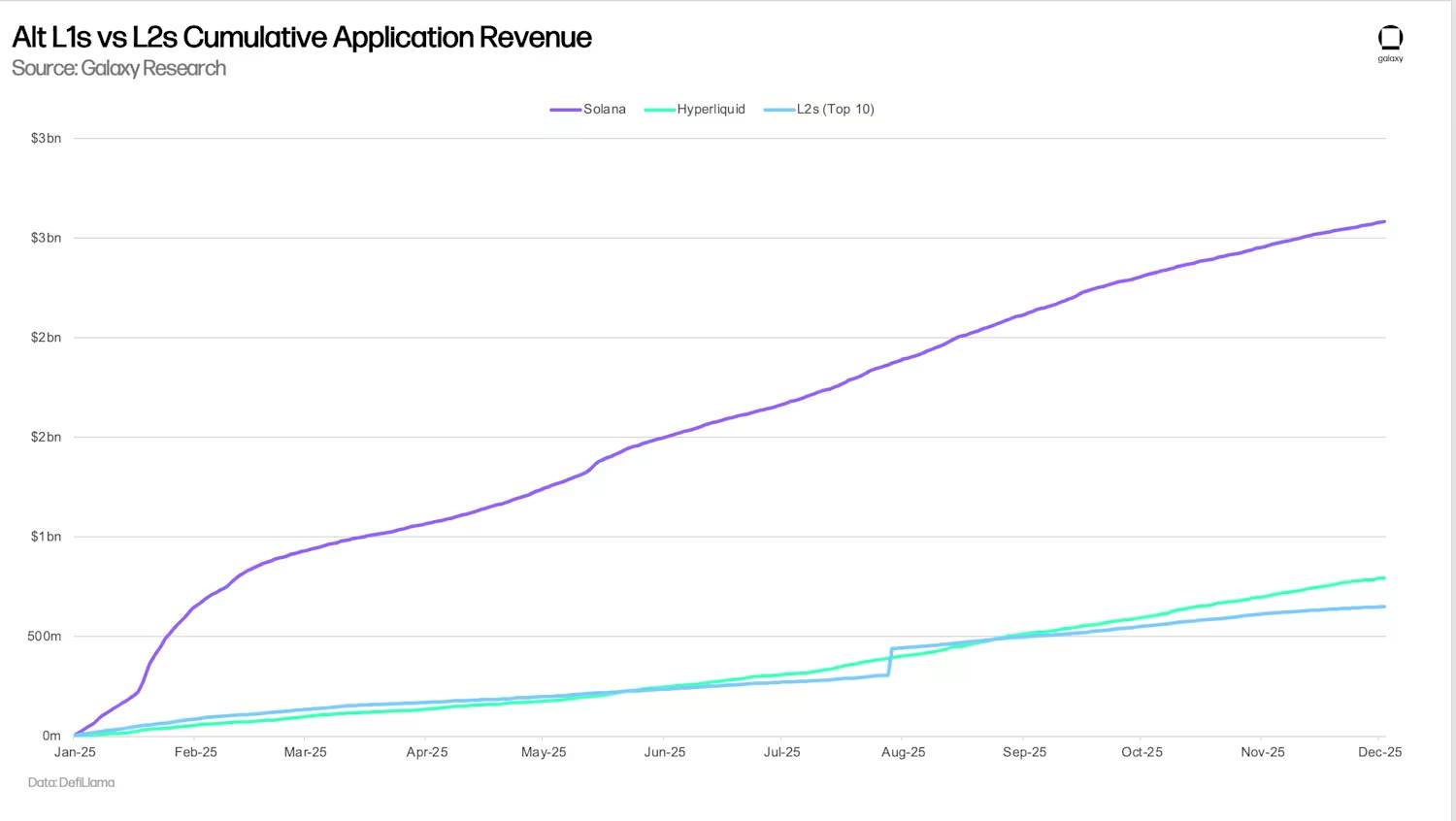
❌ Overall, Layer 2 activities will surpass Alt-L1 (the alternative first-layer blockchain) by 2025.
Result: This prediction did not materialize. In terms of networks and applications, Layer 2 performs worse than the main Alt-L1 chains. Solana has solidified its position as the leading chain for retail trading, accounting for the majority of transaction volume and fees in the industry. Hyperliquid has become the dominant platform for perpetual contract trading, with its single-platform revenue exceeding that of the entire Layer 2 ecosystem. Although Base is the only Layer 2 chain close to Alt-L1-level attractiveness—accounting for nearly 70% of Layer 2 application revenue by 2025—even its growth is insufficient to surpass Solana and Hyperliquid’s economic dominance.
– Lucas Tcheyan
DeFi
✅ DeFi will enter an “income-sharing era,” where on-chain applications will distribute at least $1 billion in nominal value to users and token holders through treasury funds and revenue sharing.
结果:截至2025年11月,通过应用收入回购的金额至少达到了10.42亿美元。Hyperliquid和基于Solana的应用是今年回购其代币最多的项目。回购活动成为了今年的重要叙事,市场普遍认可,甚至在某些情况下拒绝了不支持这种活动的项目。截至目前,仅顶级应用就已向终端用户返还了8.188亿美元。Hyperliquid在这一领域遥遥领先,通过代币回购返还了近2.5亿美元。
——扎克·波科尼(Zack Pokorny)
✅ 链上治理将迎来复兴,应用程序将尝试基于futarchy(未来市场)治理的模式,总活跃投票者将至少增加20%。
结果:2025年,DAO治理中对futarchy模式的使用显著增加。Optimism开始尝试这一概念,而基于Solana的MetaDAO在一年内引入了15个DAO,包括Jito和Drift等知名组织。目前,这些DAO中有9个完全采用futarchy模式来管理战略决策和资本分配。这些决策市场的参与度呈指数级增长,其中一个MetaDAO市场的交易量达到了100万美元。此外,MetaDAO交易量前10的提案中有9个发生在今年。我们见证了越来越多的DAO使用futarchy进行战略决策,还有一些DAO纯粹以futarchy模式启动。然而,绝大多数对futarchy的实验发生在Solana网络上,并由MetaDAO引领。
——扎克·波科尼(Zack Pokorny)
银行与稳定币
❌ 全球四大托管银行(纽约梅隆银行、摩根大通、道富银行、花旗银行)将在2025年提供数字资产托管服务。
结果:这一预测接近正确。纽约梅隆银行(BNY Mellon)确实在2025年推出了加密托管服务。道富银行(State Street)和花旗银行(Citigroup)虽然尚未推出,但宣布计划在2026年提供相关服务。只有摩根大通(JPMorgan Chase)仍然持观望态度,其一位高管在10月告诉CNBC:“目前托管服务并不在我们的计划中”,但这家大型银行将参与数字资产交易。总结来看,四大托管银行中已有三家提供或宣布计划提供加密托管服务。
——亚历克斯·索恩(Alex Thorn)
✅ 至少会有10种由传统金融(TradFi)合作伙伴支持的稳定币推出。
Results: Although some stablecoins have not been officially launched yet, at least 14 major global financial institutions have announced plans to introduce such currencies. For example, in the United States, JPMorgan Chase, Bank of America, Citigroup, and Wells Fargo have formed a consortium to develop a joint stablecoin. Other companies involved include brokerage firms like Interactive Brokers, as well as payment and fintech companies like Fiserv and Stripe. Outside of the United States, there is even stronger competition from organizations like Klarna, Sony Bank, and a global banking alliance composed of nine major banks. Additionally, crypto-native stablecoin issuers like Ethena have joined the competition. They are working with federally regulated bank Anchorage to launch their own USDtb stablecoin.
——Jianing Wu
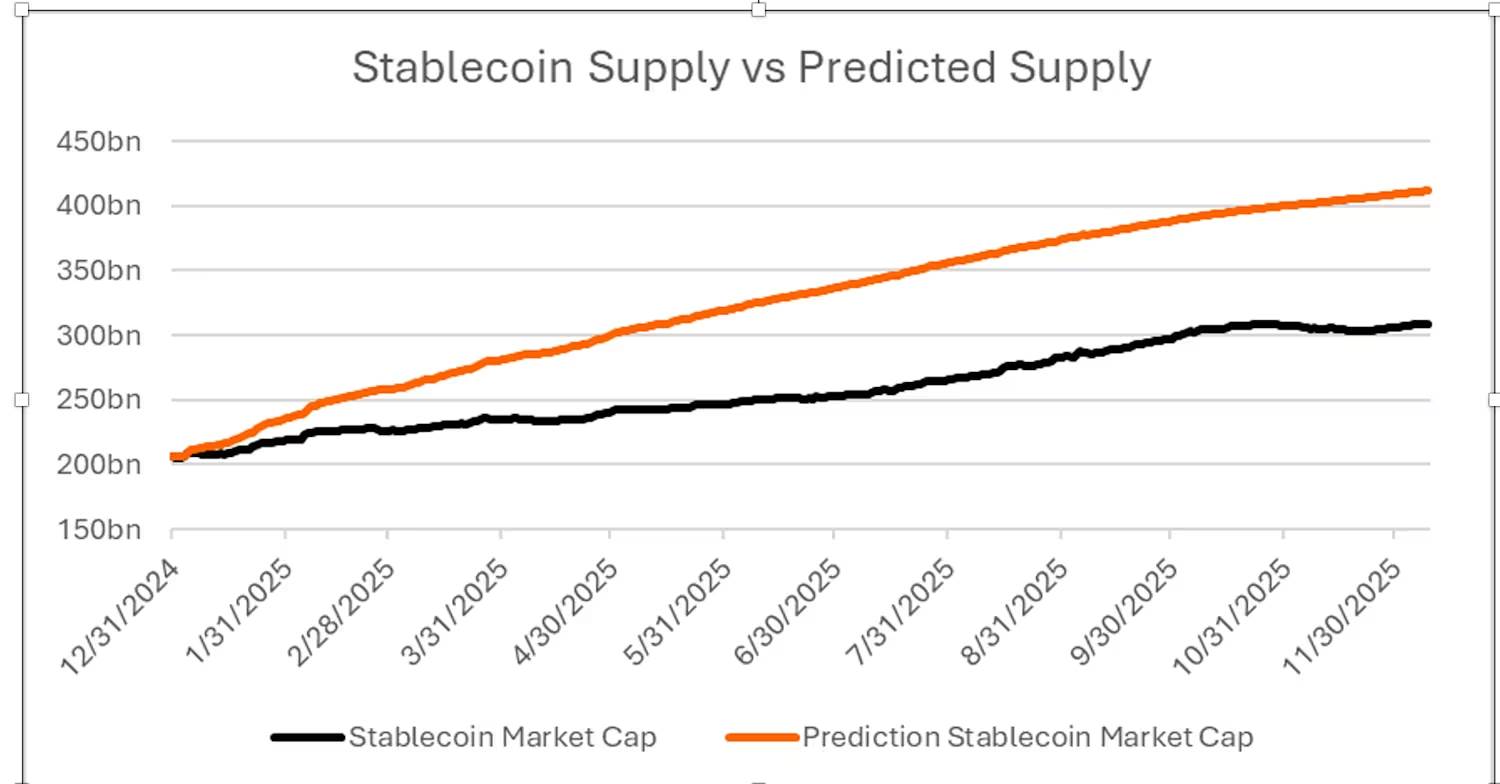
❌ By 2025, the total supply of stablecoins is expected to double, reaching over $400 billion.
Results: The growth of stablecoins continues to be strong. So far, the value of these currencies has increased by 50% since the beginning of the year, reaching nearly $310 billion. However, this still falls short of the 100% growth rate predicted at the beginning of the year. With the passage of the GENIUS Act and the establishment of relevant regulations, the regulatory framework for stablecoins is becoming clearer. Therefore, it is expected that the growth of stablecoins will continue to be robust.
——Thad Pinakiewicz
❌ Tether’s dominant position in the stablecoin market is expected to decline by 50% by 2025, due to competition from income-based stablecoins such as BUIDL from Blackrock, USDe from Ethena, and USDC tokens offered by Coinbase/Circle.
At the beginning of the year, this scenario seemed possible due to the explosive growth of USDe and other income-based stablecoins. However, during the second half of the year, the market experienced a downturn, along with a general decrease in the total supply of stablecoins. As a result, Tether continued to maintain its position as the leading stablecoin issuer in the crypto market. As of this writing, Tether accounted for nearly 70% of the market supply. Tether has already prepared to launch a new stablecoin called USAT, in accordance with the GENIUS Act, to complement its flagship token USDT. However, it appears that Tether hasn’t adjusted its collateral assets to meet the requirements of the proposed U.S. laws. Circle’s USDC remains Tether’s main competitor, with its market share increasing from 24% to 28% of the total supply throughout the year.
– Thad Pinakiewicz