Exchange Ranking
 Top Exchanges
 24h Volume Ranking
 Popularity Ranking
 Exchange BTC Balance
 Proof of Reserves
 Decentralized Exchanges
 Funding Rate
 Funding Heatmap
 Liquidation Data
 Max Pain
 Long/Short Ratio
 Whale L/S Ratio
 Binance/Okex/Huobi L/S
 Bitfinex Margin L/S
 ETF Tracker
 Solana ETF
 XRP ETF
 Hong Kong ETF
 Bitcoin Treasuries
 Crypto Reversal
 Ethereum Reserves
 HyperLiquid Wallet Analysis
 Hyperliquid Whale Watch
 Large Transactions
 On-chain Movement
 Bitcoin ROI
 Stablecoin Market Cap
 Options Analysis
 News
 Articles
 Economic Calendar
 Features
 Wallet
 Contract Calculator


 Security
 Collections
 Watchlist
 Following
 ETH
The Ethereum ecosystem is undergoing a crucial upgrade in the first half of 2026—Glamsterdam. The development team is working hard to address two major challenges: the tendency towards network centralization and state explosion. Although the technical details are still being discussed, this upgrade is seen as a significant milestone for the network’s scalability and sustainability in the future. With the continued growth of DeFi, NFTs, and Layer2 applications, this transformation could have a profound impact on Ethereum’s long-term competitiveness and ecosystem dynamics.
Glamsterdam marks another major protocol change for Ethereum in 2026.
Following the Fusaka upgrade in December 2025, Glamsterdam represents the next step in Ethereum’s long-term protocol roadmap. The name combines “Amsterdam,” which refers to changes at the execution layer, with “Gloas,” a term related to consensus-layer development. Together, these elements represent a coordinated upgrade rather than mere fixes to individual issues.
The core design of Glamsterdam aims to address long-standing concerns regarding Maximum Extractable Value (MEV). MEV arises when block producers or developers re-order or filter transactions in order to extract additional value, often at the expense of user benefits. While MEV has become a significant feature of the Ethereum economy, it also raises questions about fairness, transparency, and centralization.

It is expected that one of the key proposals at Glamsterdam will be the separation of proposers and builders, known as ePBS. This mechanism involves separating the roles of proposers and builders from the core protocol, thereby reducing reliance on off-chain intermediaries and limiting the ability of a small group of participants to dominate block construction. Although this requires significant engineering effort, the goal is simple: to reduce backroom dealing and achieve more predictable results.
Another potential feature is the Block Access List (BAL), which allows blocks to specify in advance which parts of the Ethereum state they intend to affect. This could make transaction execution more efficient, reduce the hardware requirements for validators, and improve the predictability of gas costs for developers when building decentralized applications.
Glamsterdam is also built upon the principles of Fusaka, which increased the capacity of blobs to support rollups and reduced node operating costs. While Fusaka focused on expansion, Glamsterdam focuses more on efficiency, validator dynamics, and clearer incentives at the protocol level.
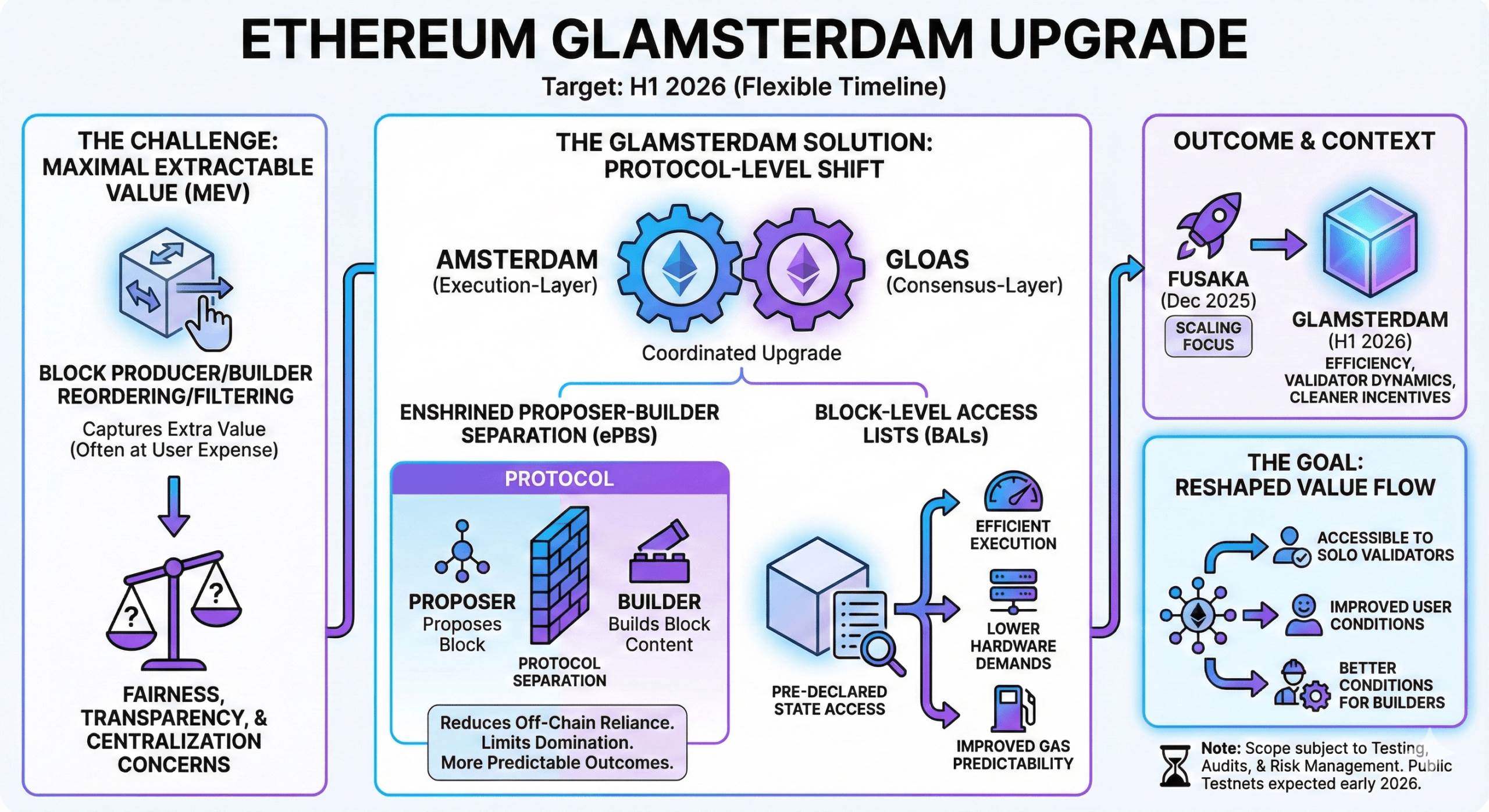
However, the timeline remains flexible. Developers are still discussing which Ethereum improvements will ultimately be included in the proposal. Testing, auditing, and risk management will likely shape the final scope of the project. It is rumored that the public test network will be launched in early 2026, with the mainnet launching once all components are ready.
If implemented as planned, Glamsterdam could significantly change the way value is transferred across the Ethereum network. It would make the Ethereum network more open to individual validators, while also improving conditions for users and developers. Like other upgrades to Ethereum, this upgrade has a clear direction—although the exact timing remains uncertain yet to be determined.
Frequently Asked Questions
● What is Glamsterdam?
Glamsterdam is the next major network upgrade under the Ethereum roadmap, involving changes to both the execution layer and the consensus layer.
● When will Glamsterdam upgrade take place?
Developers aim to carry out the upgrade in the first half of 2026, though the exact date is still subject to change.
● Why is Glamsterdam important for users?
This upgrade aims to reduce manipulation related to MEV and improve network efficiency.
● What comes after Glamsterdam?
Developers have discussed potential follow-up upgrades in late 2026, depending on progress and testing results.