Exchange Ranking
 Top Exchanges
 24h Volume Ranking
 Popularity Ranking
 Exchange BTC Balance
 Proof of Reserves
 Decentralized Exchanges
 Funding Rate
 Funding Heatmap
 Liquidation Data
 Max Pain
 Long/Short Ratio
 Whale L/S Ratio
 Binance/Okex/Huobi L/S
 Bitfinex Margin L/S
 ETF Tracker
 Solana ETF
 XRP ETF
 Hong Kong ETF
 Bitcoin Treasuries
 Crypto Reversal
 Ethereum Reserves
 HyperLiquid Wallet Analysis
 Hyperliquid Whale Watch
 Large Transactions
 On-chain Movement
 Bitcoin ROI
 Stablecoin Market Cap
 Options Analysis
 News
 Articles
 Economic Calendar
 Features
 Wallet
 Contract Calculator


 Security
 Collections
 Watchlist
 Following
在稳定币赛道里,USDe的出现引发了不少讨论。有人认为它像是在尝试破解稳定币长期存在的“三难困境”,也就是如何在稳定性、去中心化和资本效率之间找到平衡;也有人则觉得它更像是一种“对冲基金式”的运作模式,利用套利和收益机制来吸引资金。那么,USDe究竟是技术创新下的新答案,还是另一种金融玩法?这正是我们要深入探讨的话题。

1、USDe 试图解决的问题是什么?
在大部分加密货币都难以证明其实用性的世界中,稳定币是一种已经找到产品市场适应度的资产类别:
(i) 它们作为加密货币和传统金融(TradFi)之间的桥梁。
(ii) 在中心化交易平台(CEXes)和去中心化交易平台(DEXes)中,最流动的交易对是以稳定币计价的。
(iii) 它们促进即时的点对点支付,尤其是跨境支付。
(iv) 对于被迫持有弱势货币的人来说,它们可以作为价值储存工具。
然而,当前稳定币的设计存在一些挑战:
以法币支持的稳定币不是去中心化的。
目前最广泛使用的稳定币是以法币支持的,由中心化机构控制。而且还有以下缺点:
(i) 它们由易受审查的中心化实体发行。
(ii) The fiat currencies that support these stablecoins are stored in banks that may go bankrupt. Deposit accounts are opaque and can be frozen.
(iii) The securities that support these stablecoins are managed by government-regulated entities, and the underlying processes are opaque.
(iv) The value of these stablecoins is limited by rules and laws that may change depending on political circumstances.
Ironically, as one of the most widely used token categories for transactions aimed at promoting decentralization, transparency, and resistance to censorship, these stablecoins are issued by centralized institutions. They rely on assets stored within traditional financial infrastructure, making them vulnerable to government control and withdrawal.
USDe aims to address these issues by providing a decentralized stablecoin solution, thereby achieving transparency, resistance to censorship, and independence from traditional financial systems.

2. The problems that USDe aims to solve
Stablecoins backed by cryptocurrencies lack scalability.
Before gaining support from real-world assets (RWAs), MakerDAO’s DAI was a relatively decentralized stablecoin that could be verified on the blockchain.
DAI’s collateral consists of volatile assets like ETH. To ensure a safety margin, DAI issuance requires locking up 110-200% of the collateral. This makes DAI inefficient in terms of capital utilization and has limited scalability.
1) Algorithmic stablecoins are unstable
Algorithmic stablecoins like Terra Luna's UST have advantages in terms of scalability, capital efficiency, and decentralization. However, their disastrous failure clearly shows that they are unstable, leading to a long-term downward cycle in the cryptocurrency market.
Ethena Labs' USDe attempts to address these identified challenges. I will evaluate whether it has achieved this goal below.
2) What is USDe?
USDe is a scalable synthetic dollar currency, supported by an incremental neutral investment portfolio consisting of long-term spot assets and short-term derivatives positions. It can be used in DeFi protocols without relying on traditional banking infrastructure.
How does USDe maintain its peg to the US dollar?
The assets that support USDe include:
● Long-term spot assets: Liquid equity-backed tokens such as stETH, rETH, BTC, and USDT.
● Short-term derivative positions: Utilizing the same collateral.
The mechanism works as follows:
Institutions that comply with KYC regulations in permitted jurisdictions can mint USDe when depositing LSTs, BTC, or USDT with Ethena Labs.
For example, assuming 1ETH equals $3000. Users who are on the whitelist can mint 3,000 USDe by depositing 1ETH. Ethena Labs will use the deposited ETH as collateral to open perpetual contracts or futures hedging positions on derivatives trading platforms.
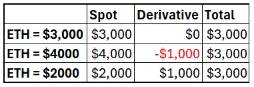
Initially, the supporting assets for 3,000 USDe are:
● 价值为 3000 美元的 1ETH
● 价值为 0 美元的 1 份 ETH 空头期货(执行价格为 3000 美元)(暂时忽略空头头寸卖方获得的资金费率或基差差额)
如果 ETH 的价格上涨了 1000 美元,3000 个 USDe 的支持资产为:
● 现价 4000 美元的 1ETH
● 现在价值为 -1000 美元的 1 份 ETH 空头期货
如果 ETH 的价格下跌了 1000 美元,3000 个 USDe 的支持资产为:
● 现价 2000 美元的 1ETH
● 现在价值为 1000 美元的 1 份 ETH 空头期货
● 支持 USDe 的投资组合的价值始终为 3000 美元。
3)USDe 如何能够提供超过 25% 的收益率?
USDe 有两个收益来源:
● 质押收益 - 作为抵押品的 LSTs 会以以下形式产生质押收益:(i)共识层通胀,(ii)执行层交易费用和(iii)MEV。现在,BTC 也可以作为合格的抵押品铸造 USDe,但必须指出 BTC 不会产生质押收益。
● 基差差额和资金费率 - 基差交易是最为人所知的套利策略之一。期货通常以溢价交易。因此,购买现货,以溢价出售期货,并以差额(即基差差额)获取利润。至于永续合约,通常当永续合约的价格高于标的资产时,持有多头仓位的交易者需要向持有空头仓位的交易者支付资金费率。
Not all USDes can generate income.
Please note that not all USDes automatically generate income. Only stUSDees can earn income. Users in eligible regions must pledge their USDees in order to receive the distributed income. This increases the yield rate, as the income is generated based on all the USDees issued, but only those who have pledged their tokens will receive the income.
Assuming only 20% of USDees are pledged.
● Total number of USDees issued: 100
● Pledge yield rate: 4%
● Funding fee rate: 3%
● Total yield rate of the protocol: 7%
● Yield rate of stUSDees: 7/20 * 100 = 35%
USDe vs. UST
The high yield rate has sparked speculation about the similarities between USDe and UST.
I hope the above explanations can clarify that this comparison is incorrect. UST is a Ponzi scheme, where new investors’ funds are used to pay off earlier investors. The income generated by USDees is real and can be understood mathematically. There are risks involved, and we will discuss these risks later. But for those who can manage these risks, the returns are tangible.
3. Has USDe solved the three challenges faced by stablecoins, namely scale, decentralization, and stability?
1) Scale
Since USDe supports both spot and derivatives, we need to consider the scalability of both.
Spot transactions: Compared to DAI, USDe has an advantage in terms of scalability, as it does not require excess collateral. However, USDe only accepts ETH, BTC, and USDT as collateral, while DAI can accept several other crypto tokens, as well as real-world assets. Stablecoins like USDT have an advantage in terms of scalability, as their market value is much smaller compared to the trillions of dollars worth of government bonds.
Derivatives: If Ethena Labs limited itself to decentralized exchange platforms (DEXes), its scalability would be limited. Instead, it chooses to utilize centralized exchange platforms (CEXes), which offer 25 times more liquidity.
USDe also has limitations in terms of scalability, but given its current market value, there is still significant room for growth.
2) Decentralization: Unlike stablecoins like USDC and USDT, which rely on fiat-backed systems, USDe does not depend on traditional banking infrastructure to manage and support its collateral. The LSTs, USDT, or BTC that support USDe can be tracked transparently on the blockchain.
Regarding derivatives positions, using only decentralized trading platforms (DEXes) would result in higher transparency. However, as mentioned above, Ethena Labs has carefully decided to use centralized trading platforms (CEXes) to achieve scalability. By working with “over-the-counter” settlement providers, the centralization and counterparty risk associated with CEXes can be reduced. When establishing derivatives positions with centralized trading platforms, ownership of the collateral isn’t transferred to the trading platform but remains with the “over-the-counter” settlement provider. This allows for more frequent settlement of pending positions and reduces the risk of bankruptcy related to the trading platform.
Although collateral positions can be tracked transparently on the blockchain, the actual value of derivatives isn’t necessarily so transparent. Users need to rely on Ethena Labs’ disclosure processes to track hedging positions across multiple trading platforms. The value of derivatives can be highly volatile and often deviate from theoretical prices. For example, when the price of ETH halves, the price of short positions might rise, but this rise may not be enough to offset the decrease in ETH prices.
3) Stability
Cash arbitrage strategies have been used in traditional finance for a long time, involving buying spot assets and selling futures to capture price differences. The derivatives markets for top crypto assets have matured enough to support such proven strategies.
But, to what extent can stability be considered sufficient? If USDe is to be used as a “payment method,” then maintaining a 1:1 ratio with the US dollar for only 98% of the time isn’t enough. It needs to maintain its stability even in the most volatile markets.
The reason why the banking system is so trusted is that we know that one US dollar from Wells Fargo is equivalent to one US dollar from Bank of America, just like the physical US dollars in your wallet—it’s consistent.
I believe the cash arbitrage model cannot achieve such a level of stability.
To mitigate the effects of market fluctuations and negative funding rates, USDe offers two forms of protection:
Pledge income serves as the first layer of protection, providing support for the US dollar-based anchor.
If the pledge income isn’t enough to cover the negative funding rates, then the reserve fund will act as the second layer of protection, offering additional support for the US dollar-based anchor.
If higher negative funding rates persist even after the reserve fund runs out, then the anchor could break.
Historically, funding rates have been positive for most of the time. Over the past three years, the average funding rate was 6-8%, including the bear market of 2022. According to the Ethena website: “The longest period of consecutive negative funding rates was 13 days. The longest period of consecutive positive funding rates was 108 days.” However, this doesn’t guarantee that the funding rate will remain positive.
4) Ethena Labs is essentially a hedge fund.
Ethena Labs operates like a hedge fund that manages the risks associated with complex investment portfolios. While the returns are real, users must also face the risk of market fluctuations, as well as the challenge of determining whether Ethena Labs has the necessary skills to effectively manage portfolios that aim to maintain an unbiased portfolio structure. Maintaining a unbiased position in portfolios that include physical assets and short-term derivatives is a continuous process. When USDe is issued, derivative positions are opened, and these positions are continuously opened and closed to achieve desired profits or losses.
(i) Optimizing the various contract specifications and capital efficiency offered by trading platforms;
(ii) switching between contracts backed by tokens and those backed by dollars;
(iii) Derivative prices often deviate from their theoretical values. Every transaction involves transaction fees, and there may be losses due to slippage.
People need to trust Ethena Labs’ experienced team to manage the portfolios responsibly.
The real limitation to scaling up might be the lack of incentives to issue USDe.
The goal of any hedge fund is to attract assets under management (AUM). For Ethena Labs, attracting AUM means attracting more people to issue USDe.
I can understand why some people would want to “post” USDe. Even considering the risks, the potential rewards are compelling. But I don’t understand why some people would want to “issue” USDe.
In the world of traditional finance, when people need cash, they often use assets or stocks as collateral instead of selling those assets. This is because they want to retain the potential for these assets to increase in value.
Similarly, when you issue DAI, you know that you will receive back your original collateral when you repay DAI.
However, when someone issues USDe, they don’t get the right to receive their original collateral. Instead, they get collateral worth the same as the USDe they issued.
Suppose 1 ETH equals $3000. If you issue 3000 units of USDe, and you decide to redeem them after 6 months, but by then the value of ETH has risen to $6000, you will only get 0.5ETH. If the value of ETH drops to $1500, you will get 2ETH instead.
This would be equivalent to selling your ETH today. If the price of ETH rises, you can buy fewer ETH in the future. If the price of ETH falls, you will need to buy more ETH in the future.
The returns are awarded to those who can pledge USDe. The only benefit for those who issue USDe is the possibility of receiving a bonus of ENATokens.
Without clear incentives for issuing USDe, I don’t understand how they can attract a market value of over $2 billion.
It should be noted that regulatory uncertainty might be one of the reasons why they choose not to provide returns for all USDe issued. Such returns could make USDe similar to securities, leading to various problems with the U.S. Securities and Exchange Commission(SEC).
4. Conclusion
USDe is a viable attempt at solving the three major challenges associated with stablecoins. However, any temptation to use it as a stable token with risk-free returns must be resisted.
Before Bitcoin emerged, there were several attempts at digital currencies. These included eCash, DigiCash, and HashCash. Although these efforts may have failed, they made significant contributions to the field of cryptography and digital currencies. Many of their features were later incorporated into Bitcoin.
Similarly, USDe may not be perfect, but I believe its features will be integrated into a more robust synthetic dollar system in the future.