Exchange Ranking
 Top Exchanges
 24h Volume Ranking
 Popularity Ranking
 Exchange BTC Balance
 Proof of Reserves
 Decentralized Exchanges
 Funding Rate
 Funding Heatmap
 Liquidation Data
 Max Pain
 Long/Short Ratio
 Whale L/S Ratio
 Binance/Okex/Huobi L/S
 Bitfinex Margin L/S
 ETF Tracker
 Solana ETF
 XRP ETF
 Hong Kong ETF
 Bitcoin Treasuries
 Crypto Reversal
 Ethereum Reserves
 HyperLiquid Wallet Analysis
 Hyperliquid Whale Watch
 Large Transactions
 On-chain Movement
 Bitcoin ROI
 Stablecoin Market Cap
 Options Analysis
 News
 Articles
 Economic Calendar
 Features
 Wallet
 Contract Calculator


 Security
 Collections
 Watchlist
 Following
 BTC
 DOGE
 ETH
 SOL
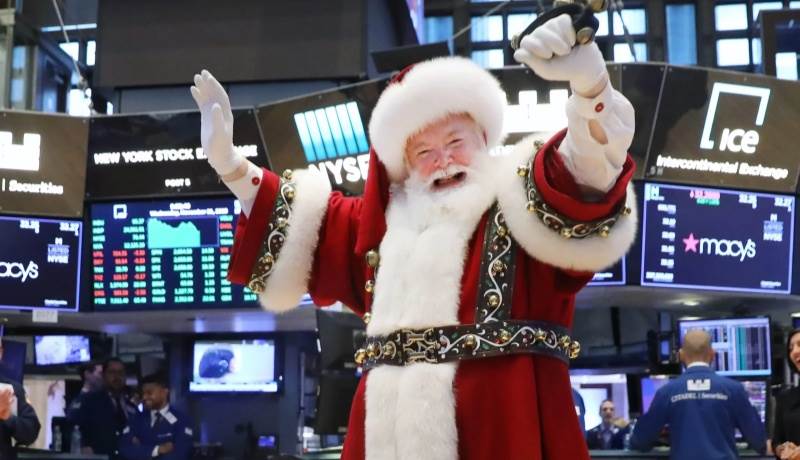
At the end of each year, the “Christmas market” becomes a hot topic in the market, and the crypto industry is no exception. As Bitcoin spot ETFs continue to attract funds, and blockchain activity shows a temporary increase around the holidays, many investors begin to expect a rally at the end of the year. Historical data shows that when trading volume is relatively low, and institutions make adjustments to their positions at the end of the year, prices are more easily manipulated by investors. But is the Christmas market a regular pattern or just a coincidence? Looking back at the trends in the crypto market at the end of each year over the past five years, we might find a more accurate answer.
Stock markets | There is a higher probability of increases during Christmas seasons.
There is no definite definition for the dates of the Christmas market. For statistical purposes, we use the last five trading days of December and the first two trading days of January as examples to see if the Christmas market has indeed existed over the past five years.
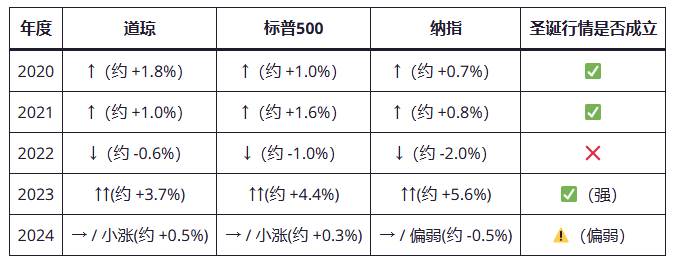
● During the five years from 2020 to 2024, three years were successful, one year failed, and one year was weak.
● The years when it failed (2022) consistently corresponded to periods of strong tightening.
Crypto markets | Only two years can be considered successful.
Since there is no market closure in the crypto industry, we used the prices from December 24th (Eastern Time close) to January 2nd of the following year as a comparison. Bitcoin, Ethereum, and SOL represent the mainstream market, while Dogecoin represents the altcoin market.
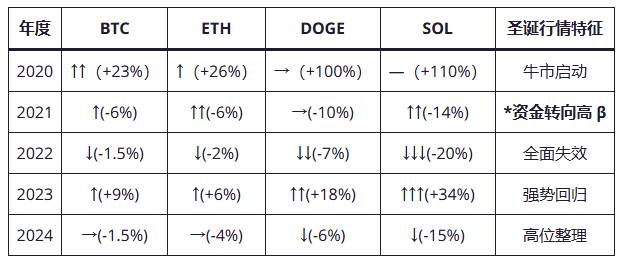
“Funds shifting to high-beta assets” refers to the phenomenon where market funds flow from relatively stable, less volatile assets towards those with greater price fluctuations and more sensitive to market conditions, in order to pursue higher potential returns.
In summary, the success rate of trading in the cryptocurrency market during Christmas season is higher than that of the US stock market.
By comparing the “Christmas season” in the crypto market from 2020 to 2024 with the three major US stock indexes, it can be seen that although both markets are influenced by financial conditions and sentiment at the end of the year, their stability and structure differ significantly. Over the past five years, except for 2022, when there was a “anti-Christmas season” due to aggressive interest rate hikes, the US stock market has maintained moderate increases in most years, showing higher consistency and predictability. In contrast, the success rate of the crypto market during Christmas season is lower, but the volatility is much greater.
Specifically, the Christmas season in the US stock market seems to be a low-volatility phenomenon, driven by statistical advantages, reflecting institutional adjustments at the end of the year, reduced selling pressure, and a slight increase in risk appetite. In contrast, the crypto market is more like an amplifier of liquidity and sentiment. When the macro environment is relaxed and risk appetite rises (such as in 2020 and 2023), crypto assets often experience much larger gains than US stocks, especially in high-beta assets like Solana and Dogecoin. However, in years when the environment is tight or systemic risks dominate (such as in 2022), the crypto market not only fails to replicate the seasonal support of the US stock market, but also tends to experience amplified declines.