Exchange Ranking
 Top Exchanges
 24h Volume Ranking
 Popularity Ranking
 Exchange BTC Balance
 Proof of Reserves
 Decentralized Exchanges
 Funding Rate
 Funding Heatmap
 Liquidation Data
 Max Pain
 Long/Short Ratio
 Whale L/S Ratio
 Binance/Okex/Huobi L/S
 Bitfinex Margin L/S
 ETF Tracker
 Solana ETF
 XRP ETF
 Hong Kong ETF
 Bitcoin Treasuries
 Crypto Reversal
 Ethereum Reserves
 HyperLiquid Wallet Analysis
 Hyperliquid Whale Watch
 Large Transactions
 On-chain Movement
 Bitcoin ROI
 Stablecoin Market Cap
 Options Analysis
 News
 Articles
 Economic Calendar
 Features
 Wallet
 Contract Calculator


 Security
 Collections
 Watchlist
 Following
 ARC
Another new development has occurred in the field of encrypted infrastructure technologies—Tempo has announced that its first L1 blockchain, designed specifically for payment scenarios, is now available for developers to experiment with on the public test network. As one of the few networks built from the ground up to handle high-frequency, small-value, and instant payments, Tempo’s initiative not only attracts attention from the developer community but also responds to the current demand in the crypto world for faster, cheaper, and more stable payment solutions. With stablecoin settlements, on-chain payments, and compliance-based clearing mechanisms becoming increasingly common, a truly dedicated L1 blockchain may be laying the foundation for the next phase of crypto payment revolution.
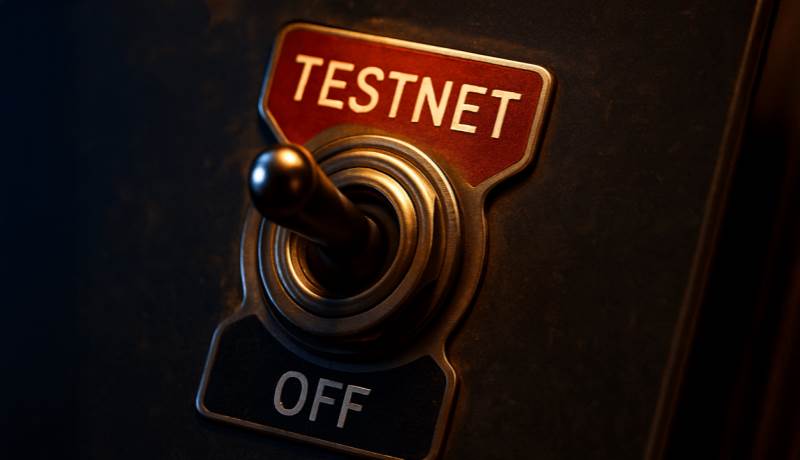
Tempo has launched a public test network.
Tempo’s development team has made its public test network available to anyone who wishes to build upon it. This marks a significant milestone since the launch of the payment-centric L1 chain earlier this year.
According to the team’s blog post, this release provides a working prototype of a blockchain designed specifically for stablecoin settlement, rather than a system intended for general financial transactions. Tempo is based on a straightforward observation: most blockchains still struggle with predictable fees, fast settlement times, and certainty that cannot be negotiated by payment processors.
This network aims to avoid traffic congestion caused by unrelated activities, such as the creation of non-fungible tokens, settlement processes, or frequent contract calls. By achieving sub-second settlement times, low fees for stablecoin transactions, and a dedicated payment channel, it hopes to achieve higher scores in all three aspects. The release on Tuesday explained that the public test network brings together several key elements of this vision: immediate settlement, a fee target of one tenth of a dollar, and support for stablecoins denominated in US dollars, without the need to use unstable gas tokens. Developers can also experiment with protocol-level custom fields, batch transfers, scheduled payments, and exchanges that automatically convert between supported stablecoins.
Tempo’s origins can be traced back to Stripe’s incubation project. After receiving a significant $500 million Series A funding round in October 2025, with a valuation of $5 billion, the blockchain project has since operated independently. Compatibility with Solidity tools was intentionally designed to simplify the entry process for developers who are already familiar with Ethereum’s infrastructure.
The company has recruited a team of experienced design partners to test real-world payment workloads, including those involving combinations of financial institutions, fintech companies, and enterprise operators. The test network also includes early versions of Tempo’s decentralized future: an open-source client that runs under the Apache license, allowing anyone to deploy contracts or run nodes in an unlicensed environment.
“Since the announcement, we have expanded the Tempo ecosystem. We’ve collaborated with 40 additional infrastructure partners, who provide various services such as development tools, integration with the chain, and DeFi applications. Each partner can offer crucial services to help businesses and users interact with Tempo.” The team explained this in detail on Tuesday.
Despite its ambitious goals, the project is still in its initial stage. The current test network relies on a group of four rotatable validators, although Tempo plans to expand this group when moving to the mainnet. Its roadmap focuses on improving reliability, increasing throughput, introducing new development tools, and conducting stress tests on actual transaction volumes.
Tempo’s broader vision is simple: to see if it can make blockchain-based payments work like existing payment channels on the internet, while ensuring modernized settlement processes. Once the testnet is launched, developers will be able to assess whether the network’s theories can withstand real-world testing.
The project doesn’t stand alone in this field—it faces competition from several competitors that share similar goals of creating stablecoins, including Coinbase’s Base, Circle’s Arc, Tether’s Stable L1, and others that also want to compete for this same opportunity.
Frequently Asked Questions
● What is Tempo?
Tempo is a first-layer blockchain built for large-scale stablecoin payments, characterized by low costs and fast settlement processes.
● Why is the launch of the testnet significant?
It provides developers with a public environment to test Tempo’s payment-related features.
● Does Tempo use local gas tokens?
No—fees are paid in supported USD-backed stablecoins, avoiding reliance on unstable assets.
● When will Tempo be launched on the main network?
No timeline has been announced yet. The project plans to expand the number of validators and optimize performance before launch.