Exchange Ranking
 Top Exchanges
 24h Volume Ranking
 Popularity Ranking
 Exchange BTC Balance
 Proof of Reserves
 Decentralized Exchanges
 Funding Rate
 Funding Heatmap
 Liquidation Data
 Max Pain
 Long/Short Ratio
 Whale L/S Ratio
 Binance/Okex/Huobi L/S
 Bitfinex Margin L/S
 ETF Tracker
 Solana ETF
 XRP ETF
 Hong Kong ETF
 Bitcoin Treasuries
 Crypto Reversal
 Ethereum Reserves
 HyperLiquid Wallet Analysis
 Hyperliquid Whale Watch
 Large Transactions
 On-chain Movement
 Bitcoin ROI
 Stablecoin Market Cap
 Options Analysis
 News
 Articles
 Economic Calendar
 Features
 Wallet
 Contract Calculator


 Security
 Collections
 Watchlist
 Following
 AAVE
AAVE has once again become a focus of market attention recently. Many large investors are quietly making investments in AAVE. Those who were liquidated due to the “Black Swan” incident have not withdrawn their funds at all; instead, they continued to increase their holdings starting in November, with their total holdings now exceeding 330,000 units. At the same time, renowned institution Multicoin Capital has also been buying into AAVE during this period, indicating a clear sign of institutional support for AAVE. These actions make many people wonder: Is there some smart capital working to establish a new bottom for AAVE? If you are looking for potential investment opportunities, the trend of AAVE might be worth further consideration.
The Aave protocol represents a “quasi-infrastructure” for on-chain lending.
If we consider on-chain lending as the most closely related area to “native finance,” then Aave has almost become the standard in this field. Whether it’s TVL, revenue, market share, or lending activities, every metric shows Aave’s success.
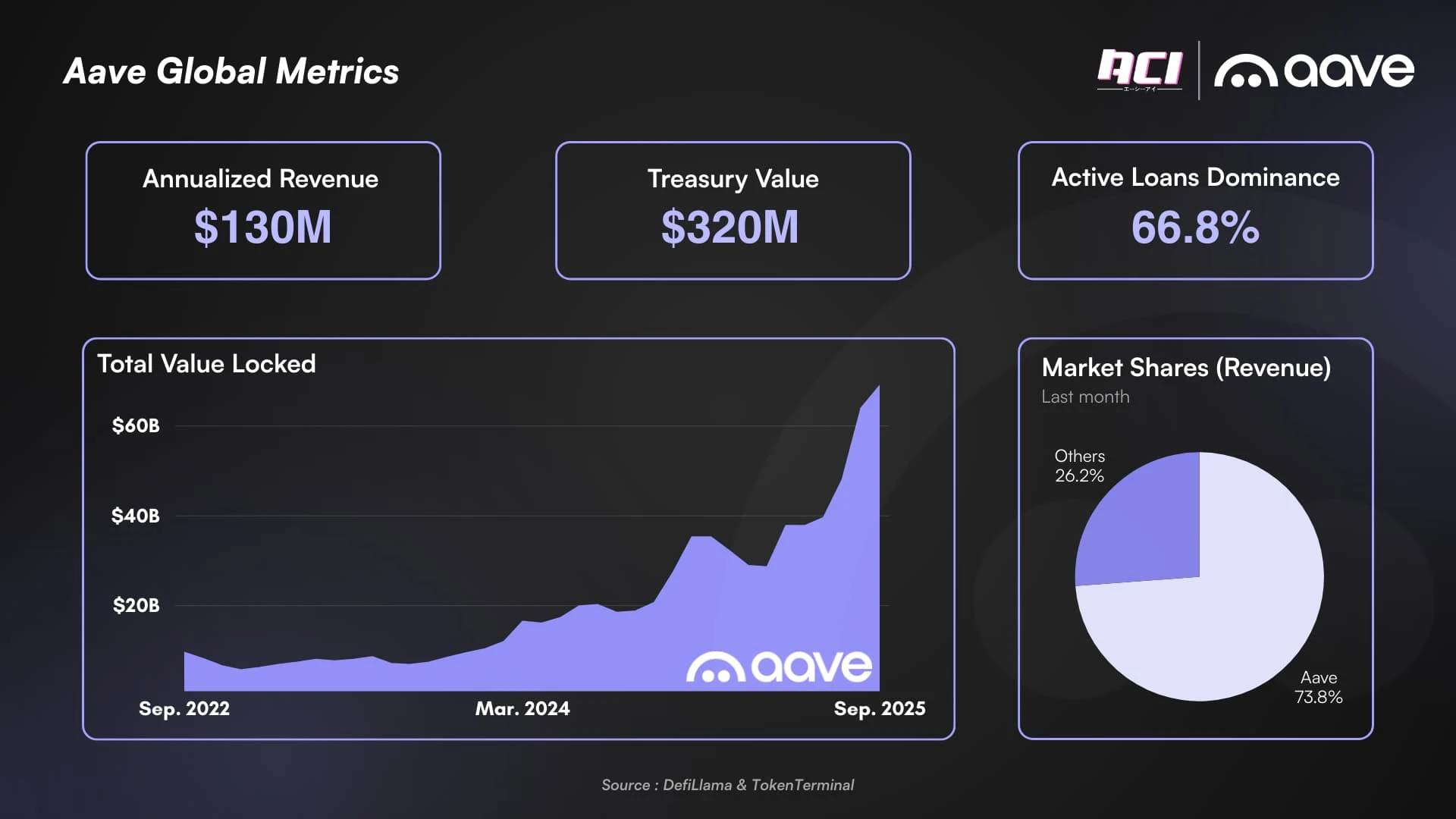
This is especially true when it comes to revenue. As one of the most crucial indicators of the value of DeFi protocols, Aave holds a dominant position in the lending market. Approximately 79% of Aave’s revenue comes from the Ethereum mainnet, and 87% of that revenue goes to Aave itself.
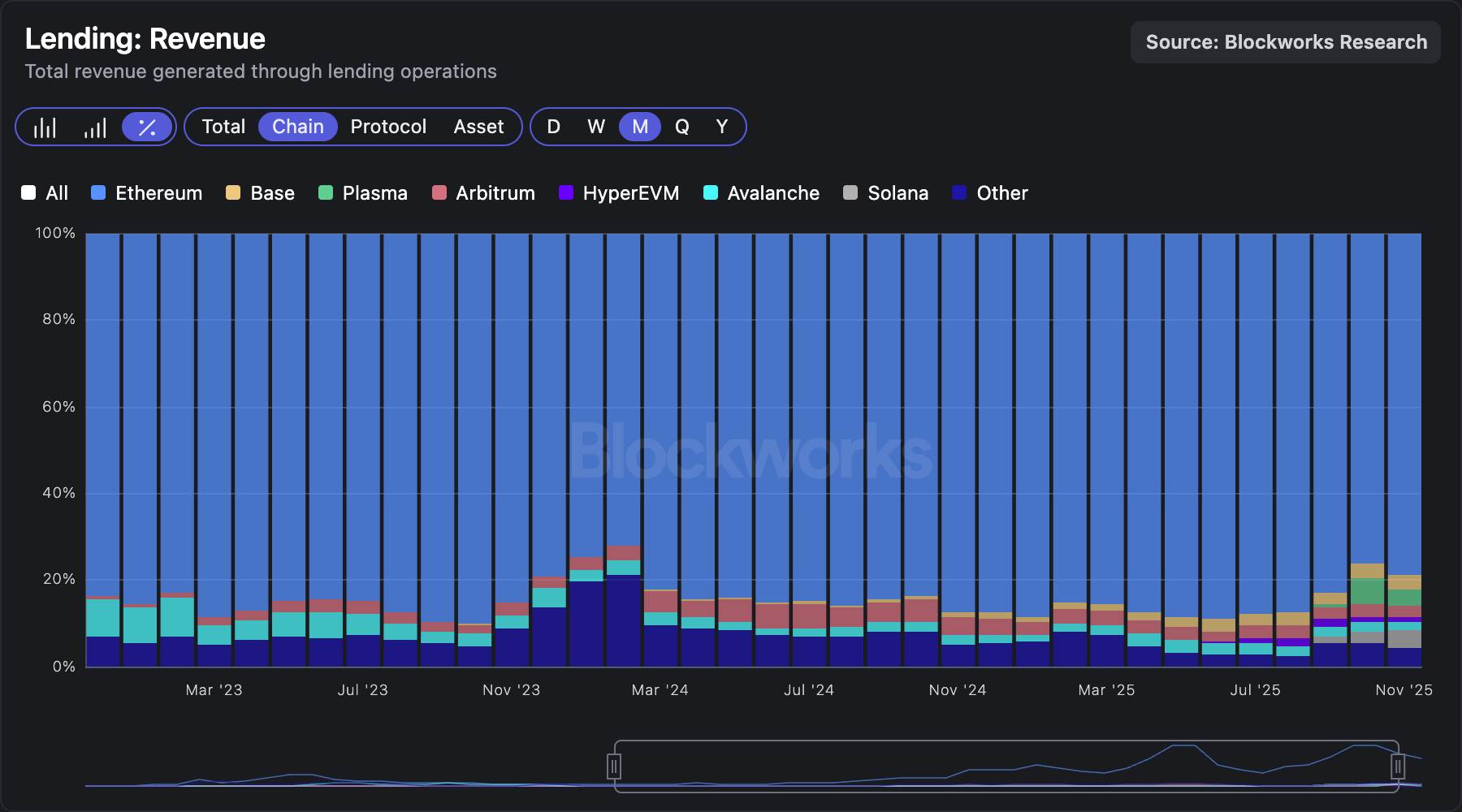
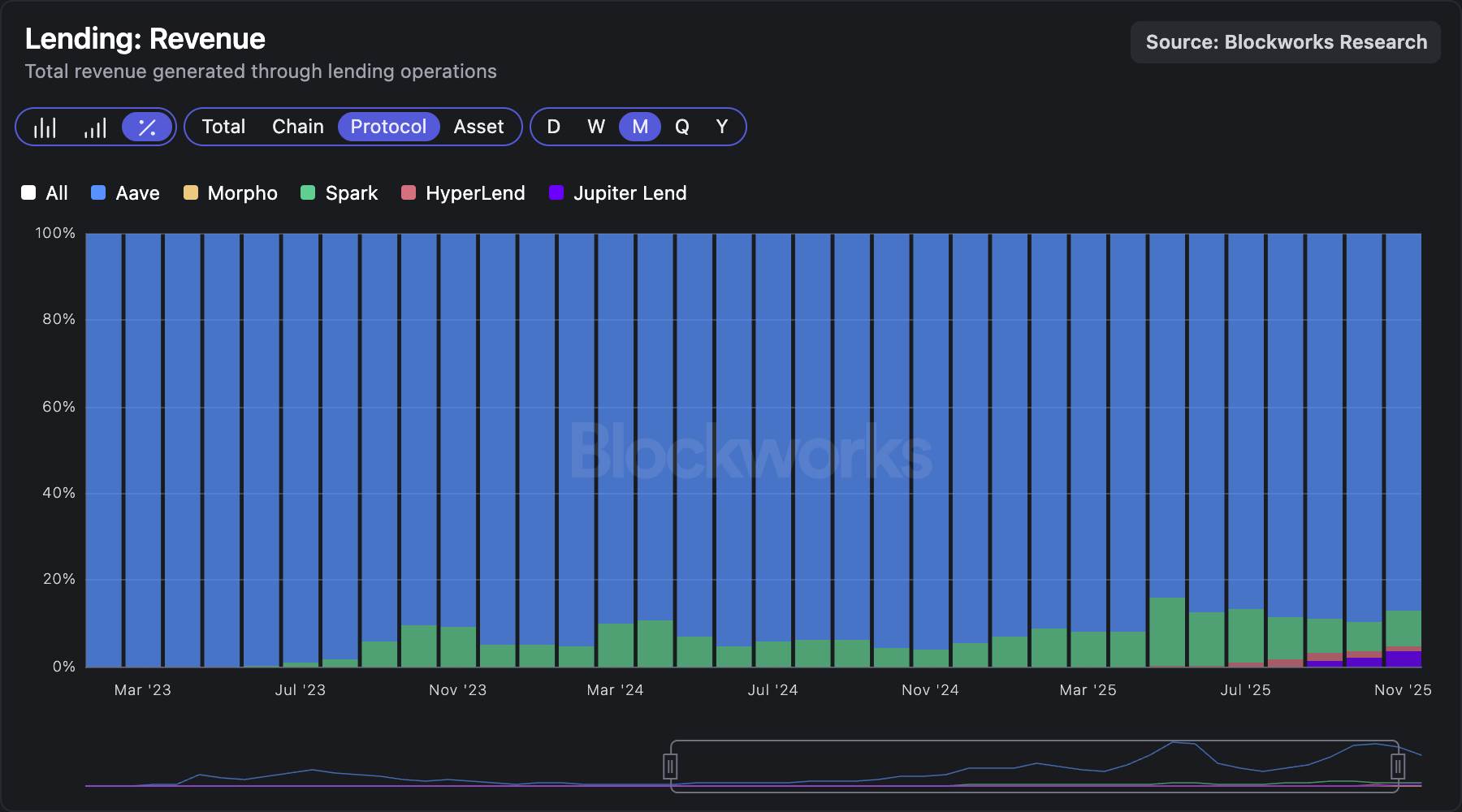
The data comes from Blockworks. This means that Aave isn’t just a “leading project”; it’s more like a foundational protocol that’s considered the default liquidity layer by the market. But the question is: Can this advantage be transformed into a more predictable cash flow pattern, thereby supporting the investment value of AAVE?
To avoid being misled by market noise, the cryptocurrency user @intern_cc has conducted a systematic analysis of Aave’s long-term financial structure. Starting from the “profitability of the protocol itself,” they evaluated whether Aave’s current growth is due to structural changes or merely cyclical fluctuations. The core analysis framework includes: 1) Revenue prediction models, built based on historical ratios, with adjustments made for diminishing marginal benefits in mature markets; 2) Product integration capabilities, assessing the stability of GHO and its role in integrating protocol revenue; 3) Capital efficiency indicators, analyzing the effectiveness of token repurchase programs and comparing them with annual targets.
Odaily Planet Daily has compiled the key data as follows:
Revenue structure: Cyclical patterns remain strong, but the “bottom” is beginning to rise.
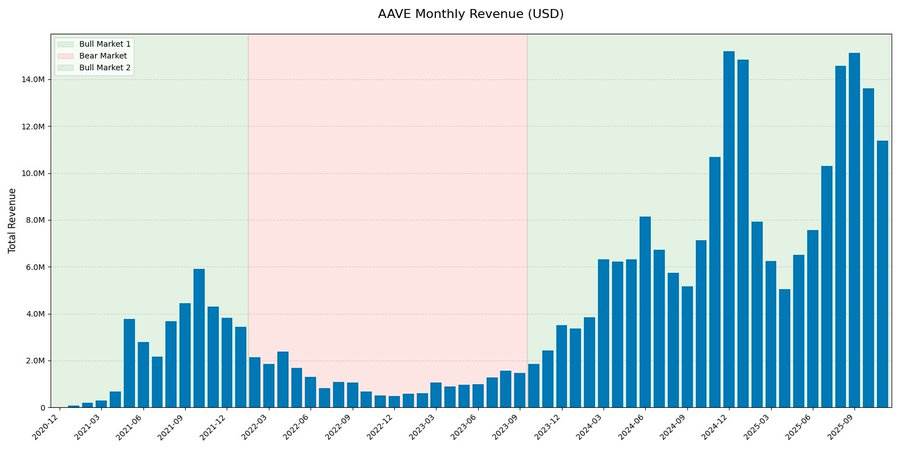
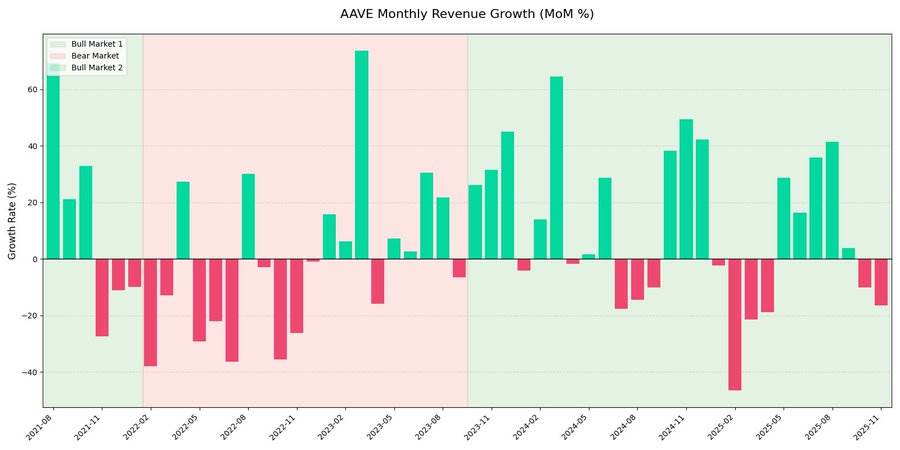
Looking back at Aave’s monthly revenue data, it shows that Aave’s revenue exhibits strong cyclical patterns. However, what is more noteworthy is the obvious structural shift that has occurred.
During the current cycle (the “second bull market”), Aave’s monthly revenue experienced explosive growth, reaching nearly $15 million, which is more than twice the level of 2021. Although the growth rate is significant, the chart clearly shows that revenue remains highly volatile, primarily driven by market activity rather than linear, steady expansion.
This data also indicates that protocol revenue exhibits clear counter-cyclical characteristics across different market cycles.
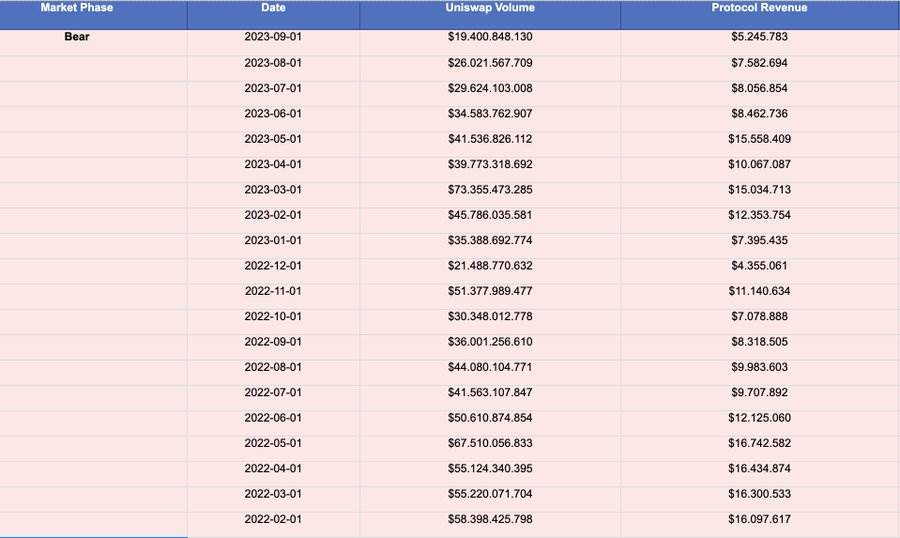
The author also pointed out that even well-established DeFi protocols like Aave will find it difficult to completely eliminate cyclical fluctuations during bear markets. newer protocols such as Ethena and Pendle may face greater challenges during bear markets, but they can experience significant prosperity during bull markets. The only well-established DeFi protocol whose trading volume and revenue decline relatively gently during bear markets is Uniswap.
GHO: The key variable that determines whether Aave moves from “horizontal expansion” to “vertical integration”
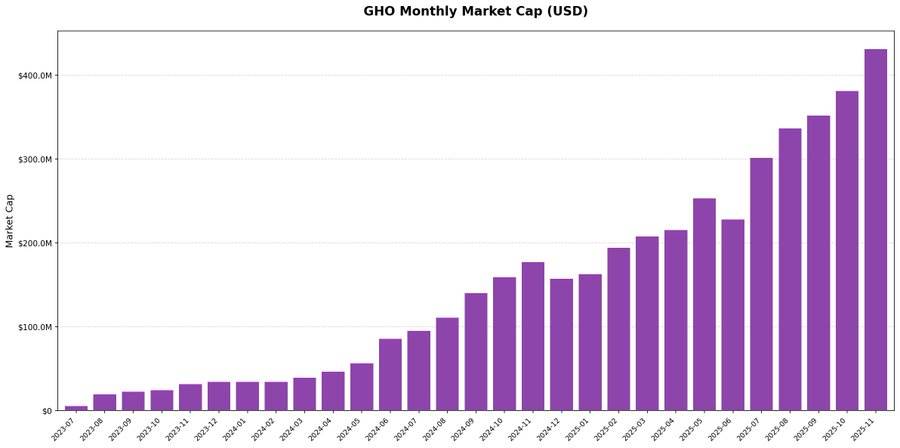
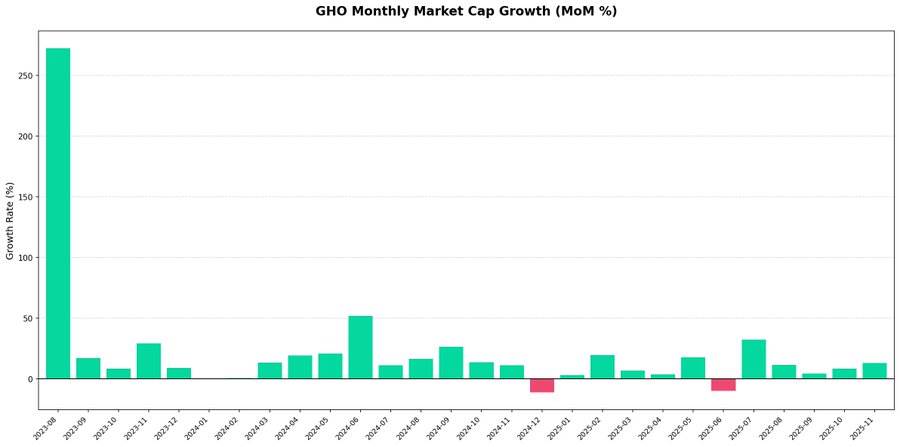
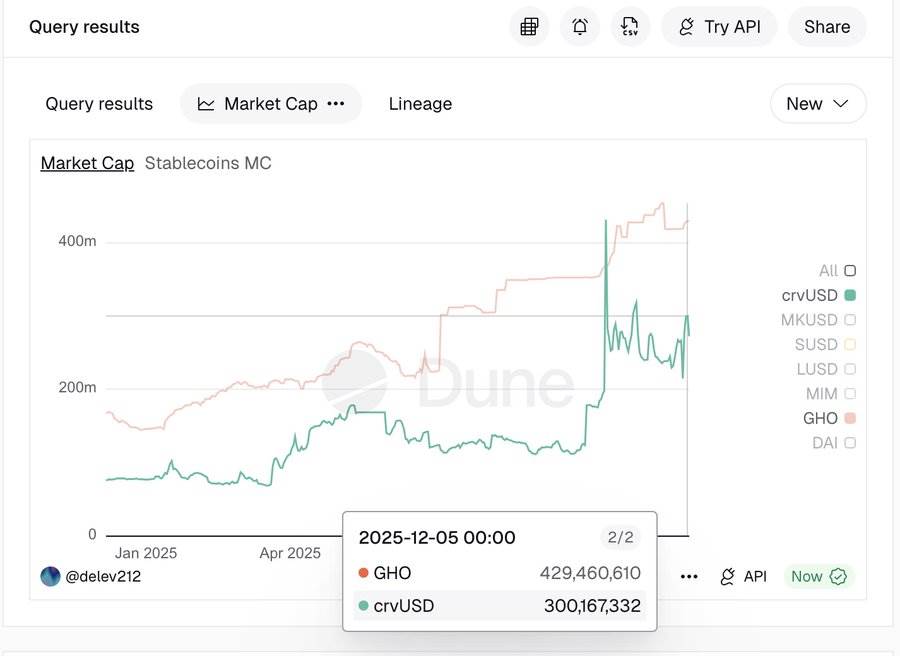
Since its launch in the third quarter of 2023, GHO has maintained a steady upward trend. By the end of 2025, its market value had exceeded $400 million.
Month-over-month data shows extremely low volatility, with almost no signs of significant capital outflows. This indicates that demand is sustainable, rather than driven by short-term speculative activities.
This trend confirms that Aave’s strategy of pursuing vertical integration is effective. GHO’s growth is natural, and there is no sudden surge in TVL.
Comparing GHO with crvUSD, it becomes clear that CDP-based stablecoins from established DeFi protocols have a strong structural basis for demand.
Revenue forecast model: Aave is moving towards the “mature protocol stage”
The author adopted a rolling window approach to modeling these cyclical patterns. Instead of relying on subjective assumptions about future growth rates, the author focused on accurately measuring the actual revenue performance of the protocol over each 12-month cycle within these market cycles. This was done by dividing the cycle into two phases: a bear market contraction phase and a bull market expansion phase.
In terms of scenario setting, three scenarios were chosen based on historical data distribution:
The conservative scenario (25th percentile)
The baseline scenario (median)
The optimistic scenario
It’s worth noting that the optimistic scenario did not use the usual upper quartile (75th percentile), but instead limited itself to the 60th percentile range, in order to eliminate extreme outliers. The main purpose of this design is to reflect the principle of diminishing marginal returns, ensuring that the model accurately reflects the growth trajectory of the protocol after it enters a mature stage, rather than relying on early-stage explosive returns.
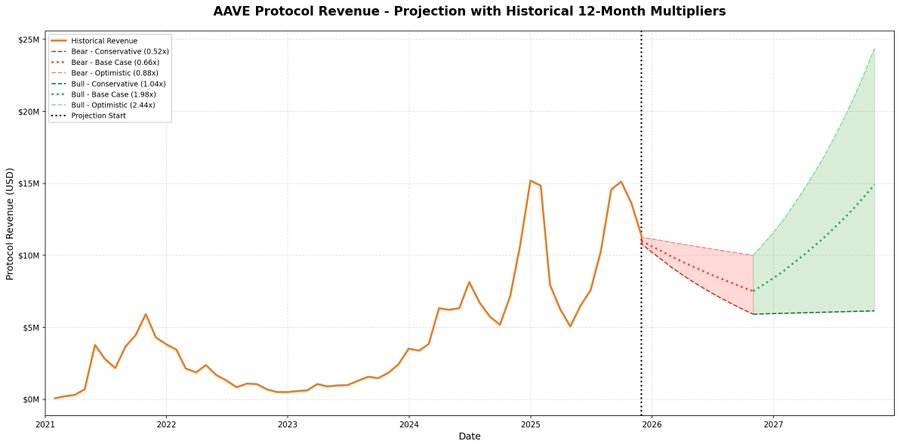
The model results show that Aave has become significantly more mature compared to the first bear market cycle. Future revenues may still decline, but the rate of decline will be much milder.
It’s particularly important to note that even under the bear market scenario (within a range of 0.52x–0.88x), the predicted minimum monthly revenue is around $6 million per month, which is still higher than the historical peak during the bull market in 2021.
AAVE repurchase: The true effectiveness of the deflation mechanism
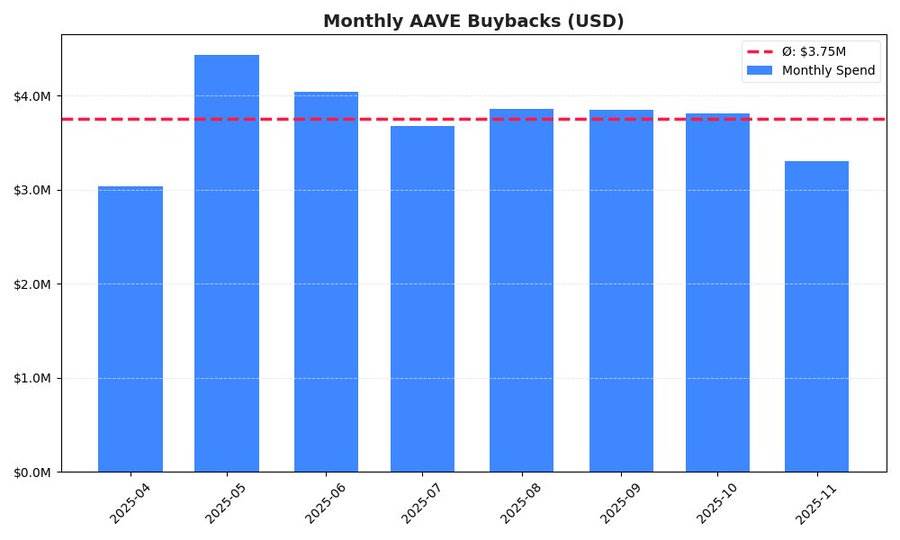
The monthly repurchase fluctuations indicate that the protocol adopts a relatively disciplined and non-speculative execution strategy. Although there are slight fluctuations (such as peaks in May), the overall rhythm remains relatively stable.
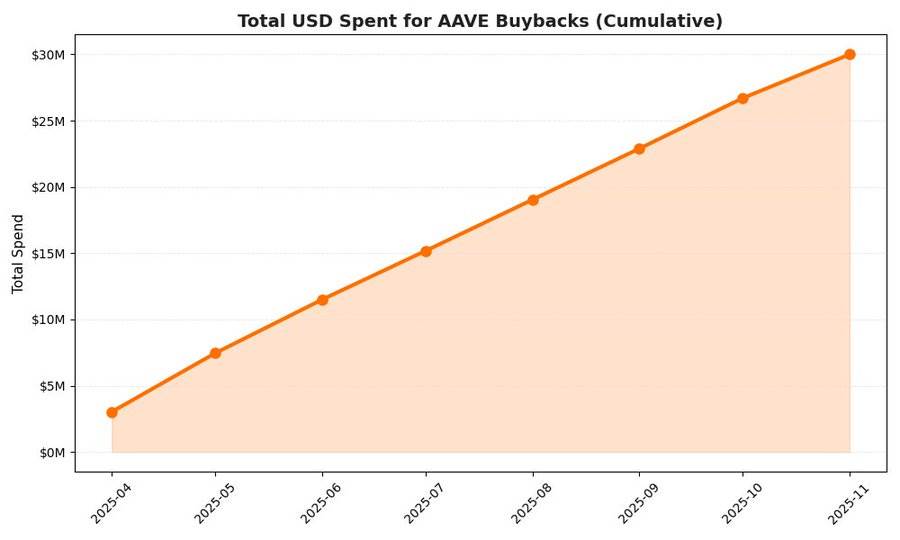
累计数据表明,在回购计划启动后的前 8 个月内,Aave 已累计投入约 3000 万美元。若要实现 年度 5000 万美元的官方目标,对应的月均节奏应达到约 417 万美元。而目前实际执行的月均节奏约为 375 万美元。按照当前速度测算,年化回购规模约为 4500 万美元,对应与目标存在约 10% 的偏差。
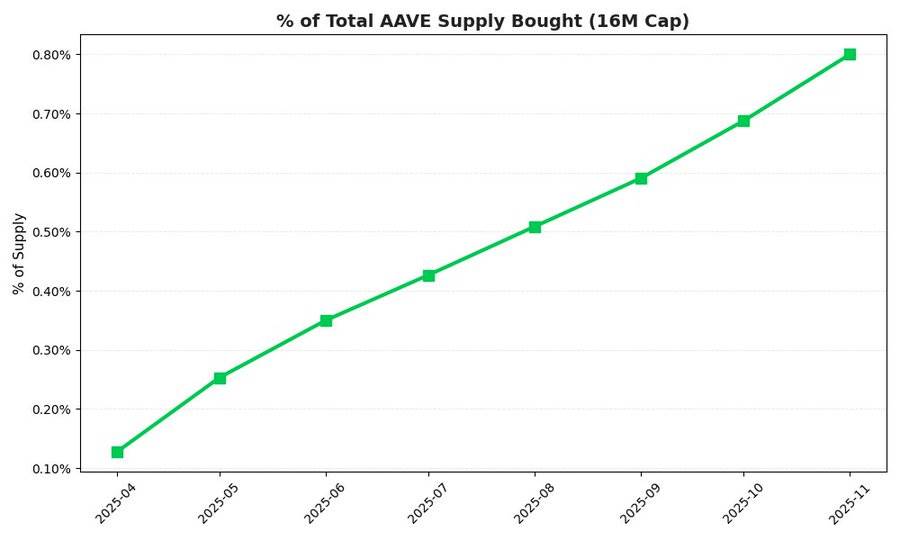
回购机制已经对代币供给产生了可量化的通缩压力:仅用 8 个月时间,协议已回购了约 0.80% 的总供应量(1600 万枚 AAVE)。