Exchange Ranking
 Top Exchanges
 24h Volume Ranking
 Popularity Ranking
 Exchange BTC Balance
 Proof of Reserves
 Decentralized Exchanges
 Funding Rate
 Funding Heatmap
 Liquidation Data
 Max Pain
 Long/Short Ratio
 Whale L/S Ratio
 Binance/Okex/Huobi L/S
 Bitfinex Margin L/S
 ETF Tracker
 Solana ETF
 XRP ETF
 Hong Kong ETF
 Bitcoin Treasuries
 Crypto Reversal
 Ethereum Reserves
 HyperLiquid Wallet Analysis
 Hyperliquid Whale Watch
 Large Transactions
 On-chain Movement
 Bitcoin ROI
 Stablecoin Market Cap
 Options Analysis
 News
 Articles
 Economic Calendar
 Features
 Wallet
 Contract Calculator


 Security
 Collections
 Watchlist
 Following
It’s once again the annual “Institutions' Predictions Season”. At the end of each year, the world’s top investment banks release their annual forecasts, outlining the macroeconomic trends for the coming year. Recently, a netizen from abroad compiled reports from eight major investment banks including Goldman Sachs, BlackRock, Barclays, and HSBC, and then provided a systematic analysis and interpretation of these reports using Gemini Pro3. The results were quite surprising—from interest rate trends and inflation rates to potential market conditions in stocks and cryptocurrency assets, these institutions’ predictions for 2025 show both differences of opinion and striking commonalities. For investors, such forecasts serve not only as “wind vectors,” but also as an excellent opportunity to re-evaluate their own asset allocations.

Global Investment Outlook for 2026: A Time of Great Divergence and Interpretation
Executive Summary: Navigating the “K-type” New World Order
2026 is destined to be a period of profound structural transformation. This transformation isn’t characterized by a single global synchronized cycle, but rather by a complex interplay of economic realities, policy inconsistencies, and thematic shocks. This comprehensive research report gathers forward-looking strategies and economic forecasts from leading global financial institutions, including JPMorgan Asset Management, BlackRock, HSBC Global Private Banking, Barclays Private Banking, BNP Paribas Asset Management, Egon Shurff, Paxful Group, and Allianz Group.
These institutions collectively depict a scenario in which the global economy is undergoing adjustments, but has not yet collapsed. The “loose monetary policy” era of the past decade has given way to a new landscape characterized by high interest rates for an extended period, as well as government-led policies and technological disruptions. Barclays Private Bank has labeled 2026 as a year of “interpretation of signals.” In this environment, economic data is contradictory, public opinion changes rapidly, and market participants must actively interpret these conflicting signals, rather than relying on passive beta strategies. The core theme of predictions for 2026 revolves around the differences between the United States and other regions. JPMorgan and T.Rowe Price believe that the driving force behind the U.S. economy lies in the unique combination of artificial intelligence capital expenditures and massive fiscal injections, known as the “OBBBA.” It is expected that these stimulus measures will lead to a “sugar spike” in early 2026, driving economic growth by more than 3%, before gradually subsiding. This dynamic stands in stark contrast to the “calm is good” recovery predicted by Allianz and BNP Paribas in the eurozone. However, behind these impressive growth figures lies a more turbulent reality. Allianz warns that the number of corporate bankruptcies worldwide will reach “all-time highs,” with an expected increase of 5% by 2026, as the delayed effects of high interest rates will eventually destroy those “zombie companies.” This indicates a “K-type” expansion pattern: large technology companies and infrastructure firms will benefit from “artificial intelligence giants” (a concept proposed by BlackRock), while smaller companies that rely on leverage will face a test of survival or extinction.资产配置共识已发生巨大转变。传统的60/40投资组合正在被重新定义。贝莱德提出了“新连续体”的概念,认为公共市场和私人市场之间的二元界限正在消融,因此有必要永久性地配置私人信贷和基础设施。景顺和汇丰银行倡导回归固定收益领域的“质量”,摒弃高收益债券,转而投资级债券和新兴市场债券。
本报告对2026年的投资格局进行了详尽的机构和主题分析。报告探讨了“实体人工智能”贸易、“电子科技经济”的细微差别、日益高涨的保护主义和关税阴影,以及投资者在这个支离破碎的世界中必须采取的战略要务。
第一部分:宏观经济格局——多速增长的世界
许多人曾期盼疫情后全球经济同步复苏,但这一愿景并未实现。相反,2026年将呈现出增长动力各异、政策分化的特点。主要经济体正以不同的速度发展,受到各自独特的财政、政治和结构性因素的影响。
1.1 美国:“北极星”与OBBBA刺激计划
美国仍然是全球经济无可争议的引擎,但其动力来源正在发生变化。它不再仅仅依靠自然消费需求驱动,而是越来越依赖于政府财政政策和企业在人工智能领域的资本支出。
“一项大型美好法案”(OBBBA)现象
JPMorgan Asset Management and T.Rowe Price identified one key finding in their outlook report for 2026: the expected impact of the “Grand Bipartisan Act of Congress” (OBBBA). This legislative framework is expected to be the most significant fiscal event in 2026.
● Action mechanism: According to JPMorgan, the OBBBA is a comprehensive legislative measure that extends the key provisions of the Tax Cuts and Jobs Act of 2017, while also introducing new spending items. This includes approximately $170 billion allocated for border security measures (law enforcement, deportation procedures), as well as $150 billion for defense expenditures (such as the Golden穹顶导弹防御系统, shipbuilding projects). Additionally, it increases the debt ceiling by $5 trillion, indicating that fiscal easing policies will continue.
● Economic impact: T.Rowe Price believes that this bill, along with investments in artificial intelligence, will help the U.S. economy “escape” the growth crisis that began at the end of 2025. JPMorgan predicts that the OBBBA will drive real GDP growth at around 1% in the fourth quarter of 2025, and then accelerate to over 3% in the first half of 2026, as tax refunds and spending initiatives stimulate the economy. However, this is considered a temporary acceleration—a reversal of the “fiscal cliff” situation—with economic growth slowing down to a trend rate of 1-2% in the second half of the year, as stimulus measures fade away.
● Tax implications: This bill is expected to permanently extend the top individual income tax rate by 37%, and also restore the ability to deduct 100% of corporate depreciation and research and development costs. Morgan Stanley believes that this would be a significant incentive on the supply side, potentially reducing the actual corporate tax rates in some industries to 12%. This would thereby stimulate “super cycles of capital expenditure” in the manufacturing and technology sectors.
There is a paradox in the labor market: “economic drift”.
Despite government funding, the U.S. economy still faces structural challenges due to insufficient labor supply. JPMorgan Chase describes this situation as “economic drift”, noting that the sharp decline in net immigration is likely to lead to a decrease in the absolute number of working-age people.
● Impact on growth: This supply-side constraint means that it is estimated that there will be only 50,000 new jobs per month by 2026. This is not a failure on the demand side, but rather a bottleneck on the supply side.
● Unemployment rate ceiling: Therefore, the unemployment rate is expected to remain artificially low, with a peak of around 4.5%. While this “full employment” situation avoids a deep economic recession, it also sets a strict upper limit on potential GDP growth. This exacerbates the feeling of economic “stagnation”, even though economic data shows positive trends.
1.2 Eurozone: A surprise of “dullness being beautiful”
In contrast to the unstable and financially troubled United States, the Eurozone appears to be stable. All three banks, Union Bank of France and BNP Paribas, believe that Europe’s performance in 2026 may exceed expectations.
● Germany’s “fiscal reset”: BNP Paribas believes that Germany is undergoing a crucial structural transformation. Germany will abandon traditional zero-level fiscal austerity measures and is expected to significantly increase spending on infrastructure and defense. This fiscal expansion is expected to have a multiplier effect on the entire eurozone, boosting economic activity by 2026.
● Consumer support: Additionally, BNP Paribas notes that policies such as reducing VAT rates on food prices and energy subsidies could help support consumer spending and prevent a collapse in demand.
● Growth forecasts: Allianz predicts that GDP growth in the eurozone will range between 1.2% and 1.5% in 2026. While these figures may not seem significant compared to the “OBBBA surge” in the United States, they represent a steady and sustainable recovery from the stagnation experienced from 2023 to 2025. Barclays Bank also agrees with this view, stating that the eurozone could “deliver surprises”.
1.3 Asia and emerging markets: “Expansion on a larger scale” versus structural slowdown
The situation in Asia shows a clear polarization: on one side, there is China, which is becoming more mature and experiencing slower growth; on the other side, there are India and ASEAN region, which are dynamic and growing rapidly.
China: Gradual deceleration
It is widely agreed among all major institutions that China’s era of rapid growth has come to an end.
● Structural challenges: BNP Paribas predicts that by the end of 2027, China’s economic growth rate will slow down to below 4%. T.Rowe Price added that although stimulus measures will be implemented, due to deep-rooted problems in the housing market and population structure, such measures are unlikely to provide any real boost.
● Targeted stimulus measures: Authorities are expected to avoid widespread “rocket-like” stimulus measures. Instead, efforts will focus on “advanced manufacturing” and strategic sectors. This transformation aims to push the economy towards higher-value chains, but it may sacrifice short-term consumption growth. Barclays predicts that China’s consumer growth rate will be only 2.2% in 2026.
India and ASEAN: Growth Drivers
In contrast, HSBC and S&P Global see South Asia and Southeast Asia as new global growth hubs.
● The trajectory of India: HSBC predicts that India’s GDP growth rate in 2026 will be 6.3%. This makes it one of the fastest-growing major economies. However, HSBC also issued a warning: despite strong macroeconomic conditions, corporate profit growth seems weak compared to high valuations. This could pose potential risks to stock investors.
● Artificial Intelligence Supply Chain: JPMorgan Chase and HSBC both emphasized that the "artificial intelligence sector" will benefit emerging markets in Asia significantly, especially Taiwan and South Korea (in the semiconductor industry), as well as ASEAN countries (in data center assembly and component manufacturing). The "expansion" of artificial intelligence-related trade is a key driver of development in this region.
1.4 Global Trade: Tariffs
One major concern for economic prospects in 2026 is the rise of protectionism. HSBC has downgraded its forecast for global economic growth to 2.3% from 2.5%, mainly due to the "multi-purpose tariffs" imposed by the United States.
● Stagnant trade growth: HSBC predicts that global trade growth will be just 0.6% in 2026. This near-stagnant situation reflects efforts by supply chains to avoid tariff barriers by outsourcing and re-planning their routes.
● Stimulation of inflation: T.Rowe Price warned that these tariffs will effectively tax consumers, causing inflation in the United States to remain “above target levels”.

Part Two: The Mystery of Inflation and Interest Rates
The "great relaxation" that existed before the 2020s has been completely replaced by a more volatile situation. The interaction between high inflation in the United States and deflation in Europe is leading to a significant shift in central bank policies.
2.1 Inflation differentiation
● United States: Inflation and Structural Factors: T.Rowe Price and BNP Paribas believe that due to the Obama healthcare reform stimulus plan and tariffs, inflation in the United States will remain high. JPMorgan Chase offers a more detailed analysis: due to the impact of tariffs, inflation rates are expected to rise in the first half of 2026, reaching slightly below 4%. However, as the economy gradually recovers, inflation rates are expected to drop to 2% by the end of the year.
● Europe: Contractionary pressures: In contrast, BNP Paribas believes that Europe will face deflationary pressures, partly due to the influx of cheap Chinese exports into the European market. This could lead to inflation rates falling below the European Central Bank’s target, in stark contrast to the situation in the United States.
2.2 Central Bank Disengagement
This divergence in inflation dynamics has led to differences in monetary policy, creating opportunities for macro investors.
● Federal Reserve (“Slow Path”): It is expected that the Federal Reserve will be limited in its actions. JPMorgan Chase estimates that the Fed may only cut interest rates 2-3 times by 2026. T.Rowe Price is even more hawkish, warning that if the OBBA stimulus plan causes economic overheating, the Fed might not be able to reduce interest rates at all in the first half of 2026.
● European Central Bank (“Pessimistic Approach”): Faced with weak economic growth prospects and deflationary pressures, market expectations are that the ECB will cut interest rates significantly. Allianz and BNP Paribas estimate that the ECB will lower interest rates to 1.5%-2.0%, far below current market expectations.
● Implications for the foreign exchange market: 不断扩大的利率差(美国利率居高不下,欧元利率下降)表明美元兑欧元具有结构性强势,这与通常与成熟周期相关的“美元疲软”的普遍预期相悖。然而,景顺(Invesco)持相反观点,押注美元疲软将支撑新兴市场。
第三部分:专题深度探讨——“超级力量”与结构性转变
2026年的投资策略不再侧重于商业周期,而是更多地关注超越季度GDP数据的结构性“超级力量”(贝莱德推广的术语)。
3.1 人工智能:从“炒作”到“现实”
人工智能的叙事正在从软件(大型语言模型)转向硬件和基础设施(“物理人工智能”)。
● “资本支出超级周期”:摩根大通指出,数据中心投资已占美国GDP的1.2%至1.3%,并且还在持续增长。这并非昙花一现的趋势,而是实实在在的钢铁、混凝土和硅材料建设。
● “电子科技经济”:巴克莱银行提出了“电子科技经济”的概念。人工智能的电力需求永无止境。投资电网、可再生能源发电和公用事业被视为把握人工智能热潮最稳妥的方式。汇丰银行也表达了类似的观点,建议轮动投资公用事业和工业板块,这将“推动”这场变革。
Countering the prevailing optimistic consensus, HSBC expresses serious doubts about the financial viability of leading companies in the field of artificial intelligence. According to their internal analysis, companies like OpenAI may face leasing costs for computing power amounting to as much as $1.8 trillion, resulting in a significant funding gap by 2030. They believe that while artificial intelligence is indeed a reality, the profitability of those who develop these models remains questionable. This further supports their call for investing in “underground companies” such as chip manufacturers and utilities rather than model developers.
3.2 The “new continuum” in the private equity market
BlackRock’s outlook for 2026 is based on the evolution of the private equity market. They believe that the traditional binary distinction between “public” markets (with high liquidity) and “private” markets (with low liquidity) is outdated.
● Continuous development: Through “permanent structures,” European long-term investment funds (ELTIFs), and secondary markets, private equity assets are becoming more semi-liquid. This democratization allows broader investors to capture the “illiquidity premium.”
● Private equity credit 2.0: BlackRock believes that private equity credit will evolve from leveraged buyouts to “asset financing” (ABF). This means lending against physical assets such as data centers, fiber networks, and logistics hubs, rather than against corporate cash flows. They believe this will create “major” opportunities in 2026.
3.3 Population structure and labor shortages
摩根大通和贝莱德认为人口结构变化虽然缓慢,但却是一股不可阻挡的力量。
● 移民悬崖:摩根大通预测美国净移民数量将下降,这成为经济增长的关键制约因素。这意味着劳动力将持续稀缺且成本高昂,从而抑制工资上涨,并刺激对自动化和人工智能的进一步投资,以取代人力劳动。
第四部分:资产配置策略——“60/40+”比例与阿尔法收益
受访机构普遍认为,2010年代的被动“买入市场”策略在2026年将表现不佳。新的环境要求积极管理、多元化投资以及注重“质量”。
4.1 投资组合构建:“60/40+”模型
摩根大通和贝莱德都明确呼吁改革传统的60%股票/40%债券投资组合。
● “+”部分:他们提倡“60/40+”模型,即将约20%的投资组合配置于另类资产(私募股权、私募信贷、实物资产)。这种配置旨在提供不相关的收益,并在股票债券相关性较高的市场环境中降低整体投资组合的波动性。
4.2 股票:质量与轮动
● 美国股市:BlackRock and HSBC continue to maintain overweight ratings for US stocks, primarily driven by trends related to artificial intelligence and economic resilience. However, due to high valuations, HSBC has recently reduced its holdings in some US stocks. Investors are advised to sell off “giant technology stocks” and instead invest in other sectors that offer broader benefits, such as finance and industry.
● International value stocks: JPMorgan believes that value stocks in Europe and Japan are highly investment-worthy. These markets are experiencing “corporate governance reforms” (stock repurchases, increased dividends), and their stock prices are at a historical discount compared to US stocks.
● Emerging markets: Invesco believes emerging markets are promising. They expect the weakening of the dollar (contrary to predictions by other institutions) to unlock the value of assets in emerging markets.
4.3 Fixed income: Recovery in yields
Bonds are not just meant for capital appreciation (with bets on interest rate cuts); they also serve as an income source.
● Credit quality: Given AIA’s warnings about bankruptcy risks, HSBC and Invesco prefer investing in investment-grade bonds rather than high-yield bonds. The risk premium associated with high-yield bonds is considered insufficient to compensate for the upcoming default cycle.
● Duration: Invesco continues to overweight duration bonds, especially UK government bonds. It expects central banks to cut rates faster than market expectations. JPMorgan advises investors to be “flexible” in their trading strategies, avoiding large-scale one-sided bets.
● CLO: Insist Capital has explicitly incorporated AAA-rated CLOs (Collateralized Debt Obligations) into its portfolio management strategies. This is because CLOs offer higher yields and a more stable structure, making them a preferred choice over cash.
4.4 Alternative Solutions and Hedging
● Infrastructure: This represents one of the most reliable investments among “physical assets”. BlackRock describes it as a “once-in-a-lifetime opportunity”. It can serve as a hedge against inflation, while also allowing investors to benefit from the current wave of artificial intelligence-related capital expenditures.
● Gold: HSBC and Insist Capital continue to view gold as an important tool for portfolio hedging. In a world where global geopolitical tensions are rising and potential inflation risks exist, gold is seen as a necessary safeguard against “tail risks”.
Part Five: Risk Assessment – The Shadow of Bankruptcy
Although fiscal stimulus measures suggest a strong macroeconomic outlook in the United States, credit data reveal a more pessimistic situation. Aon’s report provides a balanced perspective that counters these optimistic assumptions.
5.1 The Wave of Bankruptcies
Aon predicts that the number of corporate bankruptcies worldwide will increase by 6% in 2025, and further by 5% in 2026.
● “Lagging Impacts”: This increase is due to the lingering effects of high interest rates. Companies that locked in low interest rates during 2020-2021 will face challenges in 2026, forcing them to refinance at higher costs.
● “Tech Bubble Burst” Scenario: 安联明确模拟了“人工智能泡沫”破裂的下行情景。在这种情景下,他们预测美国将新增4500家破产企业,德国将新增4000家,法国将新增1000家。
5.2 弱势群体
该报告指出了面临风险的具体行业:
● 建筑业:对利率和劳动力成本高度敏感。
● 零售/非必需消费品:受到“K型”消费趋势的挤压,低收入消费者减少了支出。
● 汽车行业:面临高昂的资本成本、供应链重组和关税战的完美风暴。
这项风险评估有力地支持了资产配置中的“质量”偏好。投资者应警惕那些仅靠廉价资金苟延残喘的“僵尸”公司。
第六部分:制度观点的比较分析
下表综合了各机构报告中对2026年GDP和通胀的具体预测,突出了预期方面的差异。
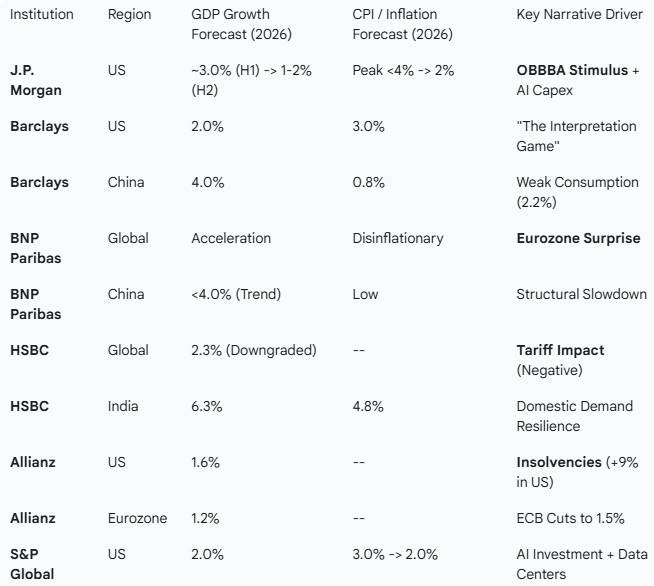
结论:2026年的战略要务
2026年的投资格局由财政/技术乐观主义(美国OBBBA、人工智能)和信贷/结构悲观主义(破产、人口结构)之间的紧张关系决定。
对于专业投资者而言,未来的发展方向需要摒弃广泛的指数投资策略。经济的“K型”波动——数据中心蓬勃发展而建筑公司却步履维艰——要求投资者积极选择行业板块。关键战略要点:
1、密切关注“OBBBA”脉搏:美国财政刺激的时机将决定2026年上半年的节奏。押注美国资产在第一季度/第二季度的“糖分飙升”,然后在下半年逐渐减持,是一种审慎的策略性交易(摩根大通)。
2、购买人工智能领域的“镐和铲”:避免纯粹人工智能模型的估值风险(汇丰银行的警告),专注于实体基础设施:公用事业、电网和数据中心REITs(巴克莱银行、贝莱德)。
3、通过私募市场实现多元化:利用“新连续体”获取私人信贷和基础设施,确保这些资产是“基于资产的”,以抵御破产浪潮(贝莱德、安联)。
4、应对解读游戏:由于叙事快速变化,应持有黄金等结构性对冲工具,并利用“杠铃”策略(增长+优质收入)来应对波动(汇丰银行、景顺集团)。
2026年不会是被动者的年份,而是主动者的年份。