Exchange Ranking
 Top Exchanges
 24h Volume Ranking
 Popularity Ranking
 Exchange BTC Balance
 Proof of Reserves
 Decentralized Exchanges
 Funding Rate
 Funding Heatmap
 Liquidation Data
 Max Pain
 Long/Short Ratio
 Whale L/S Ratio
 Binance/Okex/Huobi L/S
 Bitfinex Margin L/S
 ETF Tracker
 Solana ETF
 XRP ETF
 Hong Kong ETF
 Bitcoin Treasuries
 Crypto Reversal
 Ethereum Reserves
 HyperLiquid Wallet Analysis
 Hyperliquid Whale Watch
 Large Transactions
 On-chain Movement
 Bitcoin ROI
 Stablecoin Market Cap
 Options Analysis
 News
 Articles
 Economic Calendar
 Features
 Wallet
 Contract Calculator


 Security
 Collections
 Watchlist
 Following
The "licensing battle" in the cryptocurrency industry is taking place in Southeast Asia. A recent report by Tiger Research indicates that the Vietnamese government is working on establishing a new framework for licensing cryptocurrency exchanges. The application threshold is as high as $380 million in minimum capital requirements. This initiative has quickly attracted the attention of global giants like Binance and Bybit, along with local financial institutions. All parties are competing fiercely for the limited number of licenses available. As Vietnam becomes a leading hub for crypto innovation and regulatory experimentation in Southeast Asia, this competition isn’t just about gaining access to the market—it could also determine who will be the first to control the “pass” to this emerging market.

● Vietnam’s new framework sets extremely high entry barriers. Only large banks, securities firms, or global exchanges with strong partnerships can qualify for licensing.
● Seven local companies are ready to participate, but most of them lack sufficient capital and institutional expertise to meet the requirements.
● Binance and Bybit have met with senior government officials, indicating that foreign companies will have a chance to get a place among a few licensed domestic companies.
1. Changes in the Vietnamese market: stricter regulations
In 2025, Vietnam’s digital asset market will enter a critical period of transformation. After years of unclear regulation, the government has introduced a three-part framework aimed at transforming the country from a lax “gray zone” into a regulated and tax-compliant environment.
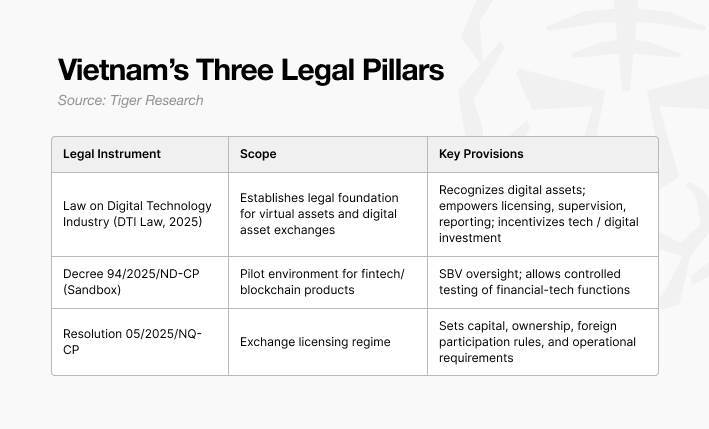
The first pillar is the “Digital Technology Industry Law” (DTI Law), which was passed by the National Assembly in June 2025 and is scheduled to come into full effect on January 1, 2026. This law provides legal recognition for digital assets, distinguishing them from securities and other financial instruments. The DTI Law lays the legal framework for taxation, anti-money laundering requirements, and regulatory powers, all of which will be specified in subsequent regulations.
The second milestone is the “Sandbox Decree” (No. 94/2025/NĐ-CP), which will take effect on July 1, 2025. This sandbox mechanism is managed by the State Bank of Vietnam (SBV) and aims to create a controlled environment for testing innovations in the banking and financial sectors. While the scope of the sandbox is broader than that of cryptocurrency, it is expected to cover areas such as anti-money laundering measures, customer identification requirements, and licensing for exchanges.
The third and most urgent policy initiative is Resolution No. 05/2025/NQ-CP, issued by the government on September 9, 2025. This resolution initiates a five-year pilot program for the issuance and trading of virtual assets. This is Vietnam’s first practical framework that allows exchanges to operate legally. Importantly, the resolution stipulates that during the pilot phase, only Vietnamese companies can obtain operating licenses. Therefore, foreign exchanges can only participate through joint ventures or by providing technology, compliance systems, and liquidity services.
In summary, these measures indicate that the Vietnamese government intends to gradually reintroduce digital asset activities into the country under strict regulatory oversight. The policy direction favors domestic control and compliance with the standards set by the Financial Action Task Force (FATF). This aligns with Vietnam’s ambition to develop financial centers like Da Nang. From a institutional perspective, it’s important to note that Vietnam is no longer a unregulated market—this is a positive step forward. However, the high requirements for obtaining licenses and restrictions on foreign participation suggest that Vietnam’s level of openness is limited. The next 12 to 18 months will determine whether Vietnam can become a truly attractive market or remains just a temporary policy experiment.
Second, the requirements for obtaining regulatory licenses are quite high.
Resolution No. 05/2025/NQ-CP, issued on September 9, 2025, sets strict conditions for service providers involved in Vietnam’s five-year pilot program for cryptocurrency issuance and trading. Only Vietnamese companies are eligible to apply for operator licenses, and they must be registered under the Corporate Law.
Licensed entities must have a registered capital of at least 10 trillion Vietnamese dongs (approximately 380 million US dollars), and all payments must be made in Vietnamese dongs. At least 65% of the capital must come from institutional shareholders, and more than 35% of the capital must be contributed by at least two institutions. These institutions must belong to one of the following categories: commercial banks, securities firms, fund management companies, insurance companies, or technology companies. Institutional shareholders must also prove that they have been profitable for two consecutive years, and their financial statements must be audited and provide unqualified opinions.
The share held by foreign investors may not exceed 49% of the registered capital, afin to ensure that licensed operators remain under domestic control. In addition, licensed service providers must meet strict requirements regarding human capital and infrastructure. This includes a CEO with at least two years of experience in the financial industry, a CTO with at least five years of experience in related IT fields, as well as at least ten employees who hold cybersecurity certifications, and another ten employees who hold licenses as securities professionals. The technical systems must meet the fourth-level information security standards, which are the highest standards for domestic financial services.
The licensing framework indicates that the government intends to expand the regulated cryptocurrency market. However, the requirements are quite stringent even for established financial institutions. For exchanges, the threshold is already high; if they expand to offer wallet services, GameFi projects, or medium-sized exchanges, most native cryptocurrency companies will not be eligible.
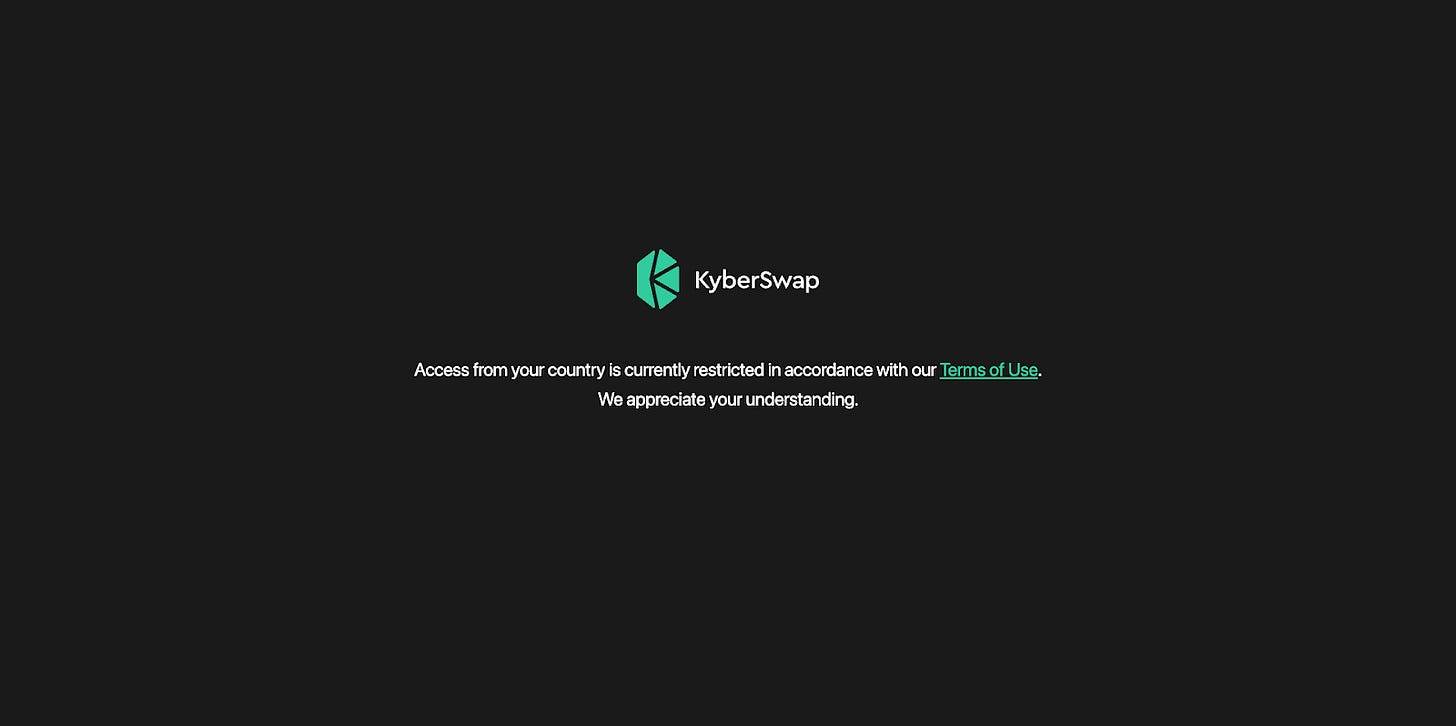
KyberSwap restricts access for users from Vietnam. Source: KyberSwap
It’s worth noting that local Vietnamese projects like KyberSwap and Coin98 have suspended their operations in the country. In fact, a hybrid model may emerge: banks, securities companies, insurance firms, and large tech companies will dominate the licensing process, while Web3 projects will primarily serve as technology and service providers. This dynamic will transfer market control to regulatory authorities, keeping startups and native cryptocurrency companies out of the licensing process.
该框架还将活动限制在资产支持代币发行和现货交易,结算货币仅限于越南盾。使用加密货币作为支付方式仍然被禁止,衍生品和保证金交易也被排除在外。与美国、新加坡和香港等先行者相比,越南的监管制度仅允许较为狭窄的业务范围。
3、市场参与者(本地 vs. 全球)
3.1、当地参与者
为应对越南新版牌照框架,一些越南公司已经成立了名为“数字资产交易所”的公司。这些实体代表着该制度生效后最有可能争夺官方批准的国内竞争者。然而,它们目前的资本水平和股东结构仍远未达到第05/2025号决议中规定的严格要求。
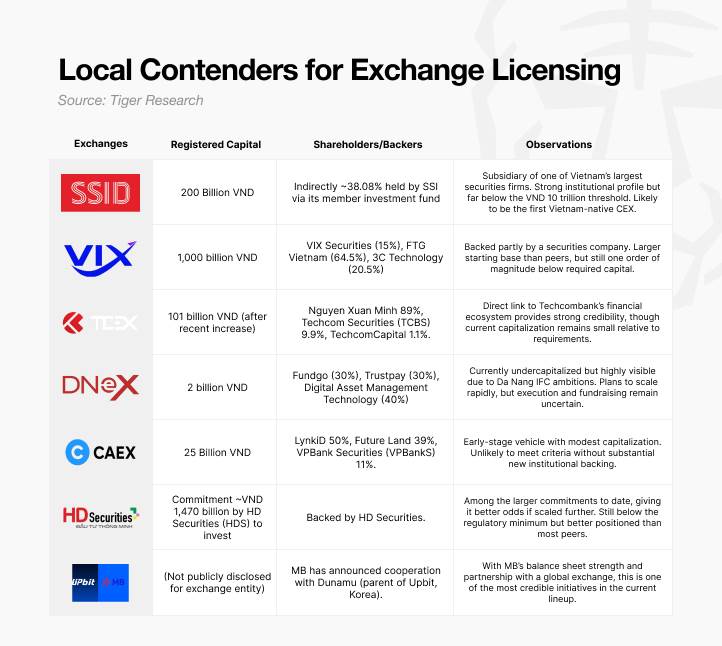
对于机构投资者来说,有三点值得关注。首先,资本缺口至关重要。目前所有进入越南市场的机构资本总额都在20亿越南盾至1.47万亿越南盾之间,远低于10万亿越南盾的法定最低资本要求。如果没有银行、证券公司或保险公司的大规模注资,这些机构中的大多数将无法获得牌照。
其次,机构锚定将决定谁能生存。该决议要求机构持股比例至少为 65%,其中至少 35%来自至少两家银行、证券公司、保险公司或科技企业。这项规定显然有利于已经与 SSI、VIX、Techcom、HD 和 MB 等主要金融机构挂钩的参与者,而像 DNEX 或 CAEX 这样由金融科技主导的机构则处于不利地位,除非它们能够吸引到更强大的合作伙伴。
最后,市场预期表明牌照数量有限。有传言称,初始阶段获批的运营商不会超过五家。鉴于至少有七家竞争者已经做好准备,一些运营商将不可避免地被排除在外。对于评估越南市场的全球交易所而言,这凸显了尽早与最可靠的国内合作伙伴达成一致的重要性。
3.2、全球参与者和政府参与
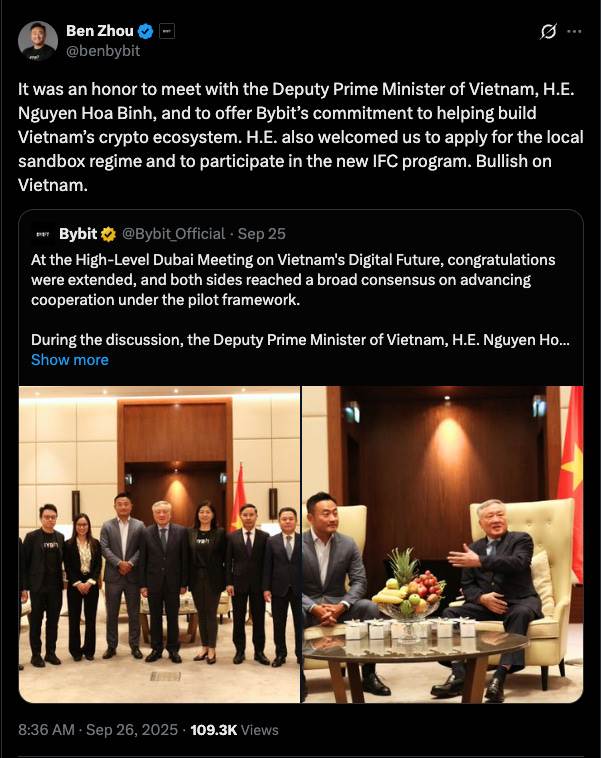
Bybit 首席执行官周本会见越南副总理阮和平。来源:Bybit
全球交易所正积极与越南当局建立关系。2025 年 9 月 24 日,越南常务副总理阮和平在对阿联酋进行正式访问期间会见了币安首席执行官 Richard Teng。副总理邀请币安在岘港设立总部,并与越南规划中的国际金融中心合作,部署一家获得许可的数字资产交易所。他还邀请曾领导阿布扎比全球市场的 Teng 担任越南金融中心计划的高级顾问。该邀请已在政府的沟通渠道上正式发布,彰显了明确的政策意图。
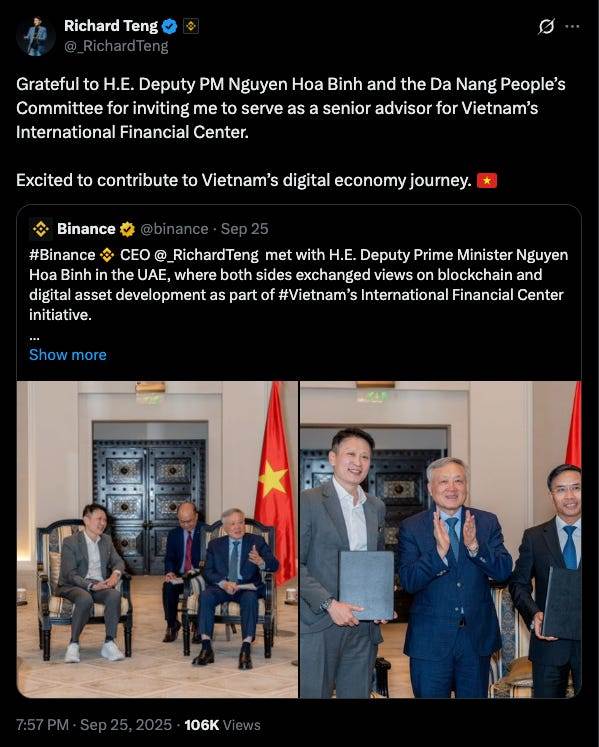
币安首席执行官理查德·腾 (Richard Teng) 在岘港与越南领导层会面。来源:币安
与此同时,岘港市人民委员会与币安签署了一份谅解备忘录,确立了双方在区块链和数字资产开发领域的合作。因此,币安的参与既获得了政治支持,也体现了地方政府的合作框架。
Bybit 也已做好了强有力的定位。2025 年 9 月 17 日,它与岘港市人民委员会、阿布扎比区块链中心 (ADBC) 和 Verichains 签署了一份谅解备忘录。该合作涵盖流动性供应、基础设施安全和生态系统连接,与越南的治理目标紧密契合。Bybit 的协议虽然不如币安与副总理的会晤那么高级别,但却为其在国际金融公司 (IFC) 的叙事中奠定了坚实的基础。
These measures have placed Binance and Bybit among the top global platforms among all participants. As mentioned above, it is estimated that only five licenses will be granted under this system. If two of these licenses are reserved for global exchanges, then only three licenses will remain available for local companies. However, at least seven companies are already competing for these licenses. This situation intensifies competition in Vietnam, as local entities must demonstrate their ability to operate as institutional players and their scale in order to get one of the remaining licenses.
The positioning of Binance and Bybit also raises another question: what will happen to other global exchanges that already dominate the Vietnamese retail market, such as BingX and MEXC? These companies have a large user base in Vietnam through their offshore platforms. But without early government support, they risk being marginalized in the licensed market. Unless they establish partnerships with approved local entities or receive invitations like those given to Binance and Bybit, their operations will remain outside of regulatory oversight. Once the regulatory framework begins to take effect, they may face legal risks in the future.
4. Strategic approaches: The GTM strategy of “CEX Tiger”
Under the new policies, what options do projects seeking to enter the Vietnamese market have? Suppose a global exchange called “CEX Tiger” wants to enter the Vietnamese market. What strategies would be most viable?
The most important decision is to choose a partner. Foreign exchanges cannot obtain licenses directly; they must work in collaboration with established domestic institutions. It’s crucial to determine which Vietnamese banks, securities companies, or insurance firms are most likely to obtain the limited licenses available. The choice of partners will determine market access, compliance requirements, and long-term scalability. Once the partners are selected, the next step is to decide on the operational model. A hybrid structure is required: the Vietnamese partners will hold the licenses and be responsible for regulatory matters, while CEX Tiger will provide technical, liquidity, and operational expertise. The joint venture will become a formal entity, with the Vietnamese institutions serving as legal and regulatory bodies, while the exchange handles the underlying services. Business expectations also need to be adjusted. This framework limits activities to spot trading, VND settlement, and limited investor participation. This isn’t a market focused on immediate volume or derivatives-driven revenue. Instead, its strategic goal should be to ensure early participation, establish a good reputation in terms of regulation, and create legitimacy before potential liberalization occurs in the future. However, competition will be fierce. If Binance and Bybit secure both licenses, there will only be three licenses left available for domestic institutions. For newcomers, the real issue isn’t whether Vietnam is attractive—market growth and user base already prove this—but whether reliable domestic partners can be found, and whether those partners are willing to cooperate. Missing out on the first round of license distribution could delay entry until the framework has expanded further.
For exchanges like CEX Tiger, the strategy should be to view Vietnam as a platform for long-term investment, rather than just a means to generate short-term profits. The key to success lies in finding suitable domestic partners, acquiring minority stakes, and integrating into one of the fastest-growing cryptocurrency markets in Asia.
From a retail perspective, the challenges are even more complex. Vietnamese users are already accustomed to using global platforms. Even if they obtain licenses, new entrants will still face strict inspections regarding security standards, the range of assets available for trading, and overall reliability. While a license can provide legitimacy, it may not necessarily lead to user trust or market share.
Ultimately, exchanges like CEX Tiger face a strategic choice: either participate in the competitive licensing process with domestic partners, or remain outside of regulatory oversight, maintaining their existing user base while keeping an eye on regulatory developments.