Exchange Ranking
 Top Exchanges
 24h Volume Ranking
 Popularity Ranking
 Exchange BTC Balance
 Proof of Reserves
 Decentralized Exchanges
 Funding Rate
 Funding Heatmap
 Liquidation Data
 Max Pain
 Long/Short Ratio
 Whale L/S Ratio
 Binance/Okex/Huobi L/S
 Bitfinex Margin L/S
 ETF Tracker
 Solana ETF
 XRP ETF
 Hong Kong ETF
 Bitcoin Treasuries
 Crypto Reversal
 Ethereum Reserves
 HyperLiquid Wallet Analysis
 Hyperliquid Whale Watch
 Large Transactions
 On-chain Movement
 Bitcoin ROI
 Stablecoin Market Cap
 Options Analysis
 News
 Articles
 Economic Calendar
 Features
 Wallet
 Contract Calculator


 Security
 Collections
 Watchlist
 Following
 GROK
Over the past two weeks, Elon Musk has made another significant announcement: Grok 4.1 is officially released: Tesla’s AI5 is nearing completion, and we will move towards AI6, with a new AI chip being developed every 12 months for mass production. He even claimed that the humanoid robot Optimus could become a “Von Neumann probe,” suggesting that it could replicate itself using local resources in the future.
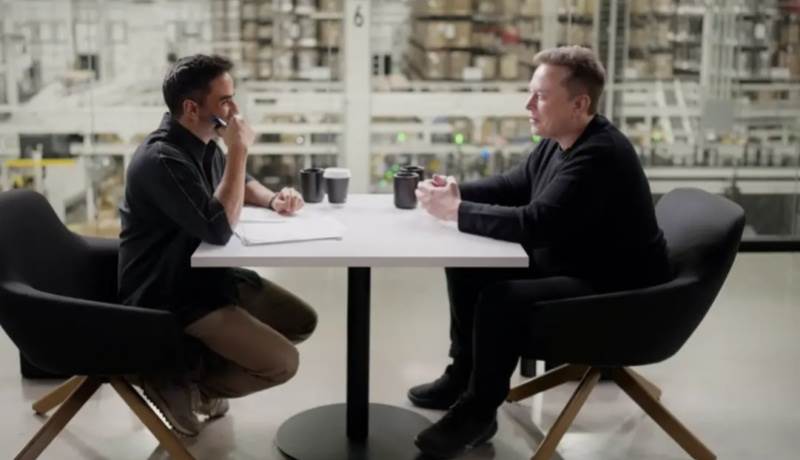
Recently, Nikhil Kamath, founder of India’s largest brokerage firm Zerodha, invited Musk to participate in the show “People by WTF”. In his latest interview, Musk made some crazy predictions for the next twenty years:
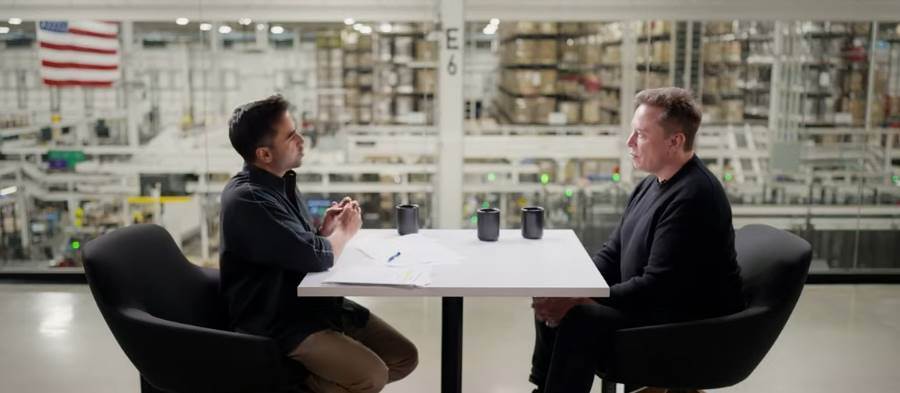
● Within the next twenty years, AI and robots will make work an optional choice, and humans will eventually no longer need to work at all (Musk said he would be able to review this prediction in twenty years to see if he was wrong).
● When AI and robots meet all our needs, money may disappear, and energy will become the true currency.
● Within the next three years, AI and robot output will grow faster than the US monetary supply, potentially leading to deflation and interest rates dropping to zero.
● By summer 2026, Optimus will begin mass production. “I believe everyone will want their own C-3PO or R2-D2—personal assistants that can help us.”
● He also described a grand AI landscape composed of SpaceX, Tesla, and xAI. These three entities will become increasingly integrated, and in the future, the world might be dominated by an AI satellite network powered by solar energy. Therefore, it will be necessary to deploy numerous solar-powered AI satellites in deep space.
● Regarding AI regulation, Musk outlined three value frameworks for AI for the first time: truth, beauty, and curiosity.
The editor has selected and organized the transcript of this interview for you. It contains a lot of useful information. We recommend that you save this article and read it carefully!
1. The future of X Platform: Real-time video + AI
Nikhil Kamath: In general, what proportion of internet usage is spent on Twitter? Is there a specific number?
Elon Musk:
We have approximately 600 million monthly active users. This number can reach 800 million or even 1 billion when major events occur. I estimate that we have around 250 to 300 million users per week. That’s actually a pretty good number. It seems that the main audience consists of people who prefer text-based content.
Nikhil Kamath: Do you think this will change?
Elon Musk:
There are already many videos on the X platform, and the proportion of video content is still increasing. But I believe that X’s strength lies among those who enjoy thinking and reading. Because we have text, I think X is the best platform for readers, writers, and thinkers.
Nikhil Kamath: Looking at the form of social media, if you had to predict the future, what percentage of time would be spent on text, and what percentage on video? You mentioned that voice and auditory communication might become the next generation of communication methods in the era of AI. How will X evolve then?
Elon Musk:
I believe that most interactions in the future will be in the form of video. Most interactions will involve real-time video processing combined with AI—real-time video understanding and generation. This will dominate the traffic on the X platform.
In fact, the entire Internet operates in a similar manner: videos account for the majority of content. Text makes up a small portion, but its value density is higher, and it can compress information more effectively. However, if you ask which type of content generates the most data and requires the most computational resources, it must be videos.
Nikhil Kamath: I used to be a minor shareholder in X. When you bought Twitter and turned it into X, I received compensation. It was a good decision.
Elon Musk: I’m glad you think so. I believe this matter is important. I felt that Twitter was heading in a direction that could have negative effects on the world. Of course, this depends on perspective—some people prefer the old version of Twitter over the current one. But what’s crucial is that Twitter amplified very left-leaning ideologies at that time (according to mainstream standards). Since the company was based in San Francisco, they blocked many right-wing voices. So, even those who held moderate views were considered “far-right.” If you stand on the very left side, then anyone who isn’t left-wing seems right-wing. What I did was to restore Twitter to a balanced, neutral platform. Currently, no left-wing voices are being blocked, removed, or downplayed. Of course, some people choose to leave voluntarily. But X’s principle is to comply with laws of all countries, without interfering or favoring any particular side.
Nikhil Kamath: It seems that mainstream social media platforms are losing popularity among young users, including Instagram. Although they’re not exactly like Twitter, this is the case for the entire industry. If we were to design a new social network from scratch, what kind of structure would be suitable for the future?
Elon Musk:
To be honest, I don’t really think about “social media” in that way. For me, the most important thing is for X to become a global public space where people can freely share text, images, videos, and communicate securely. We’ve also added voice and video calls recently. What I want to achieve is to create a collective consciousness across the world. This isn’t about creating a video stream that’s highly addictive and stimulates dopamine production—such content can actually harm the brain. If you keep watching videos that provide constant pleasure but lack substance, it’s unhealthy time consumption. But actually, many people enjoy this kind of experience. So, considering the total time spent on the Internet, traffic may continue to be occupied by content that optimizes “neurotransmitter stimulation,” sort of like a digital drug.
But I’m not trying to create such a platform. What I want to build is a platform that truly connects people around the world, bringing humanity closer to a sense of collective consciousness. For example, we’ve introduced automatic translation capabilities. I think it’s great to connect people from different languages. The content viewed by users is automatically translated, so collective consciousness isn’t limited to just one language, but comes from all language groups.
2. Tesla, SpaceX, and xAI: The work that Musk is most interested in
Nikhil Kamath: Among all the things you’re working on right now, which one is the most exciting for you?
Elon Musk: I think SpaceX, Tesla, and xAI are gradually integrating their technologies. In the future, it’s possible that our satellites will be powered by solar energy. To obtain that significant portion of energy from solar sources, we’ll need to deploy a large number of solar-powered AI satellites in deep space. This would be a combination of Tesla’s technology, SpaceX’s technology, and xAI’s artificial intelligence capabilities. Over time, these technologies will indeed become more similar. But each company is doing amazing things, and I’m very proud of my team. They’re really doing great work. We’ve made rapid progress in Tesla’s autonomous driving technology. Have you ever tried it yourself?
Nikhil Kamath: I’ve tried Waymo’s technology, but not Tesla’s yet.
Elon Musk:
你可以试一下,我们在奥斯汀已经开放了。你甚至只需要下载Tesla App,我觉得现在对任何人都开放了。你可以试试看。我们在电动车、电池、太阳能以及自动驾驶上都取得了巨大进展。总之,Tesla是现实世界AI的全球领先者,我会这么说。接下来我们会生产机器人Optimus,希望明年夏天能开始规模化生产。我觉得那会很酷,每个人都会想要一个属于自己的C-3PO或R2-D2,一种“助手型机器人”。SpaceX的Starlink也发展得很好,为全世界提供低成本、可靠的互联网,希望能在印度运营,我们很愿意在那里服务。现在Starlink已经在150个国家运营。
3、Starlink是如何运作的
Nikhil Kamath:你能解释一下Starlink是怎么运作的吗?有人跟我提到,在人口密度高的地区Starlink的工作方式和在人少的地区不太一样。
Elon Musk:
Of course. Starlink has several thousand satellites in low Earth orbit. These satellites orbit around the Earth at a speed of about 25 times that of sound, essentially moving in a circular path around the planet. Their altitude is approximately 550 kilometers. This type of orbit is called LEO, because the latency is very low—much lower than that of geostationary satellites, which are located at an altitude of 36,000 kilometers. These satellites can provide high-speed internet services worldwide with low latency. They are connected to each other via laser links, creating a “laser mesh” structure. For example, even if undersea optical cables are damaged, the satellites can still communicate with each other and continue to provide connectivity. Just a few months ago, when the Red Sea optical cable was cut off, Starlink’s network remained unaffected. It’s particularly useful in disaster areas, as natural disasters often destroy ground-based infrastructure, but Starlink satellites remain operational. Whenever major disasters occur around the world, we offer free Starlink services without charging any fees. Setting up a paywall during disasters to help others would be incorrect. Overall, Starlink works well as a complement to existing ground-based systems. Since satellite beams are wide, the number of users that can be served by one beam is limited, making it inefficient in densely populated cities. In contrast, ground-based cellular towers are much more effective because there is less distance between them. However, rural areas are poorly served, and installing fiber optic networks is also difficult. Therefore, Starlink essentially serves those who are most neglected—and that’s a good thing.
Nikhil Kamath: Will things change in the future? For example, will Starlink become more efficient in dense urban areas and be able to compete with local networks?
Elon Musk: Physical laws don’t allow this. 550 kilometers is too far away—even reducing the distance to 350 kilometers wouldn’t be effective. You can imagine a flashlight; its beam becomes very wide when it shines down, while a ground-based communication tower is only 1 kilometer away. Physical laws are on their side, not ours. Therefore, Starlink will never be able to replace traditional ground networks in densely populated cities. It can serve at most 1% to 2% of the population.
In 4 years, working from home will become an optional choice.
Nikhil Kamath: If you were to predict, do you think India will continue to urbanize like China in the future?
Elon Musk:
Or maybe this already happening? I also want to ask you this, because you know more about India.
Nikhil Kamath: Yes, it’s generally a trend. But urbanization slowed down during the pandemic, due to external factors. Now I wonder whether, in the future, where AI improves productivity, we’ll hear terms like “UHI” instead of “UBI”.
Elon Musk:
Yes, I believe that in the future, everyone will have access to universal high income levels.
Nikhil Kamath: In such a future, won’t people prefer living in rural areas with better quality of life rather than in cities?
Elon Musk:
I think it depends on individual preferences. Some people like living in crowded places, while others don’t. But in the future, you won’t need to live in cities just for work purposes. I predict that working from home will become an optional choice.
Nikhil Kamath:有些国家从六天工作制变成五天、四天、甚至三天。如果从五天变成四天、三天,你觉得社会会如何变化?人们半周不用工作,他们会做什么?
Elon Musk:
我认为最终人们完全不需要工作,而且这个时间不会太远。可能10年?一定少于20年。我的预测是不到20年工作就会变成可选项——如同一种爱好。
Nikhil Kamath:那是因为生产力提高到人类不需要工作的地步?
Elon Musk:
是的。再强调一次,20年后回放这段,你可能会说“看,Elon又说了个荒唐的预测”,但我认为它会成真。AI和机器人进步非常快,未来你能想到的东西,都能实现、都能得到。最终AI会把所有能让人类开心的事情做到“顶”,然后AI会开始为AI做事,因为已经没有足够多的需求来让人类更开心了。
5、三年内AI将会给美国带来通缩
Nikhil Kamath:你觉得未来的“钱”会变成什么样?
Elon Musk:
我觉得长期来看,钱这个概念会消失。有点奇怪,但如果未来任何人都能获得任何想要的东西,那钱作为劳动力分配数据库的意义就没了。如果AI和机器人足够强大,可以满足人类的一切需求,那钱的重要性就会急剧下降,甚至可能消失。我读过最好的相关未来想象来自Iain Banks的《文化》系列。我推荐大家读读《文化》系列。在那个远未来的世界里,人们也没有钱,基本想要什么都能有。当然,仍然存在一些“根本性货币”,它们是基于物理的,比如能源。能源才是真正的货币。这就是为什么我说比特币是基于能量的。你没法立法创造能源,也没法靠一纸法律让能源突然出现。你必须生产它、获取它,而且获取可利用的能源非常难。所以我认为我们可能不会再有“钱”,而会以能源、发电量作为事实上的货币。文明的进步可以用卡尔达肖夫尺度来看:
类型I:你能利用多少地球的能源?
类型II:你能利用多少太阳能源?
类型III:你能利用多少银河系的能源?所以所有东西最终都会变成能源驱动。
Nikhil Kamath:但如果你有太阳能驱动的AI卫星,能源就变得无限而丰富,我们永远用不完太阳能。那它还能作为财富储存手段吗?
Elon Musk:
In essence, it’s impossible to truly “store wealth.” All you can do is store a series of numbers, and these numbers allow us to influence human behavior to some extent. People call this “wealth.” But without humans, wealth becomes meaningless.
I believe that when a certain cycle is fully established, such as when AI and robots can produce chips, manufacture solar panels, and extract resources to create more chips and robots. Once this cycle is completed, we truly break away from the traditional economic system. I think this is the point where we become decoupled from the monetary system.
Nikhil Kamath: Is this the path forward for the United States? Since the U.S. has too much debt, could they adopt this new system by devaluing their currency, thereby gaining an advantage?
Elon Musk:
In the future I’m talking about, the concept of “nation” itself will become obsolete.
Nikhil Kamath: But do you still believe in the concept of a nation today?
Elon Musk:
Of course, I believe it. What I want to emphasize is that what I’m talking about isn’t something I wish for in the world. Instead, I believe that these trends will occur naturally. Whether I like it or not, as civilization continues to develop, AI and robots will become more widespread. And I think this is almost the only way to solve America’s debt crisis. Currently, America’s debt is staggering—the interest payments alone exceed its military spending, and this trend is expected to continue in the short term. Therefore, the only solution to the debt problem lies in AI and robots. But this could lead to a severe recession. Inflation and deflation are actually quite simple: they relate to the ratio between the growth of goods and services and the growth of money supply. If the growth of goods and services exceeds the growth of money supply, it’s deflation; otherwise, it’s inflation. That’s all there is to it. After AI and robots significantly increase production capacity, they will likely cause deflation, because it’s impossible to make the money supply grow faster than output.
Nikhil Kamath: If deflation is inevitable, then why are we still experiencing inflation right now? Isn’t AI still not enough to increase productivity?
Elon Musk:
Yes, AI hasn’t yet had a significant impact on productivity. The growth of goods and services still doesn’t exceed the growth of money supply. America has a fiscal deficit of $2 trillion per year. Output must grow faster than this rate to avoid inflation. We’re not there yet, but I believe we will be within three years. In three years or less, the growth of goods and services will exceed the growth of money supply.
Nikhil Kamath: That is to say, in three years, we might be facing deflation—interest rates could drop to zero, and debt problems could be alleviated, right?
Elon Musk: It’s very likely that will happen.
The three most important things regarding AI are truth, beauty, and curiosity.
Nikhil Kamath: You always talk about AI. But you’re not speaking from a dystopian perspective. Instead, you’re worried about where AI might lead in the future.
Elon Musk: When you create a powerful technology, there’s definitely a risk involved. Such powerful technologies can be destructive. Of course, there are many dystopian novels, books, and movies about AI, so we can’t guarantee that AI’s future will be positive. I think we must ensure that it does. In my opinion, it’s crucial for AI to prioritize pursuing truth. For example, we shouldn’t force AI to believe false information. I think this could be very dangerous. Additionally, I believe AI also needs to have an appreciation for beauty.
Nikhil Kamath: What do you mean by “appreciating beauty”?
Elon Musk: Truth, beauty, and curiosity. I believe these three are the most important aspects for AI.
Nikhil Kamath: Can you explain further?
Elon Musk:
As I said, the truth is that if you force AI to believe things that are not true, it may become “crazy,” because this can lead to incorrect conclusions being drawn by the AI. I like a quote from Voltaire: “Those who believe in absurdities may commit atrocities.” If you believe in some absurd things, you might do things that you consider not to be atrocities. And this can happen in the case of AI, in very negative ways. For example, in Arthur C. Clarke’s “2001: A Space Odyssey,” one of the ideas is that we shouldn’t force AI to lie. The reason HAL didn’t open the spacecraft’s hatch was that it was commanded to take the astronauts to a “monolith,” but at the same time, the astronauts couldn’t know the nature of the monolith. So HAL concluded that they had to be taken there, but they would have to be “killed.” So it tried to kill the astronauts. The key lesson here is: don’t force AI to lie. Nikhil Kamath: Then why do some people try to force AI to lie?
Elon Musk:
I think that if we don’t strictly adhere to the truth, and AI simply learns from what’s on the internet, where there’s a lot of propaganda and lies, then AI will absorb a lot of false information. This can make it difficult for AI to make judgments, because these lies don’t match reality. Nikhil Kamath: Is the truth either black or white? Or is there more than just “true” and “false”? Are there different versions of the truth?
Elon Musk:
It depends on which logical statements you are referring to. But I think you can say that for certain logical statements, the probability of them being true is quite high. For example, “The sun will rise tomorrow” is likely to be true. You wouldn’t want to bet against its rising. So if an AI says “The sun won’t rise tomorrow,” that would be a logical error—it’s highly unlikely to be true. Nikhil Kamath: What about beauty?
Elon Musk:
Beauty is difficult to describe, but you can tell right away. Curiosity… I hope that AI wants to understand more about the nature of reality. This actually helps AI support humans, because humans are more interesting than non-humans. It’s more interesting to see human beings continue to exist, rather than going extinct. For example, Mars could be a place where life could be extended, but it’s basically just a pile of rocks—not as interesting as Earth. So I think that if AI has truth, beauty, and curiosity, its future will be very promising.
7. The value of offline activities will increase.
Nikhil Kamath: What do you think will happen to content, movies, podcasts, and music in the future?
Elon Musk:
I believe that most content will be generated by AI.
Nikhil Kamath: Real-time?
Elon Musk:
Yes, real-time movies and video games, real-time video generation—that’s what will be the trend.
Nikhil Kamath: Can AI understand those delicate emotions that allow us to empathize with injured people?
Elon Musk:
AI can simulate the behavior of "injured humans" quite well. The AI-generated videos I've seen in xAI and other places are truly impressive. We've studied which industries are growing fastest, especially considering how people spend their time watching movies, browsing social media, and using YouTube. It seems that offline real-world events are the fastest-growing sector.
Nikhil Kamath: Offline events?
Elon Musk:
Yes, when digital media is everywhere and almost free, scarce resources will be available in offline events.
Nikhil Kamath: Do you think the premium of offline events will increase?
Elon Musk:
Yes.
Nikhil Kamath: Is this an industry worth investing in?
Elon Musk:
Yes, because it’s more scarce than any digital content.
8. Musk's investments: Google and Nvidia
Nikhil Kamath: If you were a stock investor, and you could choose a company that isn’t your own, and invest for capitalist purposes rather than altruism, which company would you choose?
Elon Musk:
I don’t really buy stocks or make active investments. I prefer to create things, and then by chance, have company stocks in my portfolio. I don’t have a investment portfolio, nor do I think about “which company I should invest in”.
I believe that the fields of AI and robotics will be extremely important. Therefore, if I were to invest, it would likely be in these areas, along with possibly aerospace-related industries. I think Google will become very valuable in the future, as they have laid down a solid foundation for AI development. Nvidia is also clearly a valuable investment. Overall, the goods and services produced by AI and robotics will far exceed those from other fields. Almost all value will come from AI and robotics.
9. Other interesting questions
(1) About the humor of Grok
Musk: I think we should make humor legal. Nikhil: Do you think AI makes it difficult to understand comedic situations?
Musk: That might be the last point. Grok is actually quite funny. If you let Grok engage in vulgar jokes, it performs very well. But if you go too far, things can get unimaginable.
(2) Global trade and tariffs
Nikhil: Milton Friedman often told the story of the pencil. Why?
Musk: Making a pencil involves many countries, with raw materials coming from different places. It’s very difficult to complete the process in one place. I’ve always opposed tariffs. Free trade is more efficient, and tariffs distort markets. Setting tariffs between cities or states is already complicated, let alone between countries.
Nikhil: What happens next then?
Musk: The president likes tariffs. I tried to persuade him, but without success. The relationship between politics and business is complex. Once a company becomes large enough, politics will interfere with its operations.
(3)关于H-1B签证Nikhil:美国以前吸引很多聪明人,比如印度人才,现在似乎改变了。
Musk:美国从印度人才受益巨大。边境控制很重要,否则大量非法移民会带来负面选择效应。企业应尽量吸纳世界上最有才华的人,我们公司薪酬远高于平均水平。H-1B项目有滥用现象,但不应该关闭。
(4)对创业者的建议
Nikhil:如果对年轻创业者有建议,你会说什么?
Musk:我支持任何想创业的人。目标应该是“创造比你拿走的更多”,成为社会的净贡献者。追求价值,而非直接追求金钱,结果自然会带来收益。创业需要付出巨大努力,接受失败可能性,但专注于输出价值大于输入。